Campaigns pay the price for America's secular shift

Add Axios as your preferred source to
see more of our stories on Google.
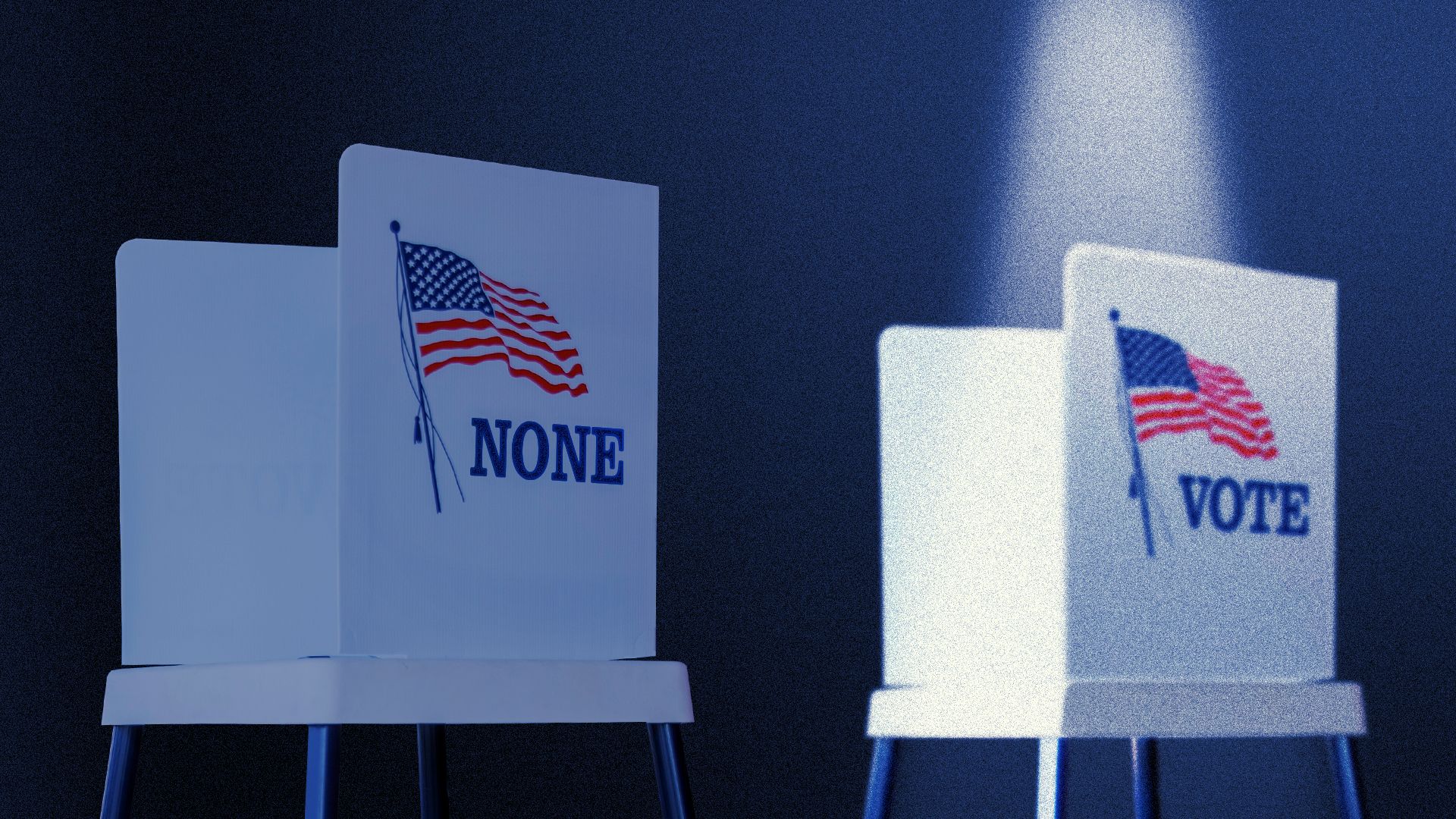
Illustration: Brendan Lynch/Axios. Stock: Getty Images
America's fastest-growing religious group is also one of the hardest — and costliest — to reach: the "nones."
Why it matters: Religiously unaffiliated Americans now make up a large and growing share of the electorate. But without church-based networks, they're significantly more expensive for campaigns to reach and mobilize.
- "Nones" are geographically and socially dispersed.
- Campaigns must rely on costly digital ads, canvassing and persuasion to reach them.
By the numbers: A record 29% of Americans now identify as religiously unaffiliated — the largest single religious cohort, surpassing Catholics (19%) and evangelical Protestants (23%), per Pew Research Center.
- Among Gen Z, it's even higher: Roughly 4 in 10 adults ages 18–29 are unaffiliated, according to the nonpartisan Public Religion Research Institute (PRRI).
- About one-third of Democrats and independents identify as nonreligious, vs. roughly 13% of Republicans, per PRRI.
Zoom in: In some of the country's most secular regions — including Seattle, Portland and parts of New England — "nones" now rival or exceed Christians as a share of the population.
- Colorado's large unaffiliated population has also pushed campaigns toward issue-based appeals — like abortion rights, climate and housing — over faith-based messaging.
Yes, but: Not all "nones" are alike — they include "spiritual but not religious" voters, atheists and agnostics.
- The broader unaffiliated group is less likely to vote than religious Americans when controlling for age and education, previous studies show.
- But atheists and agnostics — a more engaged subset — are about 30% more likely to turn out than the average religious voter.
Friction point: Campaigns spent about $1.40 per nonreligious voter versus roughly 45 cents per religiously affiliated voter in 2024, Sisto Abeyta, a Democratic consultant with the Nevada-based firm TriStrategies, tells Axios.
- Candidates can reach through existing mailing lists or megachurch coffee shops, Abeyta said. Nonreligious voters, however, have to be sought.
- "For religious voters, all I have to do is send a mailer and say I believe in God and apple pie," Abeyta said. "For nonreligious voters, I need to send a list of issues with links so they can verify and be ready for questions. It's time-consuming and costs more."
Yes, but: "When a candidate includes 'people of no faith,' that spreads like wildfire," Steven Emmert, executive director of the Secular Coalition for America, tells Axios.
- Emmert argues that secular voters are often highly engaged and quick to respond when candidates simply acknowledge them.
Zoom out: The rise of the "nones" reflects a broader decline in traditional civic institutions — from churches to labor unions — that once made political organizing cheaper and easier.
- As those networks fade, campaigns increasingly have to buy attention through ads and outreach.
- This forces democracy into a pay-to-play model where only the most well-funded campaigns can afford to "buy" the attention of the unattached.
The bottom line: As the "nones" grow, campaigns face a paradox: a key voting bloc that's harder — and more expensive — to mobilize.
