Religious resurgence stirs Gen Z


Add Axios as your preferred source to
see more of our stories on Google.
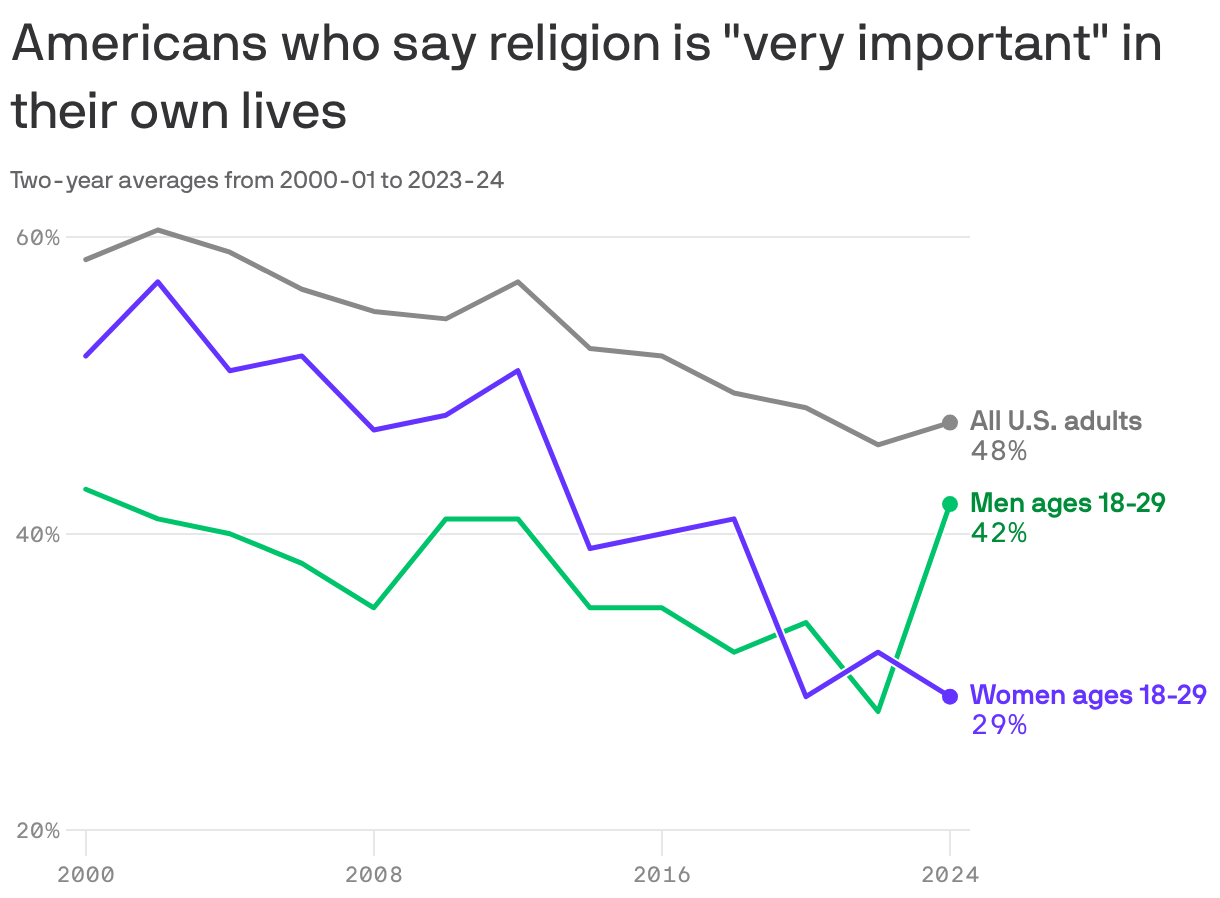
New polling shows an uptick in religious fervor among young men, even as overall U.S. levels remain near historic lows.
Why it matters: Gen Z still has the highest share of religiously unaffiliated adults in modern history. But small hints of a religious rebound have spawned speculation about how that could reshape politics, culture wars and church strategy for years to come.
Driving the news: A Gallup poll released Thursday found that 42% of young men between the ages of 18-to-29 now say religion is "very important" in their lives.
- That's up from 28% just a few years ago.
- The uptick reverses a long-standing gender gap: "One of the truisms in American social science has been there's a gender gap in religion" with women being more religious than men, Frank Newport, an author of the report and a Gallup senior scientist, tells Axios.
- "When we're seeing the gender gap essentially disappear ... among the young people, that's an interesting finding."
Reality check: An Axios review of other recent surveys showed slight increases in reported church attendance among Gen Z men but little to suggest they're driving a "revival" like the Third Great Awakening of the early 1900s or post–World War II religious boom.
- Tens of thousands of churches are expected to close over the next several years, as a record number of Americans (29%) are identifying as religiously unaffiliated.
Context: A wave of recent headlines has spotlighted young men showing up in greater numbers at churches, especially in Catholic and conservative evangelical congregations.
- Stories from outlets like The New York Times, Washington Post and Wall Street Journal have pointed to packed pews, viral conversions and "Theobro" culture as signs of a possible revival.
- Some pastors report increased interest from Gen Z men, often tied to searches for community, structure or values.
What they're saying: "There are anecdotes, but we just are not finding anything in our data," Melissa Deckman, CEO of the nonpartisan Public Religion Research Institute (PRRI), tells Axios.
- Deckman said the trend may simply be that Gen Z's decline isn't as steep as millennials', not that religion is rebounding
- "In certain parishes, there definitely is revival. But it's not at a national level. There's no hard evidence. It just seems anecdotal," Andrew Chesnut, Virginia Commonwealth University's Catholic studies chair, tells Axios.
- Chesnut said some of the attention is driven by young men — sometimes tied to conservative or "manosphere" spaces — but not a documented nationwide shift.
By the numbers: About 34% of Gen Z adults are religiously unaffiliated, far higher than older generations, a 2024 PRRI survey found.
- Just 11% attend religious services weekly, and 38% say they never attend, according to the same survey.
- Only 17% say religion is the most important thing in their life, the survey then said.
Yes, but: There is something happening: Young men's rising religiosity is real and measurable, even if limited.
- Religious attendance among young men has climbed to about 40% monthly or more, its highest level in over a decade, while young women have seen only modest gains, the new Gallup poll found.
- The share saying religion is "very important" (42%) is roughly on par with 2000–2001 highs — not unprecedented, just a rebound, according to a Gallup review of years of data.
Between the lines: Religion may be becoming countercultural for a subset of Gen Z.
- In a generation defined by declining affiliation, being religious can signal identity and rebellion — particularly among young men.
- That dynamic can look like a revival up close, even if it doesn't scale nationally.
The bottom line: There's no broad Gen Z religious revival, but there is a targeted, politically tinged uptick among young men that's reshaping the conversation.
- It could be the beginning of a tectonic shift, though Gen Z church attendance would have to skyrocket even move to defy historic trends.
