Nobody's socializing with their neighbors anymore

Add Axios as your preferred source to
see more of our stories on Google.
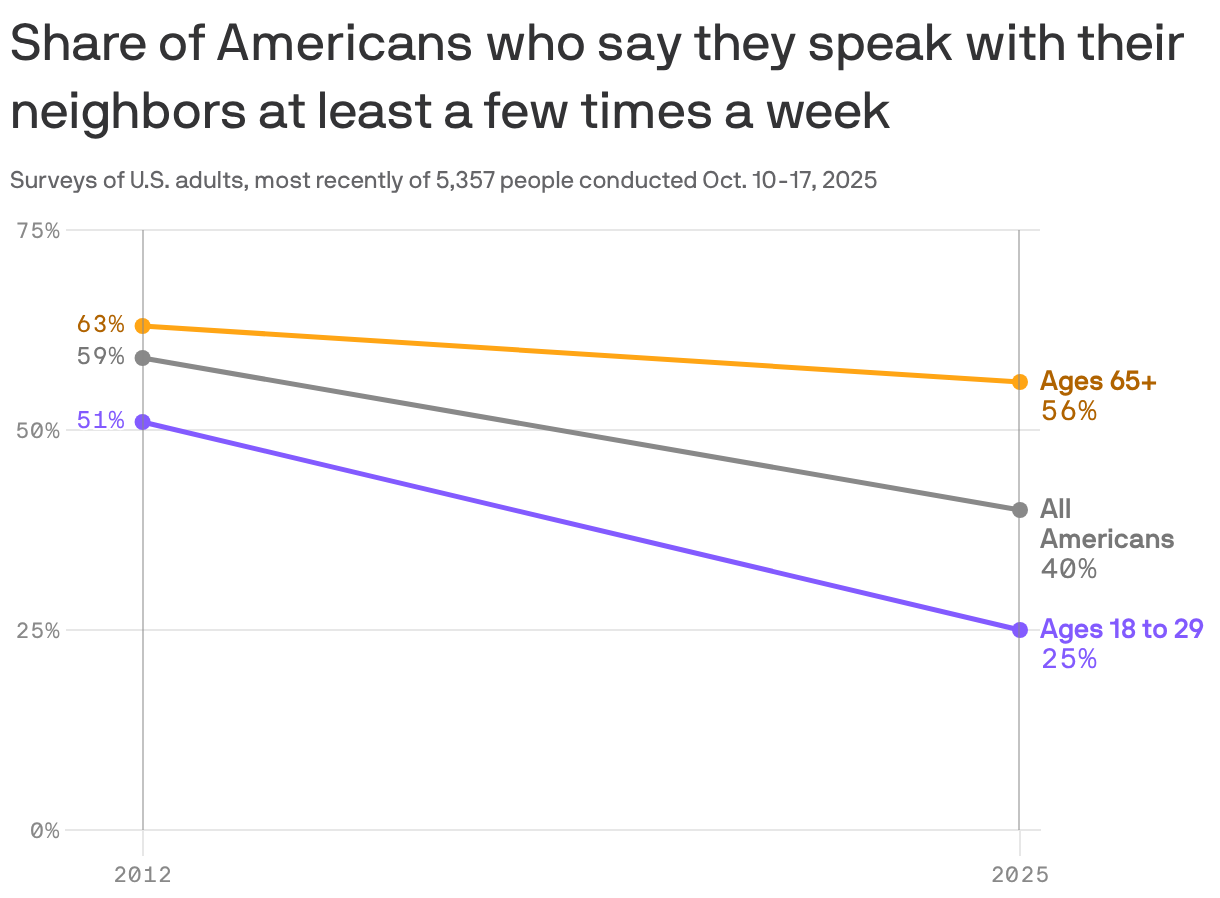
Americans are spending more time at home, yet many have become strangers to their neighbors — especially young Americans, who are increasingly unlikely to socialize with those living feet away.
Why it matters: Without casual conversations with neighbors — who are often from other races, or have different religions and political ideologies — people risk becoming more isolated and more dependent on superficial, algorithm-driven digital communities.
By the numbers: In 2012, 51% of young Americans regularly engaged with neighbors, according to a new AEI report. Today, that number has plummeted to 25%.
- By contrast, 56% of seniors socialize with neighbors, a seven-point drop since 2012.
- More broadly, 59% of Americans chatted with neighbors a few times per week in 2012. In 2025, that number is 41%.
What they're saying: Daniel Cox, head report researcher and director of the Survey Center on American Life at AEI, tells Axios that technology deserves some of the blame.
- "In the previous generation, if you sat around your apartment long enough, you started to go stir crazy, and that would often compel people to go out," he said.
- He said that homes have become entertainment bunkers that let Americans stream, scroll, get directions, and find recommendations without knocking on a neighbor's door.
- While independence is "empowering" there's a "pernicious element too... It's sort of changing the culture around what we can expect from each other and particularly our neighbors," Cox said.
Zoom in: Young people are also more likely to live in new cities, live among strangers and frequently relocate. Whereas someone who's lived in the same community for decades has years to build relationships.
The intrigue: Cox said young Americans also talk less with neighbors because they have less practice with face-to-face connections during their formative years.
- He noted that young people who grew up in the pandemic or entered the workforce as remote employees missed out on the everyday interactions that build confidence and community.
- "When we deny young people these opportunities, we can't expect them to learn this stuff on their own," Cox said.
- He added that regular religious attendance drives community connection across all denominations, and research shows Gen Z is increasingly less religious than older generations.
At the same time, Gen Zers are turning towards digital communities for connections, which Cox said can offer friendship but are "very limited in terms of creating an actual supportive community that people really need."
- He added that online friends can't water your plants when you're on vacation, help you move furniture, or watch your dog.
- Online communities are also more fragile. When interest in a game or hobby fades, friendships built around it often fade too. Meanwhile, neighborhood ties are maintained through shared schools, sidewalks and emergencies.
What we're watching: Abandoning neighborly interactions may also contribute to America's political polarization.
- Online communities allow users to curate what they read, see and hear.
- "That's not really how you build understanding. That's not really how you learn to live in a pluralistic, multicultural society," Cox said.
- "People have different experiences based on their race, gender, their religious background, and I think being exposed to those different ideas and different experiences is really critical."
The bottom line: As Americans retreat indoors, the invisible glue of neighborhoods is continuing to erode.
Go deeper: Exclusive: More than a third of young people say loneliness disrupts daily life
