Google reinvents search before AI rivals replace it

Add Axios as your preferred source to
see more of our stories on Google.
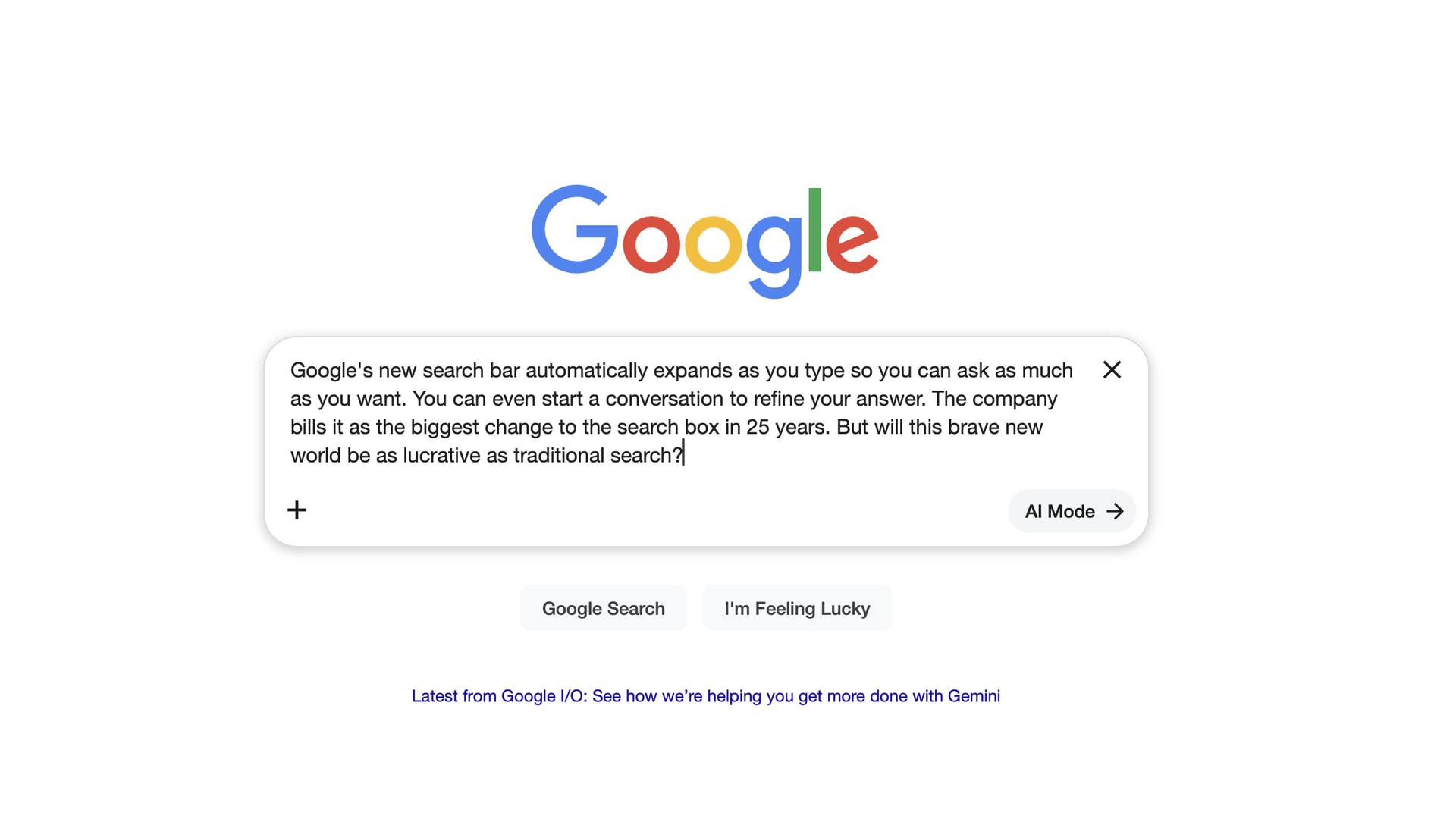
A sample query for Google's expanded new search bar. Ina Fried/Axios
Google is reinventing the product that made it one of the richest companies in history: search.
Why it matters: Search is the cash cow that funds Google's sprawling empire. But it faces an existential threat from AI chatbots, so the company is moving proactively to upend its own core business before someone else does.
- It's also an acknowledgment that describing what you're looking for in conversational language is a better way to find information than guessing the right keywords.
Driving the news: In what it billed as the biggest change to the search box since its debut, Google announced Tuesday that it is allowing the box to expand for longer queries and chat-style exchanges.
- Google has been headed in this direction for a while. It already puts AI-generated summaries at the top of search results and has a more chat-like experience known as AI Mode.
- But the company's announcement pushes that strategy much farther, signaling Google's determination to keep more users from drifting to standalone chatbots.
- As part of that effort, Google is bringing the hottest trend in AI — agents — into search. Instead of just finding out when your favorite band is coming to town, users can create a standing query that alerts them if any of the acts announce shows nearby. Similar "information agents" can help with recurring questions around shopping and news.
What they're saying: "Agents in search is the next step," Google DeepMind chief Demis Hassabis said in an interview. "One of the cool things we get to do here at Google is build technologies that get immediately deployed into multibillion-dollar products."
The big picture: Google's AI infusion goes far beyond search. It's betting that AI is breaking free from the chatbot and will find a home in virtually everything it makes, including new types of hardware, such as wearables.
- The company is putting AI wherever it thinks customers might want it. For example, a new "Ask YouTube" feature lets people ask a how-to question and get both a text answer and a video that contains the answer.
- The Gemini app has been designed for those who want to use agents for a wider range of tasks. In addition to an updated model — Gemini 3.5 Flash — Google has added Spark, a personal assistant that will eventually also be integrated into the Chrome browser and other apps.
- On the hardware front, Google is finally moving forward with AI glasses, more than a decade after the flop of Google Glass. Meta has had success here with its Ray-Ban smart glasses, and Google sees its AI and search prowess as a way to stand out from its rival.
- Google said the audio-only version of the smart glasses it is co-developing with Samsung and eyewear makers Warby Parker and Gentle Monster will be available this fall.
- The company is also giving the first hands-on look at Project Aura, the wearable device being developed with Xreal. The product is something of a tweener, with a far wider field of view than the display-equipped glasses, but less fully immersive than the Galaxy XR mixed reality headset.
- "It's a really exciting use case for where AI can get out into the real world," Hassabis said.
The bottom line: Google's answer to the AI threat is to turn all of its products into AI products.
