Google unveils broad new push to put AI everywhere

Add Axios as your preferred source to
see more of our stories on Google.
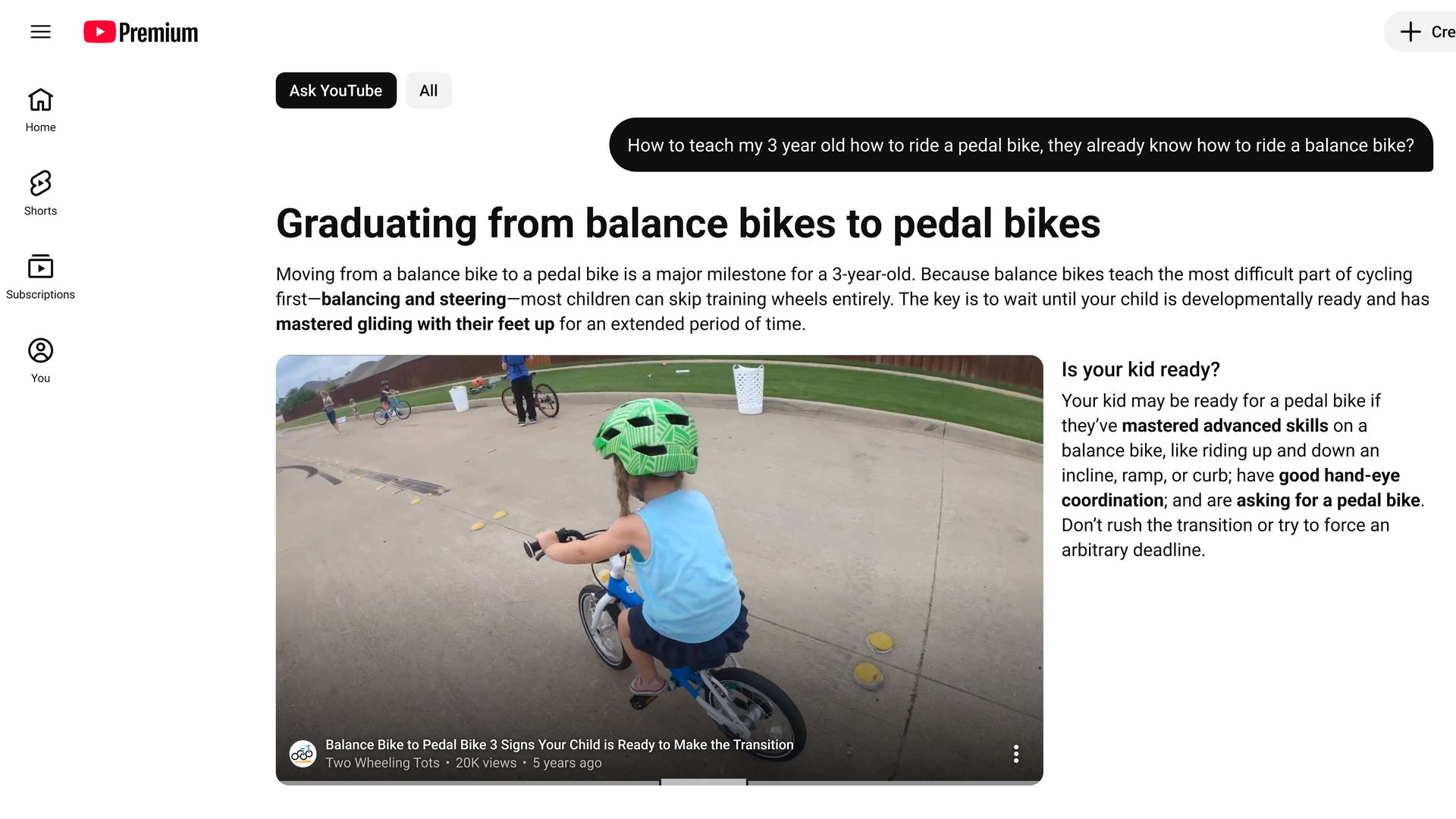
Google's new "Ask YouTube" feature. Image: Google
Google used its I/O developer conference on Tuesday to showcase how deeply it plans to embed AI across its products — from new models and a revamped search bar to forthcoming AI glasses and conversational search in YouTube.
Why it matters: Google comes to the AI race with arguably the deepest set of assets, but also the largest amount of surface area to defend against a world of AI-native apps.
Zoom in: Here's what Google announced on Tuesday:
YouTube
- A new "Ask YouTube" feature allows users to make conversational search queries and get results across Shorts and traditional videos. In most cases, results include both text answers and the videos from where they are drawn.
- It's being tested now and will be more broadly available this summer.
AI models
- Google DeepMind head Demis Hassabis announced Gemini Omni, which is designed to translate between different forms of media, including text, audio, images and video. Its initial release, however, is focused solely on generating video from combinations of text, images, audio and video.
- "Anything becomes a canvas for creating entirely new realities," Hassabis said, calling the model a key step towards so-called artificial general intelligence.
- Omni is being offered first to Google AI Plus, Pro and Ultra subscribers.
- Google also debuted Gemini 3.5 Flash, an updated version of its lower-cost workhorse model. Google characterized it as more powerful than last year's pro model, saying it's close in performance to today's best models but far faster. For now, it's accessible both in the Gemini app and the AI mode in Google search.
- Google said a higher-end Pro version is coming soon.
Gemini app
- In addition to Gemini 3.5 Flash and Gemini Omni, Google is adding an agentic capability known as Gemini Spark that can handle recurring tasks and other autonomous work.
- Google also aims to make it possible soon for people to control their Spark agent through e-mail or chat.
- Spark is coming to certain testers this week and next week to AI Ultra subscribers. Google is also adding a cheaper $100 per month tier of Ultra and dropping the price of its higher-end version of Ultra from $250 per month to $200 per month.
Android
- Google made most of its Android announcements last week, but it did preview a new capability called Android Halo. It allows people to see what tasks an agent is doing on their phone.
Google Workspace
- Google added a new image editing app called Pics as well as improved voice control for Gmail, Docs and Keep. Pics will come first to a group of testers, with Pro and Ultra customers gaining access this summer.
- It's also expanding access to its AI inbox feature to Plus and Pro customers.
Search
- Google, which has already added AI to the top of its search results as well as in a separate AI mode, is now redesigning the search box itself. It will now automatically expand for longer queries and offer suggestions as you go that go beyond traditional autocomplete.
- The company is also starting to bring agentic capabilities to search, allowing people to have queries that can run 24/7 in areas such as news and shopping.
Hardware
- Google is also showing off updated prototypes of the smart glasses it is co-developing with Samsung and eyewear makers Warby Parker and Gentle Monster. Voice-only models are due this fall, with a version with a small display set for expanded testing at the end of this year.
- The company is also giving the first hands-on look at Project Aura, the wearable device being developed with Xreal. The product is something of a tweener, with a far wider field of view than the display-equipped glasses, but less fully immersive than the Galaxy XR mixed reality headset.
What they're saying: "It's been an intense year," CEO Sundar Pichai said, kicking off the event in Mountain View, Calif.
- Pichai noted that Google is now processing 3.2 quadrillion tokens per month, a key measure of AI usage. That's up from 480 trillion tokens per month a year ago and 9.7 trillion tokens per month two years ago.
- "We knew how profound AI would be to advancing our mission and improving people's lives at scale.
Yes, but: Pichai acknowledged that people want more than flashy demos.
- "We are in that part of [the] cycle, though, where people want to see real value in the products they use on a day-to-day basis, and that's been a real focus for us," Pichai told reporters during a briefing Monday.
