Burgers approach luxury territory as beef prices remain high

Add Axios as your preferred source to
see more of our stories on Google.
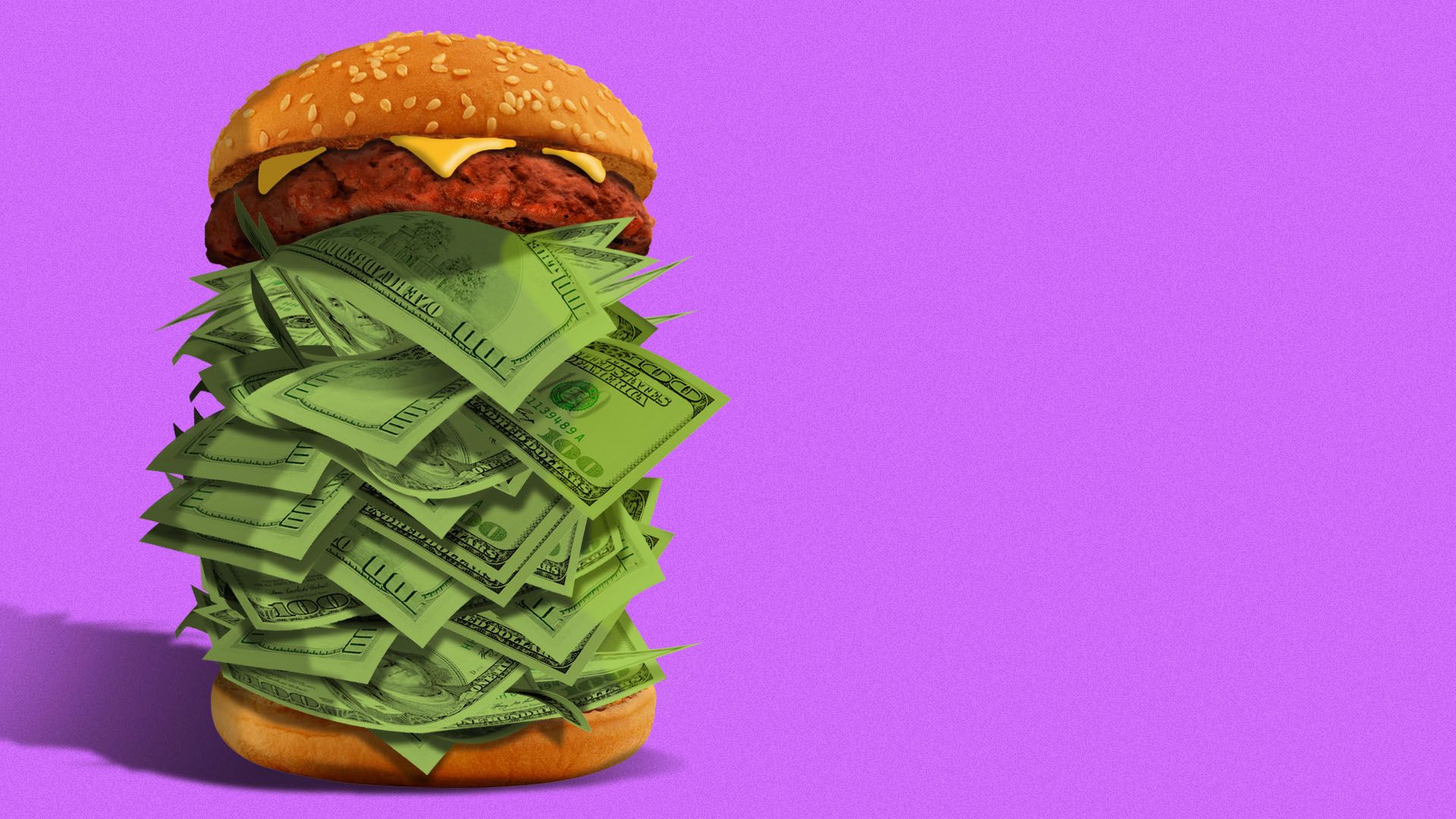
Illustration: Sarah Grillo/Axios
U.S. beef supplies are shrinking, imports are rising and prices are stuck near record highs — with little relief in sight.
Why it matters: The all-American hamburger is becoming a luxury item, nudging consumers toward cheaper proteins like chicken and pork.
The latest: U.S. beef production is forecast to fall again in 2026, to about 25.79 billion pounds, according to a new USDA outlook.
- Prices are holding near record levels, with cattle expected to average roughly $241 per hundredweight this year — about 8% higher than 2025, per USDA estimates.
- Imports are rising to fill the gap, while exports are falling as domestic supply tightens.
The big picture: The U.S. beef market is shifting from a surge in prices to a plateau — where costs remain high because supply can't quickly recover.
- Ground beef averaged about $6.70 per pound in March for U.S. shoppers, roughly 16% higher than a year earlier, according to Bureau of Labor Statistics data.
"Retail beef prices have flattened out for the last 6 months," said Michael Swanson, chief agricultural economist at Wells Fargo's Agri-Food Institute.
- But prices are still elevated year over year, and "we are still several years away from a meaningful increase in the U.S. cattle herd," he said.
Between the lines: Even record prices aren't fixing the supply problem, according to economists and industry data.
- Years of drought pushed the U.S. cattle herd to its lowest level in decades, forcing ranchers to shrink herds and slowing rebuilding as feed, labor and financing costs rise.
- Cattle are being kept on feed longer, producing heavier animals that help offset — but don't solve — the shortage, USDA data shows.
- Supply disruptions, including a recent strike at a major processing plant, have slowed slaughter and added pressure to the system, according to the USDA report.
Zoom in: The U.S. is leaning more on imported beef.
- Imports are nearing 5.8 billion pounds this year, while exports are expected to fall about 8%, according to USDA forecasts.
- That shift is reshaping the market — especially for ground beef.
What they're saying: "High beef prices are due to a supply-demand imbalance compounded by the broader inflation story," said Dennis Follmer, chief investment officer at Montis Financial.
- "These higher prices are driven mostly by structural factors," he added, noting "consumers shouldn't expect near-term relief."
Prices may move sideways in the coming months as consumers shift to cheaper proteins, Swanson said.
- But without a significant increase in cattle supply, meaningful price declines are unlikely, economists say.
What's next: Rebuilding the U.S. cattle herd — when it begins — won't happen overnight. It can take more than two years for new cattle to reach the food supply.
- Producers — many of them small, family-run operations — are still wary after the last cattle boom peaked in 2015 and then corrected sharply, and continue to face debt, high land costs and volatile markets.
The bottom line: Beef prices aren't rising as fast — but they're still stuck high, and the forces keeping them there aren't going away anytime soon.
More from Axios:
