Supreme Court rejects Colorado's conversion therapy ban


Add Axios as your preferred source to
see more of our stories on Google.
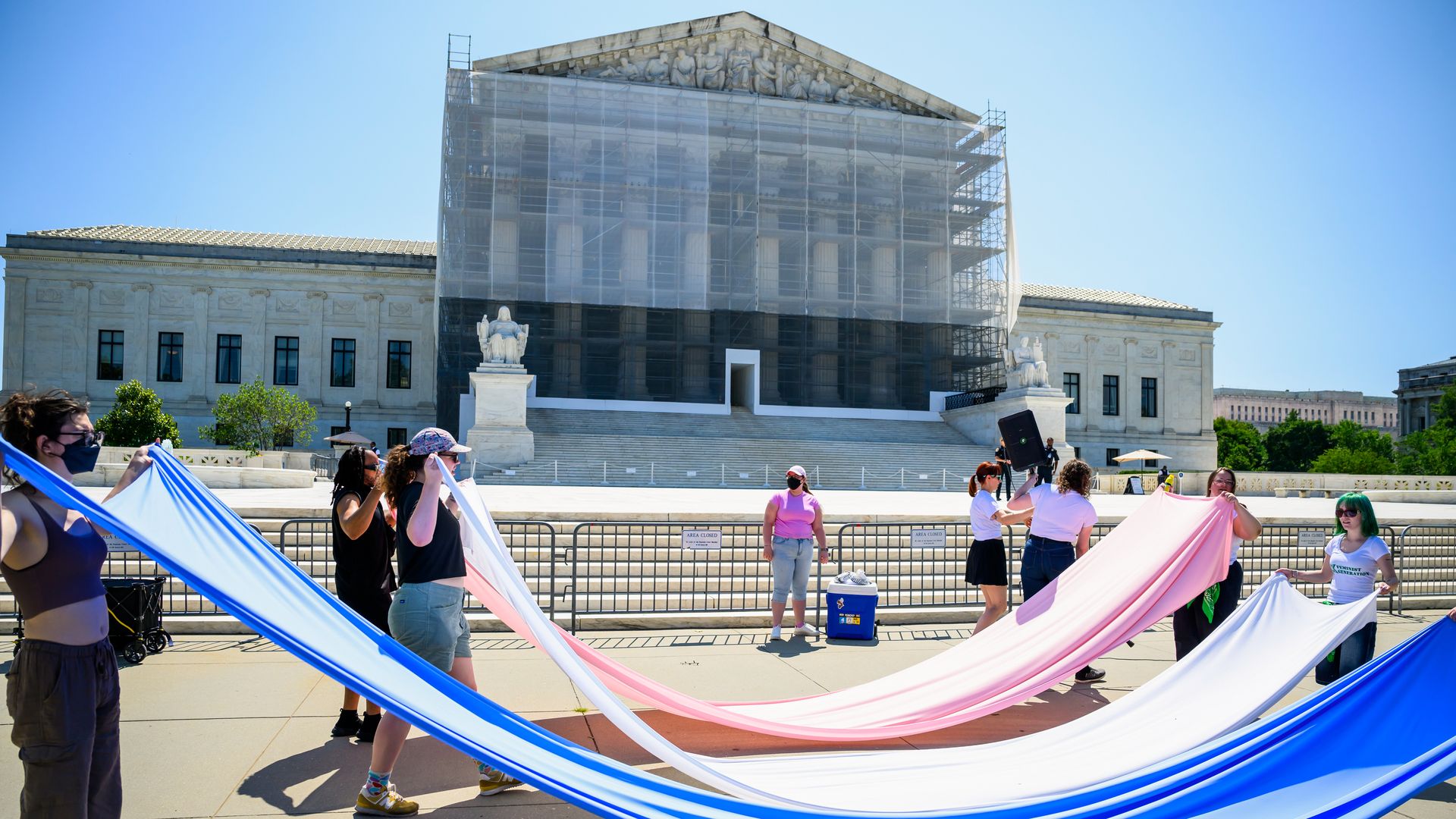
Demonstrators display a transgender pride flag outside the Supreme Court in Washington, D.C., on June 20, 2025. Photo: Pete Kiehart/Bloomberg via Getty Images
The Supreme Court sided Tuesday with a Christian talk therapist who contended a Colorado law banning the discredited practice of conversion therapy to change minors' sexual orientation or gender expression violated her First Amendment rights.
The big picture: The decision has implications beyond the Colorado therapy sessions. It sets precedent that therapists' conversations with patients are regarded as a form of constitutionally protected speech and rolls back protections for LGBTQ+ youth.
- A study from suicide and crisis prevention group The Trevor Project found that young people who reported going through conversion therapy were more than twice as likely to have reported attempting suicide and having multiple attempts compared to those who had not.
Driving the news: In an 8-1 decision, the court ruled that Colorado's law, even though it was tailored to licensed professionals, does not overrule free speech protections.
- "They may believe that state-imposed orthodoxies in speech pose few dangers and many benefits in this field (and who knows what others). But their policy is not the First Amendment's."
- "The Constitution does not protect the right of some to speak freely; it protects the right of all. It safeguards not only popular ideas; it secures, even and especially, the right to voice dissenting views. "
- "Consistent with these principles, our precedents have expressly rejected the State and dissent's notion that 'professional speech' represents some 'separate category of speech' subject to 'diminished constitutional protection.'"
Justice Ketanji Brown Jackson was the lone dissenter, arguing medical speech is different from generic free speech, as patients need to rely on sound industry-aligned advice.
- "In the worst-case scenario, our medical system unravels as various licensed healthcare professionals — talk therapists, psychiatrists, and presumably anyone else who claims to utilize speech when administering treatments to patients — start broadly wielding their newfound constitutional right to provide substandard medical care."
- "It is baffling that we could now be standing on the edge of a precipitous drop in the quality of healthcare services in America. But the Court sees fit to bring us one step closer to that fate today," she wrote.
Catch up quick: Therapist Kaley Chiles, represented by lawyers from the conservative Alliance Defending Freedom, contends the 2019 law acts as a de facto gag order on counselors to "censor speech."
- The high court agreed to hear the case after the Denver-based 10th U.S. Circuit Court of Appeals upheld the law, which it determined was a legal "regulation of professional conduct incidentally involving speech."
But in their petition to the Supreme Court, Chiles' lawyers argued that the law is a viewpoint-based infringement on her freedom of speech.
- Because the state disagrees with her views on gender and sexuality, her lawyers write, it "puts itself in Chiles's counseling room, forbidding her from discussing the values she and her clients share."
- Additionally, they stated that Chiles uses only talk therapy in her practice, in which she "does not seek to 'cure' clients of same-sex attractions" and works only with "voluntary clients" who determine their own goals.
The other side: The Colorado Attorney General's Office defended the law as a necessary regulation on professional conduct to protect patients from harmful treatment.
- "Central to Petitioner's position is her claim that mental health professionals' counseling of their patients is no different from a chat with one's college roommate, such that both interactions receive the same First Amendment protection," Colorado's opposing brief read. "Not so."
Zoom in: Shannon Minter, legal director of the National Center for LGBTQ Rights, tells Axios that Tuesday's decision "should not be understood as green-lighting conversion therapy, or saying that it's 'legal.'"
- "All this does is take off the table one way of protecting kids. There's still many other legal avenues to protect people harmed by conversion therapy," he said.
- He cited malpractice and consumer fraud claims, as well as professional licensing boards' ability to discipline therapists who "harm patients through conversion therapy."
Between the lines: More than 20 states have banned conversion therapy for minors, and Minter said Tuesday's decision will likely render most unenforceable.
- Justice Elena Kagan's concurrence, joined by Justice Sonia Sotomayor, suggested a viewpoint-neutral version of the law would raise "a different and more difficult question."
- Minter said states could redraft these laws to bar medical professionals from pushing any view on someone's sexual orientation.
What we're watching: The court sent the case back to the 10th Circuit, where it must now be reconsidered under higher scrutiny.
Go deeper: Supreme Court upholds Tennessee ban on gender-affirming care for transgender youth
Editor's note: This story has been updated with additional comment and context.
