Supreme Court will hear challenge to Colorado conversion therapy ban

Add Axios as your preferred source to
see more of our stories on Google.
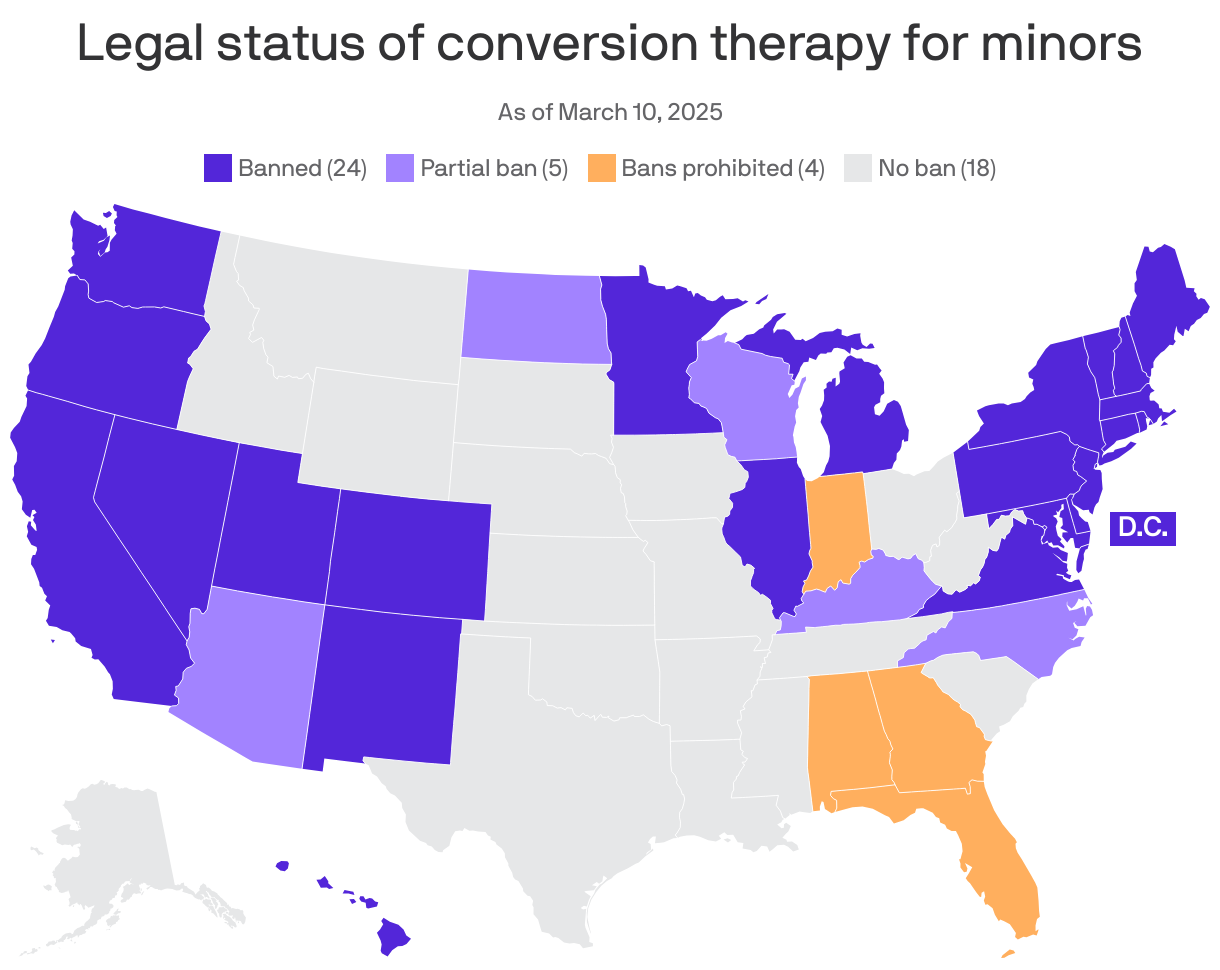
The Supreme Court on Monday agreed to hear a challenge to Colorado's law banning conversion therapy aimed at young people.
The big picture: The high court's eventual decision could deal a major setback to the LGBTQ+ community, which the executive branch has already targeted with an executive order blitz that undermines protections and quality of life for transgender people.
- Conversion therapy attempts to change people's sexual orientations or gender identities. LGBTQ+ advocates, major medical and mental health organizations have condemned the practice as harmful, discriminatory and ineffective.
Catch up quick: The high court agreed to take up a challenge from Kaley Chiles, a Christian counselor, who argued Colorado's restriction against licensed mental health professionals engaging in conversion therapy for minors violates her free speech rights.
- "To be crystal clear: this challenge has nothing to do with free speech, and everything to do with pushing dangerous, debunked practices that have only been proven to cause irreparable harm to LGBTQ+ young people all across the country," said Casey Pick, The Trevor Project's director of law and policy, in a statement provided to Axios.
State of play: More than 20 states have bans on subjecting minors to conversion therapy. But some 13% of LGBTQ+ young people in the Trevor Project's 2024 report on the mental health of LGBTQ+ youth reported being threatened with or subjected to conversion therapy.
- That included approximately one in six trans and nonbinary young people.
Zoom in: Chiles' attorneys argued that Christian clients seek her "Christian-based counseling" on questions about their sexuality that conflict with their faith, noting she works only with "voluntary clients."
- Conservative group Alliance Defending Freedom, which has argued other high-profile cases to the highest court, said in the petition: "Colorado disagrees with Chiles's beliefs on gender and sexuality."
- It added: "So much so that the State puts itself in Chiles's counseling room, forbidding her from discussing the values she and her clients share."
- Chiles' lawyers pointed to a 5-4 decision from 2018, when the justices ruled that California could not force anti-abortion crisis pregnancy centers to provide information about abortion.
Flashback: Last year, the 10th U.S. Circuit Court of Appeals in Denver upheld Colorado's law barring conversion therapy for minors, which Attorney General Phil Weiser described as "humane, smart, and appropriate policy."
- The Supreme Court rejected to hear a similar challenge in 2023 — with Justices Kavanaugh, Alito and Thomas voting to take up the case (four justices are required to grant review).
- The court separately appeared poised to uphold a Tennessee ban on gender-affirming care for minors during oral arguments late last year. Roughly half of U.S. states have passed laws restricting gender-affirming care for trans youth.
What's next: The court will hear the case in its new term, which begins in October.
- That means a decision likely won't come until summer 2026.
Go deeper: Survey: Almost 1 in 10 American adults say they are LGBTQ+
