Trump's Iran war whiplash clouds U.S. endgame

Add Axios as your preferred source to
see more of our stories on Google.
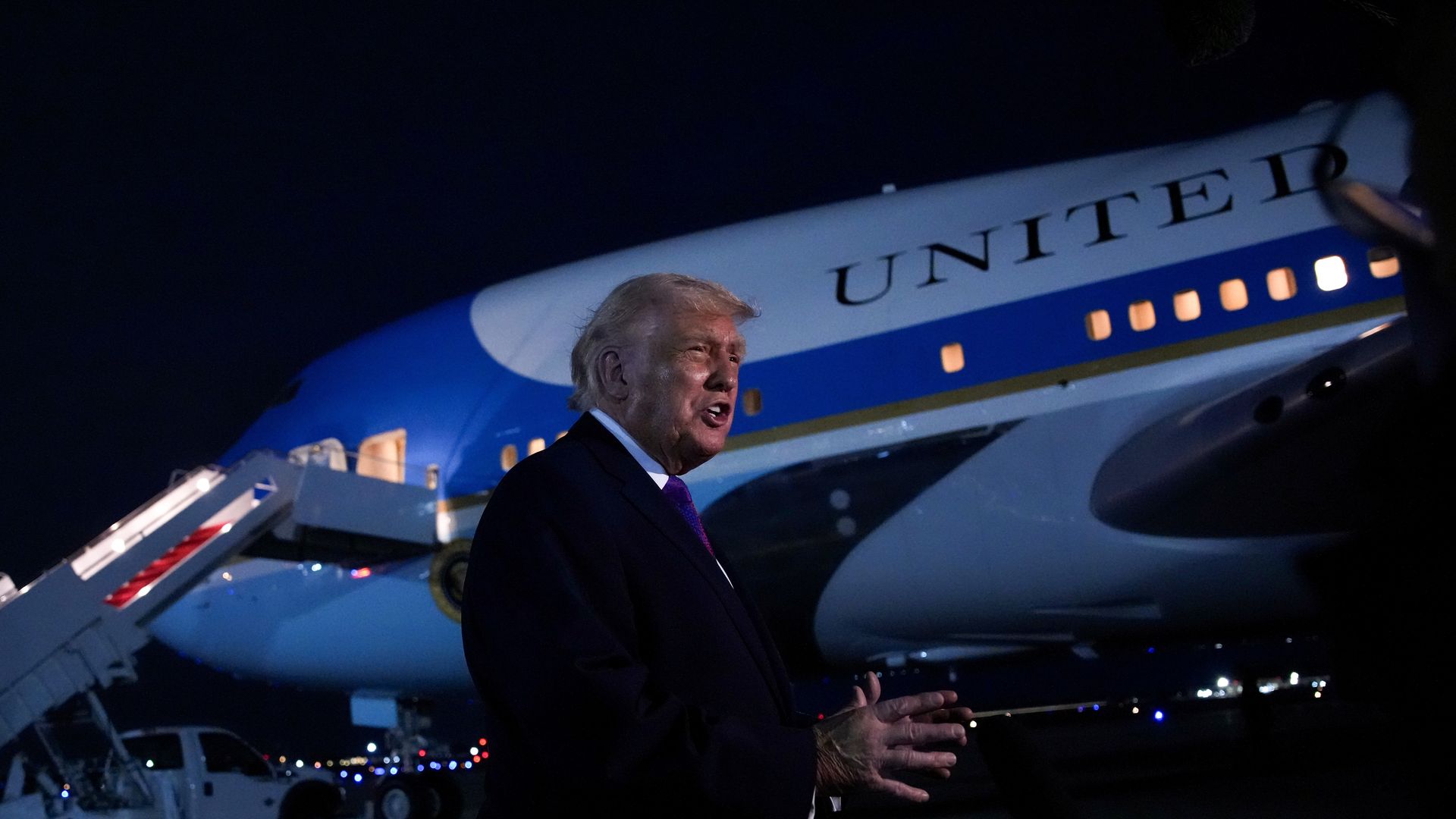
Photo: Andrew Harnik/Getty Images
After a video call with G7 leaders Wednesday, French President Emmanuel Macron declared publicly what others had said privately: no one can tell what Donald Trump wants from this war.
Why it matters: Nearly two weeks in, Trump continues to send conflicting signals about how and when the fighting ends. The confusion has left both allies and adversaries struggling to plan for what comes next.
- Two sources with knowledge of the G7 call said Trump was "ambiguous and noncommittal" — some participants left thinking he wants to end the war, others felt the complete opposite.
- "It will be up to the president of the United States to clarify both his final objectives and the pace he intends to give to the operations," Macron said after the call.
Driving the news: On the same day as the G7 call, Trump's public statements lurched from declaration of victory to vows of escalation — sometimes within the same speech.
- Prior to the call, Trump told Axios the war was going to end "soon" because "there is practically nothing left" to target in Iran.
- While departing the White House for a rally in Kentucky, he told reporters the U.S. "is not done" hitting Iran. "More of the same," he said when asked what the military still needs to accomplish.
- Onstage, Trump told a cheering crowd: "You never like to say too early you won. We won. In the first hour it was over." Minutes later, he added: "We don't want to leave early, do we? We gotta finish the job, right?"
The big picture: When Trump announced the war on Feb. 28, he laid out four objectives: destroy Iran's navy, degrade its ballistic missile capability, put a nuclear weapon beyond reach and end Iranian support for regional proxies.
- White House press secretary Karoline Leavitt stressed Wednesday that those goals have not changed, accusing the media of "pushing a fake narrative that there has been 'mixed messaging.'"
Zoom in: On the metrics Trump has touted publicly, the war is going well. On the objective that most justified launching it, the U.S. is not there yet.
- The Iranian navy is mostly destroyed. Most of Iran's missile launchers and stockpiles have been significantly degraded. Iran's military industry has taken serious damage. U.S. casualties have been lower than expected — the only fighter jets lost were to friendly fire.
- But the U.S. and Israel have not secured the 450 kilograms of highly enriched uranium Iran holds at its nuclear facilities.
- And Pickaxe Mountain — the fortified underground facility near Natanz that Iran has been quietly building since 2020, potentially buried 100 meters beneath the surface — has not been struck.
Between the lines: The U.S. and Israel entered the war together. They do not entirely agree on what winning looks like.
- Secretary of State Marco Rubio has flagged to Western counterparts that while the two allies are aligned on military objectives, there are "different nuances" when it comes to the question of regime change.
- Israeli Prime Minister Netanyahu wants the war to lay the foundation for regime change in Iran. The U.S. sees that as an added bonus, sources said.
- Israeli officials tell Axios their impression is that Trump is not planning to end the war in the next two to three weeks — but are accounting for the possibility he makes an abrupt decision if he concludes his objectives have been met.
Both Trump and Netanyahu had hoped the opening strike — which killed supreme leader Ali Khamenei and 40 top security officials — would rapidly destabilize the regime.
- Thirteen days later, both understand that has not happened. Both still hope the cracks will widen.
Behind the scenes: A source who spoke to Trump on Tuesday evening described the president as "enthusiastic" about continuing the war for at least another 3-4 weeks before making a decision.
- The focus of that phase will be a sustained campaign against Iran's powerful Islamic Revolutionary Guard Corps. "Trump calls them the Gestapo," the source said.
- The goal: degrade the IRGC enough that an internal uprising becomes possible. "They are not weak enough at the moment, but they will be in three to four weeks," the source said.
- "There are going to be efforts to unleash forces inside Iran. Maybe a town falls or a military unit flips," the source added, predicting that the Iranian population will be "re-energized" to topple the regime.
What to watch: Trump has described the war in recent days as "an excursion" — a temporary detour from his domestic agenda that will end soon. But it is not clear the war ends when Trump decides to end it.
- Traveling back to the White House on Wednesday, Trump offered his most candid assessment yet: "They are pretty much at the end of the line. It doesn't mean we are going to end it immediately — it is only a question of when."
- "We don't want to let it regrow and ideally we would like to see somebody in there who knows what they are doing," he said.
That last line cuts to the heart of the problem.
- A senior Arab official involved in mediation efforts between the U.S. and Iran told Axios that Tehran has made clear it has no intention of stopping the war on Washington's timeline.
- The Iranians want international guarantees the conflict will not resume — not another temporary ceasefire they expect will break, given the previous 12-Day War was less than a year ago.
The bottom line: With no direct dialogue between Washington and Tehran, and with Trump hinting he wants new supreme leader Mojtaba Khamenei dead, Iran has little incentive to stand down.
- Even if Trump decides to pull out, Iranian attacks on U.S. forces and Gulf states could continue.
- "It is very easy to start a war but very hard to finish it," the senior Arab official said.
