Under threat, Iraqi Kurds resist pressure to join Iran war


Add Axios as your preferred source to
see more of our stories on Google.
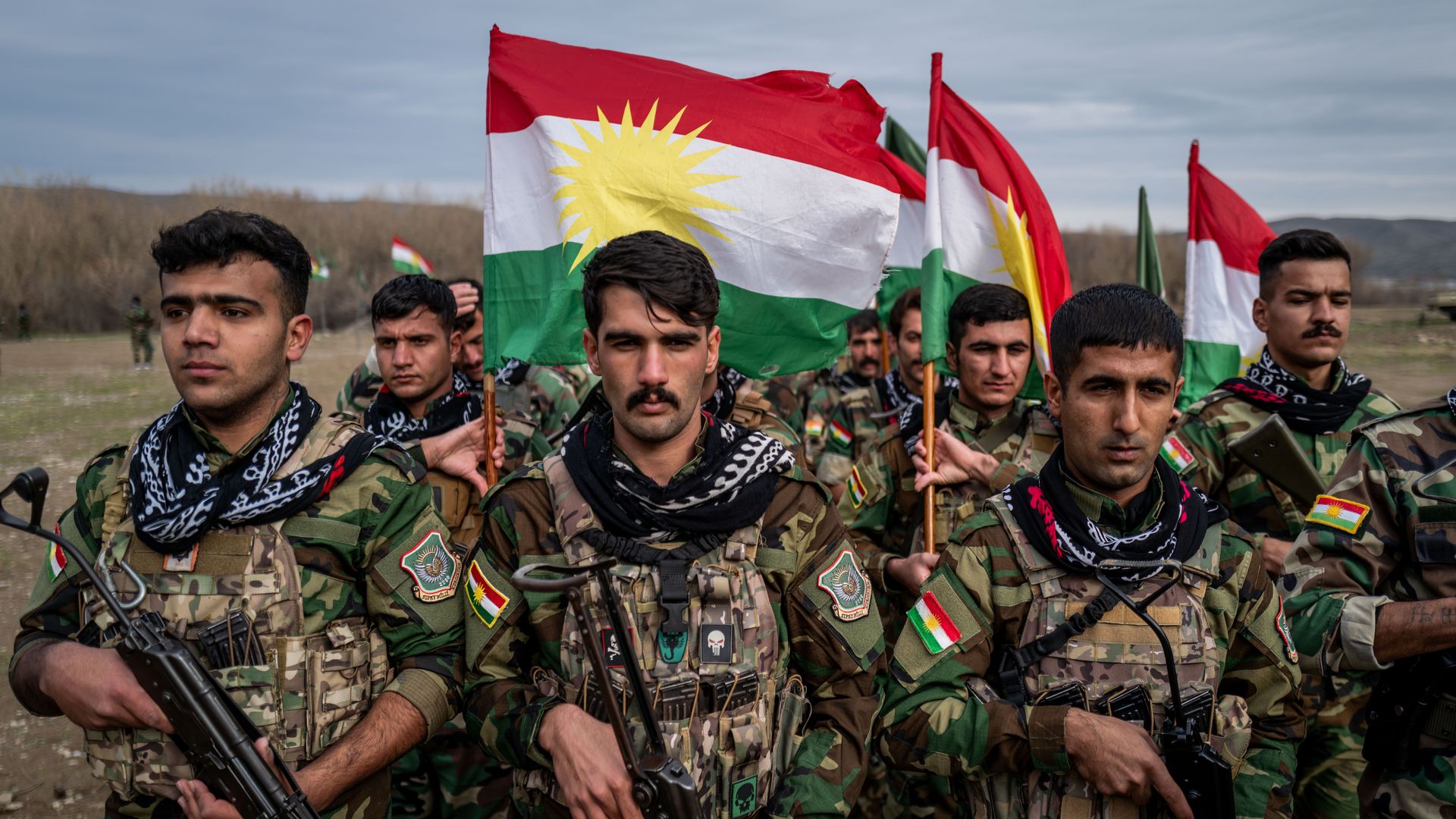
Kurdish Peshmerga fighters train on Jan. 18, 2026 near Erbil, Iraq. Photo: Ethan Swope/Getty Images
Iraq's Kurds are caught in a three-way vise as the Iran war spills across their border:
- They're uncertain, based on President Trump's messaging, whether the U.S. actually wants regime change next door.
- They're under pressure to open the border from Iranian Kurds who want to fight the regime.
- And they're facing a public threat — backed by a private warning — that Iran will retaliate if those militants attack from Iraqi Kurdish soil.
Why it matters: The Kurds of northern Iraq have carved out a stable, semi-autonomous region in one of the world's most volatile neighborhoods. Now, the war next door is threatening to make their neutrality impossible to hold.
- "The Kurds must not be the tip of the spear in this conflict," a senior Kurdistan Regional Government (KRG) official told Axios.
Zoom in: Iraq's Kurdish government prides itself on talking to all sides. But Iran changed its otherwise friendly tone Friday in a stark communique about Iranian Kurdish militants sheltering across the border.
- "Should their continued presence and plotting be permitted, or should these groups or [Zionist] regime elements enter the borders of the Islamic Republic through the Region, all facilities of the Kurdistan Region of Iraq ... will be targeted on a massive scale," Ali Akbar Ahmadian, an Iranian Defense Council official, said in a written statement.
- Iranian officials called the Iraqi Kurdish government on Friday to draw attention to the post and make clear it was official policy, the KRG official said.
- "They don't need hypersonic missiles to hurt us. 200 Shahed drones could cause a lot of damage here. We have no air defense systems. We don't have any ways to knock these things out of the skies," the official warned.
Zoom out: Trump has sent multiple different signals about what he wants to see unfold in Iran, calling for regime change without communicating what that looks like or how the U.S. will enforce it.
- "Certainly, we are staying neutral as Iraqi Kurds because there is no clarity for us on what the U.S. policy is. Is it full regime change? Or just a change in personnel?" the KRG official said.
- "Our assessment is there cannot be regime change without boots on the ground, and our assessment is that the U.S. is not sending boots on the ground," they added.
- Trump spoke to two Iraqi Kurdish leaders after launching the war Saturday but did not seek their support for an invasion, the official claimed.
Between the lines: Though Israel and the U.S. are carrying out a joint operation, their interests and activities diverge in both Iran and Iraq .
- "Israel is far more aggressive on this, both on the on the military side of it, but also in terms of pushing Iranian Kurds ... to be part of this war," the official said, adding that he saw no evidence of U.S. efforts to arm or incite Kurds to attack Iran.
- "Israel wants an annihilation of the current order in Iran and they will not stop until that happens. It's very existential," they said. "I can't see them accepting Regime Lite. I can see the United States accepting Regime Lite...Venezuela Plus."
The intrigue: Amir Karimi, co-chair of the Iranian Kurdish group PJAK, told Axios that armed members of his group are already inside Iran — but said a significant uprising won't happen without U.S. backing.
- "In the past, two major uprisings were not supported, which allowed the regime to prolong its survival," Karimi said, noting his group is contact with U.S. officials but not the Israeli government or its Mossad spy agency.
Another official with the Iraqi Kurdish Democratic Party (KDP) told Axios that the Peshmerga — Iraq's Kurdish armed forces — have so far managed to prevent Iranian Kurdish militants from launching an offensive into Iran from Iraqi territory.
- Iraqi Kurdish leaders decided to stay neutral in the war for now, partially because they're concerned the U.S. might abandon them at some point, the official said.
- "We have trust issues from the past and we don't want to get involved. Who is going to defend us if the Iranian regime ends up surviving this?" they asked
- The Iranian Kurdish fighters inside Iraq are also not as battle-hardened as Kurdish forces who fought in Syria, and they lack the training, numbers and equipment to mount an effective invasion force, Iraqi Kurdish officials say.
What's next: Iraqi Kurdish officials expect Trump to measure success narrowly, pointing to the four goals he has laid out: destroying Iran's navy, missile program, terrorist proxies and nuclear program.
- But they also recognize — as does Iran — that Trump only has three years let in office.
- "The Iranians have thousands of years of built-up patience," one Kurdish official said. "They know that in a couple of years, there might be a new president in the United States, and who knows what's going to happen in Israel. Their goal right now is to outlast this."
