Democrats demand $1,700 in tariff refunds for Americans

Add Axios as your preferred source to
see more of our stories on Google.
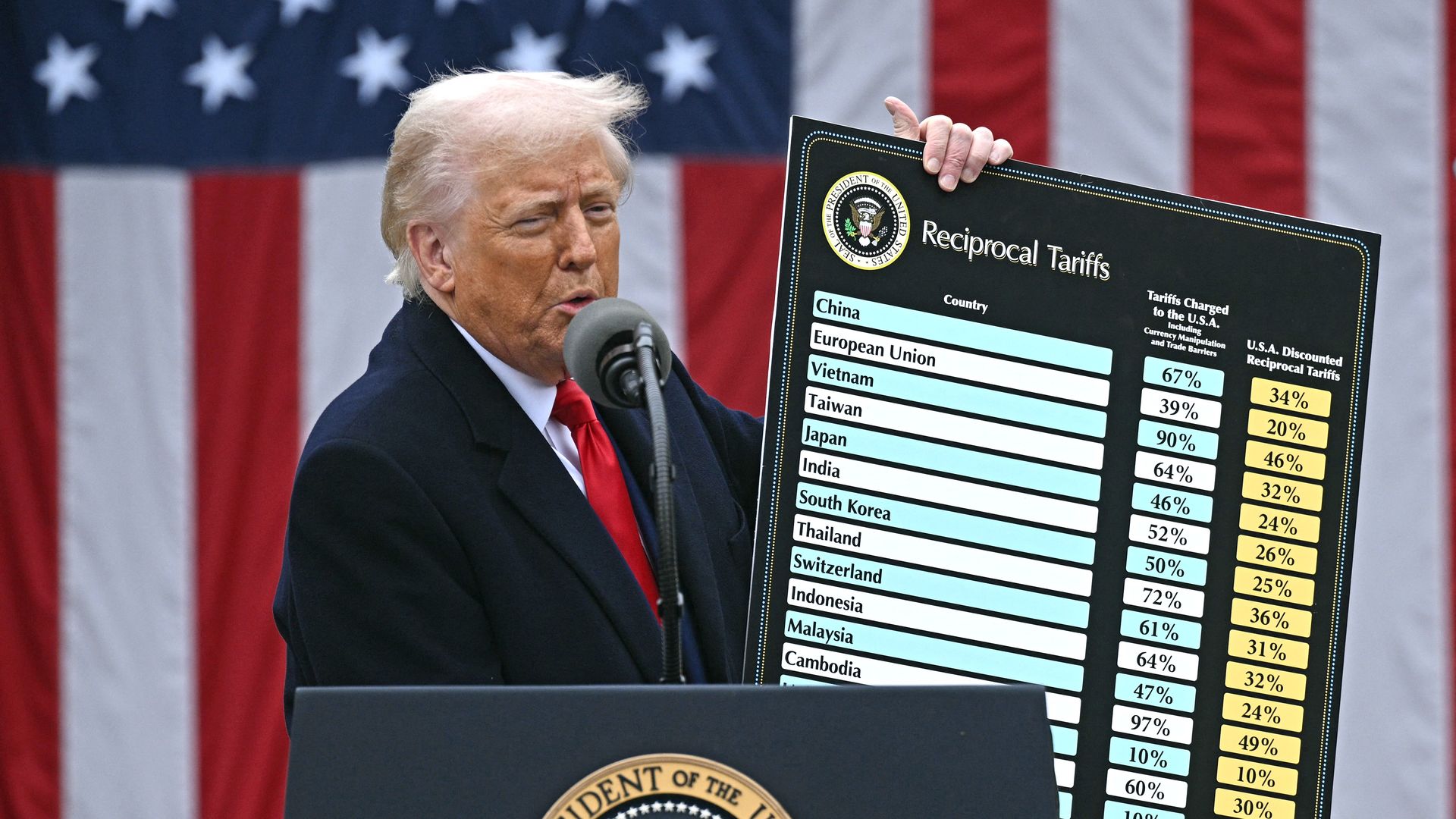
President Trump announces reciprocal tariffs in April 2025. Photo: Brendan Smialowski/AFP via Getty Images
Following the Supreme Court's blow to President Trump's sweeping tariffs agenda, the prospect of compensation for Americans remains an open question.
The big picture: A growing number of Democrats, however, are declaring that Americans are owed billions in compensation, which amounts to about $1,700 per household.
Driving the news: That includes New York Gov. Kathy Hochul, who sent a letter to U.S. Treasury Secretary Scott Bessent on Thursday calling for the federal government to "refund all tariff payments to New Yorkers."
- Several other Democratic state leaders have made similar demands, including Illinois Gov. JB Pritzker and California Gov. Gavin Newsom.
- And 26 Senate Democrats announced Thursday the "Tariff Refund Act," a bill that would require U.S. Customs and Border Protection to pay refunds, prioritizing small businesses.
Between the lines: Democrats' $1,700 refund pitch inverts Trump's own playbook for generating tariff support, promising $2,000 dividend checks amid the policy's broad unpopularity.
What they're saying: Sen. Elizabeth Warren (D-Mass.) released a video touting the $1,700 figure on Thursday.
- "Back in Massachusetts, I heard from all sorts of companies, from board game makers to baby stroller manufacturers, that tariffs made it more expensive to run their businesses and forced them to raise their prices," she said.
- "The truth is that you paid for Trump's disastrous economic policies."
- Representatives for the White House and the Office of Management and Budget did not immediately respond to Axios' Thursday evening request for comment.
By the numbers: Hochul cited a January study from the Yale Budget Lab to support the $1,700 figure.
- "The 2025-26 tariffs imply an increase in consumer prices of 1.3% (1.2% without the Greenland tariffs) in the short run, assuming full passthrough of tariffs to consumers," the researchers concluded.
- "This pre-substitution number captures consumer welfare effects and represents a short-run income loss of about $1,751 per household on average in 2025 dollars."
Reality check: A chaotic refund process is likely ahead, and it's unclear who gets to pocket that cash, Axios' Shane Savitsky writes.
- While the Supreme Court ruled the tariffs were illegal, it didn't comment on how "the government should go about returning the billions of dollars that it has collected from importers," Justice Brett Kavanaugh wrote in his dissent.
- Economists at TD Securities view the refund process as "highly unclear," estimating that it could take up to 18 months as cases make their way through the federal court system, Savitsky notes.
- Customers will likely have to wait for businesses to get reimbursed first, then get reimbursed by businesses, Robert Shapiro, an international trade lawyer and partner at the law firm Thompson Coburn, told NPR.
Zoom out: The Federal Reserve Bank of New York said this month that nearly 90% of tariffs' economic burden fell on U.S. firms and consumers.
- Companies somewhat shielded customers from the impact of the levies, but it still mostly impacted consumers.
- S&P Global published a study in October that found Trump's tariffs cost businesses more than $1.2 trillion in 2025, and that at least two-thirds of that "expense shock" was passed on to Americans.
Yes, but: After the Supreme Court ruled that the bulk of Trump's tariffs were illegal, the president implemented 15% levies globally.
- And Trump administration officials are currently devising legal strategies that would allow the government to keep its tariff revenue, Politico reported on Thursday.
What we're watching: Companies are trying to get refunds from the federal government, with Costco, FedEx and L'Oreal among those suing the Trump administration.
Editor's note: This story has been corrected to say 26 (not 25) senators signed on to the Tariff Refund Act.
