National Archives bets on AI to modernize museum

Add Axios as your preferred source to
see more of our stories on Google.
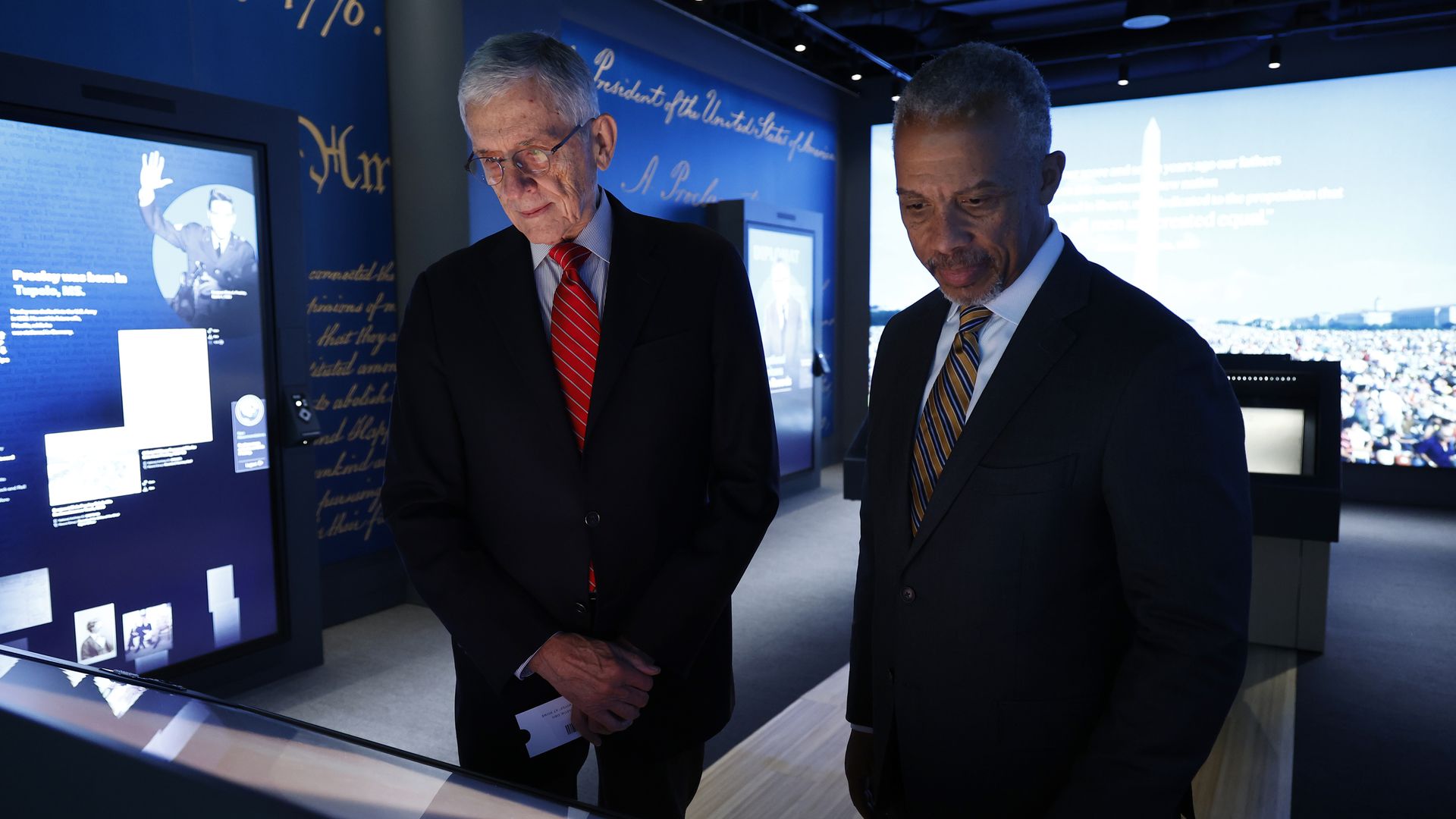
Tom Wheeler and Linwood Ham at the opening of "The American Story." Photo: Paul Morigi/Getty Images for National Archives Foundation
The National Archives' newest permanent exhibit uses machine learning to make America's historical records more accessible to the public.
Why it matters: AI's biggest superpower is tagging, organizing and presenting massive amounts of data, a growing challenge for institutions like the National Archives.
Driving the news: The exhibit, called "The American Story," opened in November, ahead of the country's semiquincentennial — the 250th birthday of the United States.
- The National Archives Museum says it's the first institution on the National Mall to power an exhibit with AI.
How it works: Visitors select topics of interest and types of records such as documents, maps and photographs.
- The AI system connects archival records to those interests, helping surface related material. Visitors can then revisit the records online later using a QR code.
- The museum's AI portals function as recommendation engines, using natural language processing for chatbot-style interactions.
By the numbers: The $40 million exhibit includes more than two million records curated by archivists and cataloged with AI.
- The National Archives says it keeps only 2%-5% of federal records generated per year.
- In total that currently adds up to around 13.5 billion pages of text, as well as maps, charts, drawings, still photos, digital images, film, video and sound recordings.
The personalization aspect of the exhibit helps visitors find gems in the vast catalog of documents, National Archives capital campaign director Franck Cordes tells Axios.
- "Part of the magic of this system is that it's nudging visitors into new territory and new areas of content that they didn't think about exploring," says John McCarthy, principal of interactive design at Cortina, the Archives' technology partner.
Between the lines: The archivists' challenge is to present the material to museumgoers without hiding the darkest parts of American history, but also making the material accessible to the youngest visitors.
- "We have some very graphic, painful imagery," Cordes says, using Nazi camps in Germany as an example.
- "We were very careful to be able to create a system that doesn't shy away from any of the stories of World War II, but does it in such a way ... that's not going to present material that a parent might be upset that their kids were seeing for the first time."
Yes, but: The explosion of generative AI tools has increased the amount of political deepfakes people see online.
- Big Tech companies test their chatbots in public, causing historical AI gaffes including producing images of Black founding fathers and Asian colonial Americans.
- Meanwhile, filmmakers struggle to maintain accuracy in documentaries and worry that generated material could be seen as real and later be included in future projects.
Reality check: The creators of "The American Story" want people to know that they're not using AI to create new historical records.
- Instead, they used AI to tag and structure data, to understand themes and time periods and connect those to visitors' interests.
- "We're not doing anything generative," McCarthy tells Axios. "We're not reinventing history or anything like that."
The bottom line: The National Archives is betting that AI can help connect museumgoers with America's history without rewriting it.
