In Davos, the AI bubble is always someone else's problem

Add Axios as your preferred source to
see more of our stories on Google.
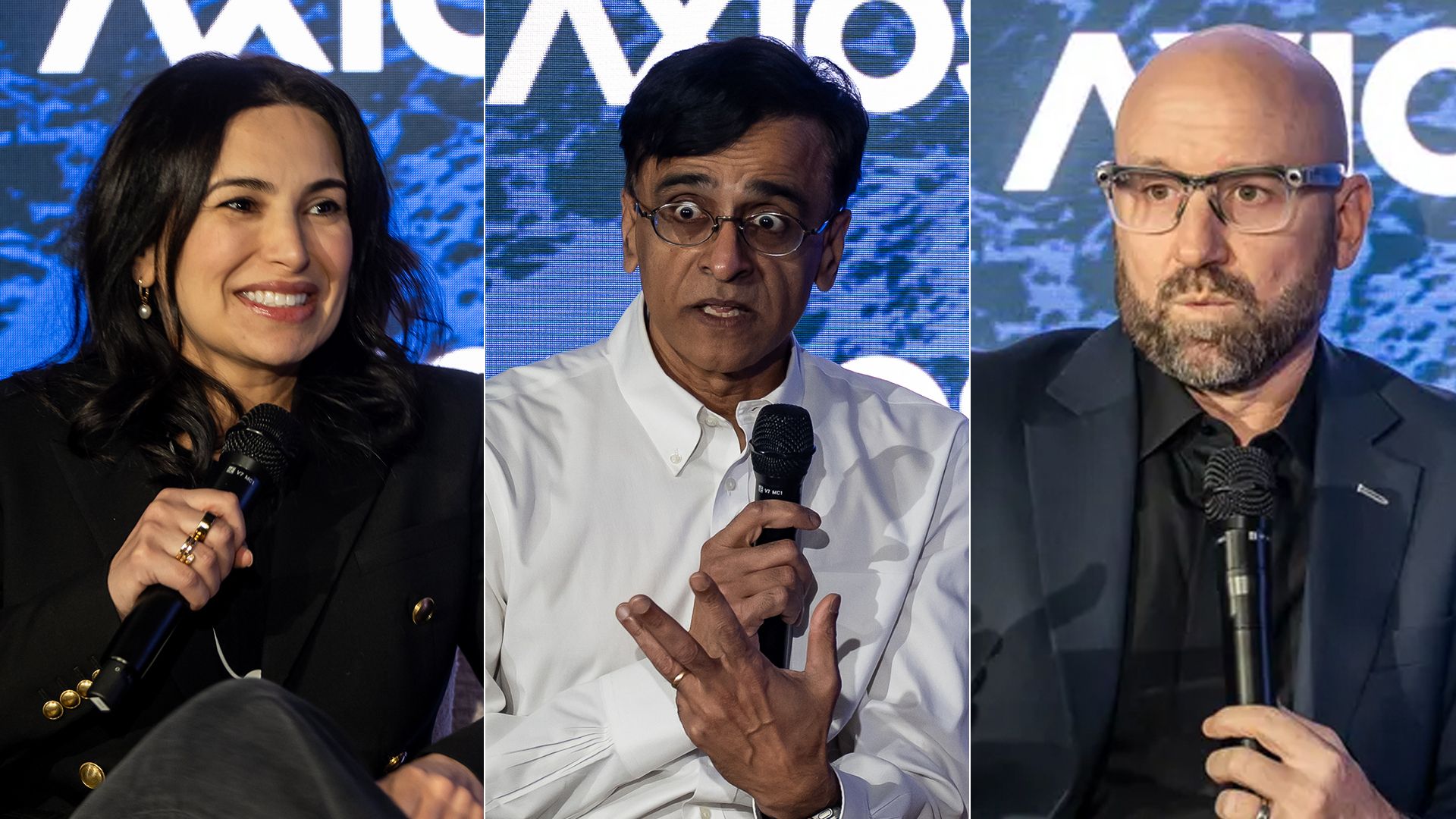
Writer CEO May Habib, Snowflake CEO Sridhar Ramaswamy and Meta CTO Andrew Bosworth. Photos: Dani Ammann Photography for Axios
There may be an AI bubble forming, but everyone in Davos is convinced they won't be the ones left holding the bag.
Why it matters: Businesses are investing almost unfathomable sums in AI, but there is a growing sense that at least some companies won't be able to recoup their massive investments.
The big picture: AI remains the talk of Davos as CEOs and political leaders remain convinced that the technology is leading to a massive societal shift.
The other side: Even if you agree AI is real and significant, the internet was real, too, and that didn't prevent the dot-com bust.
- While mood and sentiment certainly play a role in the timing of when boom turns to bust, the driving factor is the economics, namely whether too much was invested too soon to produce a reasonable return.
Zoom in: So who is safe and who is vulnerable if the tide turns? If you ask the big guys, they will be fine.
- Google, for example, points to the fact that it can spread the cost of its massive investments across its consumer and enterprise businesses, whether it's via ads on YouTube, subscriptions to Gemini or big businesses renting compute from Google Cloud.
- "We maximize the return on investment we're getting and that allows us to have real strength financially, to continue to invest going forward," Google Cloud CEO Thomas Kurian said during an interview at Axios House Davos.
Others claimed they would be insulated because they aren't building the infrastructure and can pay as they go instead.
- "SAP is very capex-lean," SAP executive board member Thomas Saueressig told Axios Friday on the sidelines of the DLD conference in Munich. "We benefit from the R&D efforts and the investments our partners are doing."
Writer CEO May Habib pointed to the biggest AI labs — Anthropic and OpenAI — as the ones most at risk.
- "When you look at either of the big labs right now, they're both basically valued at more than Salesforce plus Adobe plus Databricks plus Snowflake," Habib said on stage at Axios House on Monday. "That's hard to kind of wrap your head around, because those other companies are working really, really hard to bring AI to their customer base."
Snowflake CEO Sridhar Ramaswamy warned, however, a bubble burst would have sweeping impacts.
- "If there is a correction, then the entire stock market, including the valuation of our company, including Snowflake, is going to go down," he said on stage at Axios House on Monday.
- "On the other hand, in terms of good bubbles and bad bubbles, if this bubble results in a reinvigoration of the power sector, which as you know, is not something that's been attractive for investments, that's actually a net positive for all of us."
Zoom out: In a few decades' time, all of the investment will have been worth it, many execs agreed.
- "We're talking about a technology that can augment and maybe even replace human intelligence," Emerald AI CEO Varun Sivaram told Axios. "In the long run, my bet is that we have built less than 1% of all the compute that we will need as humanity, and we will almost never stop needing more compute."
- "We don't regret railroads, telecom fiber ... all the build-ups of this kind that we've done in history, we have ended up feeling great about," Meta CTO Andrew Bosworth said during an interview at Axios House Davos.
Yes, but: Plenty of companies won't survive long enough to reap the rewards, Bosworth acknowledged.
Between the lines: Bosworth points out that consumers will win regardless, given all the compute power that is being unleashed.
- "I think consumers and societies are ultimately the beneficiaries of this tremendous land grab of power, data centers and GPU capacity and whatnot," he said.
What we're watching: Obviously everyone is waiting for signs of a bubble popping. But also important is just how long any downturn lasts before the next upswing.
- NTT Data CEO Abhijit Dubey says his company is rare in that it sees both the demand and supply side of the AI industry because it both builds data centers and offers significant technology services to large companies that would use AI.
- "We see where enterprises are on their adoption journeys and where it is at low levels," Dubey said, noting that the buildout of data centers is outpacing enterprises adopting AI.
- However, he said he expects any correction to be short-lived, with companies adopting AI far faster than past tech shifts, such as the 10-year move to the cloud.
Axios' Amy Harder contributed to this report.
