U.S. thinks Hamas is ready to demilitarize as Gaza deal moves to "phase two"

Add Axios as your preferred source to
see more of our stories on Google.
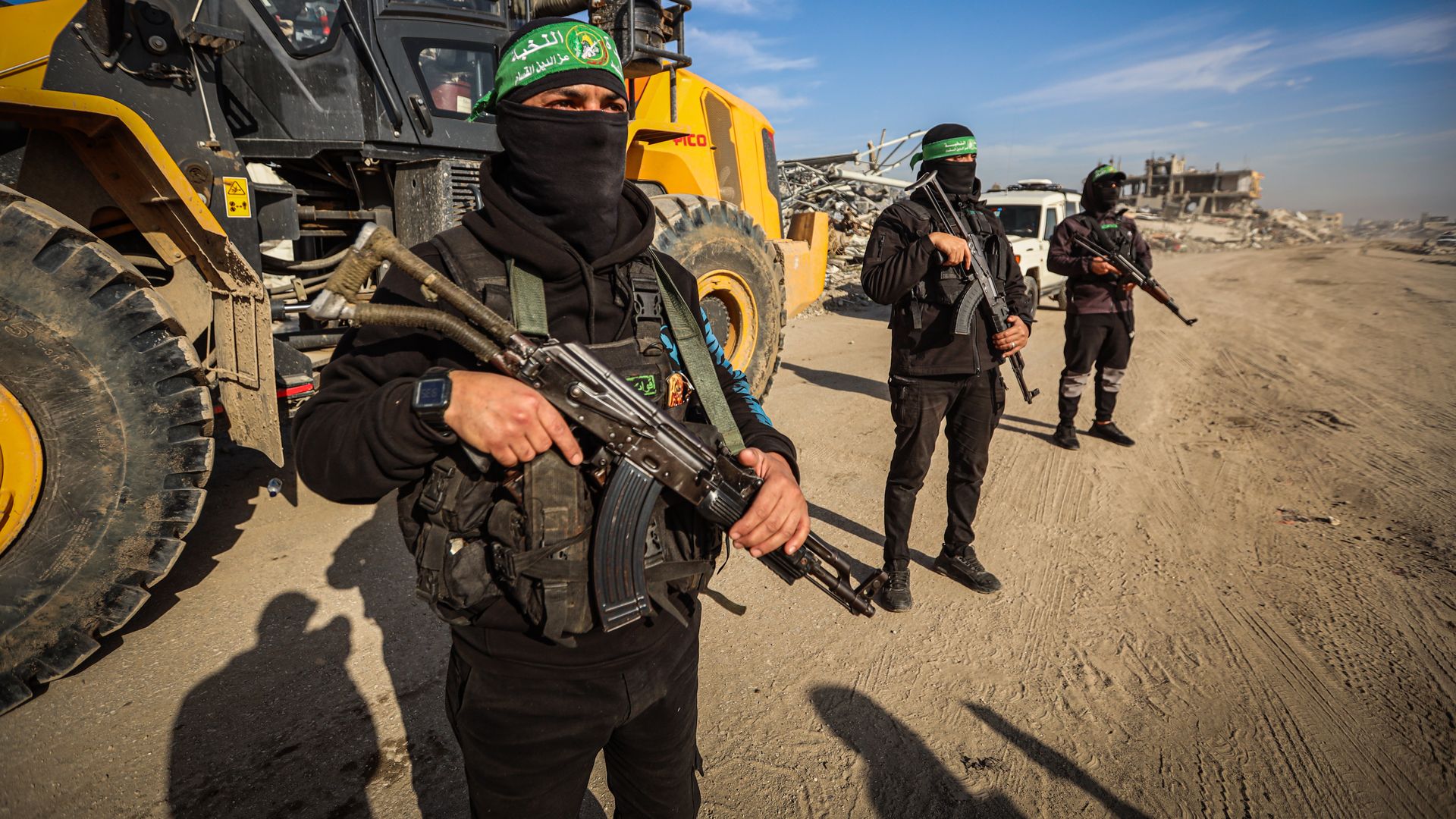
Hamas militants during search operations for the remains of a deceased hostage. Photo: Hamza Z. H. Qraiqea/Anadolu via Getty
After launching "phase two" of the Gaza ceasefire deal on Wednesday, two U.S. officials insisted in a briefing with reporters that Hamas has privately signaled it's ready to accept the U.S. demilitarization plan and begin to disarm.
Why it matters: Any hope of turning the Gaza truce into lasting peace depends on Hamas giving up its weapons, and on Israel pulling its troops back rather than trying once again to disarm Hamas by force.
Friction point: Israel is highly skeptical that Hamas will voluntarily comply with President Trump's plan.
- Israel only reluctantly agreed to move to "phase two," in part because the remains of one deceased hostage have yet to be returned under the terms of "phase one." But some hardliners within the government have long wanted to ditch Trump's deal and resume the war.
- The Trump administration and its fellow mediators — Egypt, Turkey and Qatar — are more optimistic. "We devised a plan to do [demilitarization]. The President wants to see it happening. Hamas is indicating that it will happen. We believe it can be achieved," one U.S. official said.
- The U.S. official also said "it is not a completed mission until" the remains of the last hostage are found, but that's not sufficient reason not to move forward with the peace deal.
Driving the news: The first major announcement of phase two on Wednesday was the establishment of a new Palestinian technocratic government to oversee day-to-day governance in Gaza.
- It will be headed by Ali Shaath, a former deputy minister of transportation in the Palestinian Authority.
- All members of the new government are from Gaza. They have been vetted by the U.S., Israel and Egypt and were accepted by the Palestinian Authority, Hamas and the other Palestinian factions.
- "We carefully vetted and selected. It was a robust search to find the right people," a U.S. official said. "It's a group that wants peace and wants to work on creating services for their people. We will do anything possible to help them be successful."
Behind the scenes: The U.S. and the other mediators have been in touch with Hamas in recent weeks regarding the issue of demilitarization.
- More talks on the issue will take place in the coming weeks as the implementation of phase two begins and the new Palestinian government takes power, the U.S. officials said.
Breaking it down: The U.S. officials say the Trump administration's demilitarization plan for Gaza is phased and gradual. In the immediate term, it's focused on:
- Destroying "terror infrastructure" like tunnels and weapons factories.
- Disarming heavy weapons like RPGs, rockets and missiles. Those "will be put into a place where they are not being used for attacks on Israel," a U.S. official said.
- Establishing a Gaza police force that will operate under the authority of the technocratic government, will be in charge of law and order, and will have a monopoly on weapons.
Zoom in: The U.S. wants to discuss with Israel the possibility of "amnesty programs" for Hamas operatives who want to give up their personal weapons and abandon military activity.
- "Hamas are sending positive signals [on demilitarization]. They are depleted and lost many of their people. But this needs to be real and not fake," the U.S. official said.
- The officials made clear they understand how skeptical the Israelis are that Hamas will actually disarm.
The other side: Hamas has said publicly that it won't completely demilitarize unless a Palestinian state is established — currently a very remote prospect.
- But several Hamas leaders have publicly expressed willingness to surrender the group's heavy weapons either to an Arab force or to the Palestinian government, to put them into storage.
What to watch: Another element in the new security environment in Gaza will be the International Stabilization Force (ISF) that was authorized by the UN Security Council.
- The ISF is expected to be deployed in the areas of Gaza still under Israeli control in order to allow Israeli troops to gradually withdraw.
- The U.S. officials said several countries are interested in sending troops to the ISF and said they hope it will be announced within two weeks.
Between the lines: Many countries are reluctant to send their forces to Gaza, particularly if they would have to play a role in disarming Hamas and other militant groups. One country that does want to be involved is Turkey, but the Israeli government is vehemently opposed.
- The U.S. officials said the Trump administration wants Turkey to have a role in Gaza going forward. "We think it is important to have them involved because they have influence with Hamas," one said.
- The U.S. official said the Trump administration wants to see Turkey and Israel rebuilding their relationship, which has been extremely strained since the beginning of the war in Gaza.
- "We will work on it. Hopefully we can get both sides to de-escalate their rhetoric and to work together."
