Web rot rising

Add Axios as your preferred source to
see more of our stories on Google.


Traffic to top websites has fallen by more than 11% in the past five years, according to data from Similarweb — a clear sign of the challenges traditional publishers face in the AI era.
Why it matters: Internet usage and adoption continue to grow, but older websites are struggling to keep up as newer AI-driven experiences start to dominate user attention.
- Data shows that those older sites don't just magically disappear. They continue to rot on the open web for years, clouding search results and leaving behind trails of broken or outdated links.
By the numbers: Taking a look at aggregate web traffic globally to the top 1,000 websites — including newer ones — internet traffic has held steady over the past five years at around 300 billion average monthly web visits, per Similarweb.
- Over the past 12 months, there's even been some modest growth, with that cohort rising 1.8% between November 2024 and November 2025.
- But if you remove websites that didn't exist five years ago, traffic declined 1.6% over the past year. (That doesn't include the few sites that have disappeared all together.)
Zoom out: The slow downfall of older websites has left the internet muddled for users, and scrapers trying to gather data to accurately train large language models.
- While some publishers have pushed to maintain and update their web experiences, many have instead neglected their old websites.
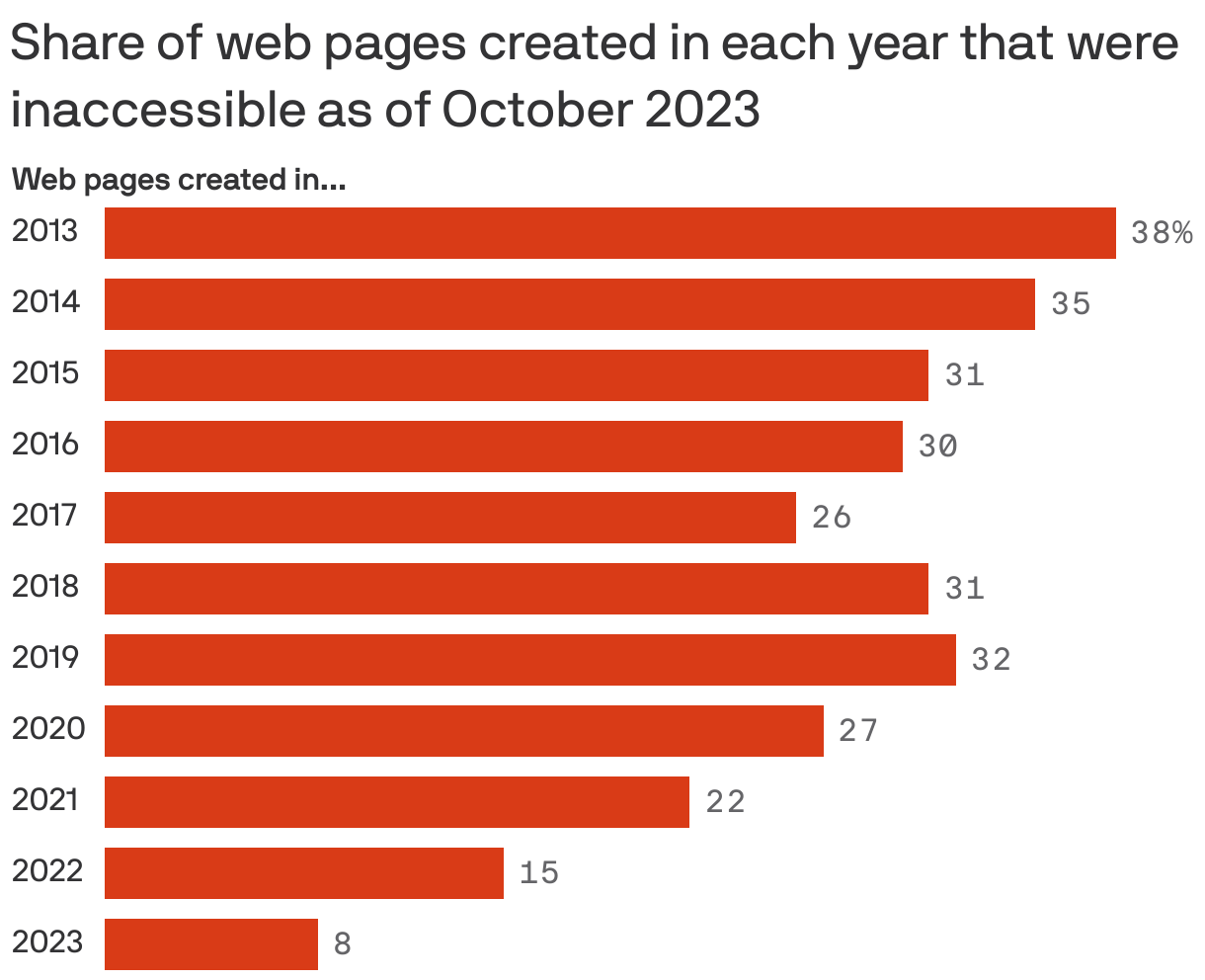
- A study from Pew Research Center found that a quarter of all webpages that existed at one point between 2013 and 2023 are no longer accessible.
- 23% of news webpages contain at least one broken link, as do 21% of webpages from government sites.
The big picture: Premium publishers have argued for years that AI firms scraping their content could inevitably put them out of business, leaving LLMs with nothing to train on besides outdated content in the future.
- Data shows that AI chatbot referral traffic to top media and news websites is roughly 96% lower than traditional Google search.
- That concern has prompted some AI companies, most notably OpenAI, to strike deals with publishers to compensate them for their content.
- The publishing industry is desperate to build a two-sided web marketplace for the AI era where they can be paid on a per-usage basis — similar to how they functioned in the search era. But those solutions for now lack scale.
