U.S. oil companies will rebuild Venezuela's industry, Trump says


Add Axios as your preferred source to
see more of our stories on Google.
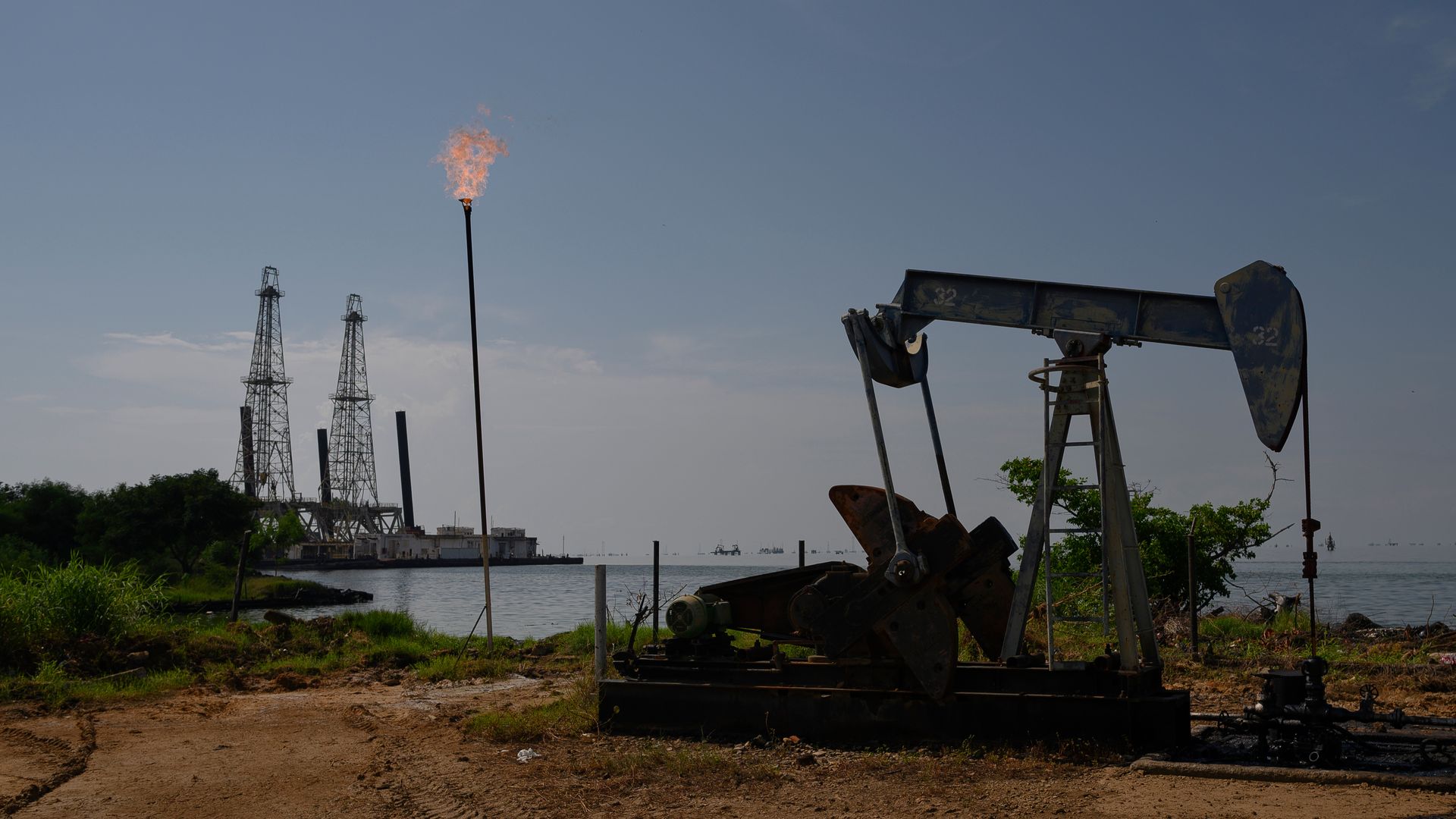
A Petroleos de Venezuela SA (PDVSA) oil pumpjack on Lake Maracaibo in Venezuela in 2023. Photo: Gaby Oraa/Bloomberg via Getty Images
President Trump said the U.S. will be strongly involved in Venezuela's oil industry, asserting that American companies will take a lead in rebuilding its deteriorating petroleum infrastructure.
The big picture: Trump's comments about the nation's huge oil reserves following the capture of President Nicolás Maduro raise many unanswered questions, including how much interest the companies have in re-establishing operations there.
- "Companies will be wary to enter without a stable security environment, and very favorable terms to reduce the risk. Especially with markets over supplied and prices low in the near term," Eurasia Group analyst Gregory Brew said via email.
The latest: "This isn't a country that's on the other side of the world ... We're in the business of having countries around us that are viable and successful, and where the oil is allowed to freely come out," Trump told reporters Sunday when asked if the U.S. is now nation-building.
- "Because that's good, it gets the prices down. It's good for our country."
Driving the news: Trump made his initial comments at a Saturday news conference following the capture of Maduro, who is in U.S. custody and faces charges including narcoterrorism.
- "We're going to have our very large United States oil companies, the biggest anywhere in the world, go in, spend billions of dollars, fix the badly broken infrastructure, and start making money for the country," he said.
- The companies "will be reimbursed" for their efforts, he said later.
He provided no details on the possible length of the U.S. commitment, saying it "takes a period of time."
- Trump also said the U.S. has long shaped the country's oil industry.
- "We built Venezuela's oil industry will talent, drive and skill, and the socialist regime stole it from us during those previous administrations," he said.
Reality check: There are huge uncertainties surrounding U.S. companies' interest in new investments and operations in Venezuela, despite its massive hydrocarbon deposits.
- The shape of the post-Maduro government and security situation remains unclear.
- And companies must consider other macro factors like the price outlook, future demand growth, and opportunities elsewhere.
- The administration asked U.S. oil companies if they were interested in returning to Venezuela, but the companies firmly declined, Politico reported last month, citing four unnamed people familiar with the discussions.
The American Petroleum Institute said in a statement on Saturday that it was "closely watching developments involving Venezuela, including the potential implications for global energy markets.
- "Geopolitical events like this reinforce the importance of strong U.S. energy leadership."
State of play: Chevron is the only U.S. oil company with operations there.
- "Chevron remains focused on the safety and wellbeing of our employees, as well as the integrity of our assets. We continue to operate in full compliance with all relevant laws and regulations," the company said in a statement.
Between the lines: Venezuela has the world's largest known reserves, but currently has a relatively small stature in global oil markets.
- Its production and exports have declined amid years of mismanagement, sanctions, and underinvestment.
By the numbers: Venezuela exported around 700,000 to 900,000 barrels per day (bpd) of crude oil over the last year or so, and China is the largest buyer.
- Output and exports have declined even further since the U.S. began thwarting tanker shipments.
- For context, Saudi Arabia exports over 6 million bpd and the U.S. crude exports are often north of 4 million bpd.
Catch up quick: When Venezuela nationalized its oil industry in the 1970s, U.S. oil companies were hit the hardest.
- The companies, which had accounted for more than 70 percent of the country's crude oil production, lost roughly $5 billion in assets but were compensated just $1 billion each, The New York Times reported at the time.
- But the companies didn't seek larger sums and "felt that it didn't make sense to press it more," Francisco Rodríguez, a Venezuelan economist at the University of Denver, told The Washington Post.
Former Venezuelan leader Hugo Chávez embarked on another nationalization effort in 2007.
- This effort was more controversial, as companies such as ExxonMobil and ConocoPhillips claimed that they were owed billions in compensation.
What we're watching: The market reaction to the strikes and Maduro's capture when oil trading begins again on Sunday evening.
- There's often an initial spike on news of geopolitical friction or conflict involving oil producers and exporters.
- But the latest developments could ultimately push prices in the other direction.
The bottom line: "Maduro's ouster is broadly speaking a bearish signal for prices, as the US may relax its blockade, having achieved the initial goal of getting him out of power," Brew, the Eurasia Group analyst, tells Axios.
- The U.S. "may even be willing to work with a new government on resuming and increasing oil flows.
- "So there's an expectation of more Venezuelan crude on the market in the near term," he said.
Go deeper: Rubio touts U.S. refineries' ability to process Venezuela's oil
Editor's note: This story has been updated with comments from President Trump and additional reporting.
