Supreme Court takes on Trump bid to end birthright citizenship: what to know

Add Axios as your preferred source to
see more of our stories on Google.
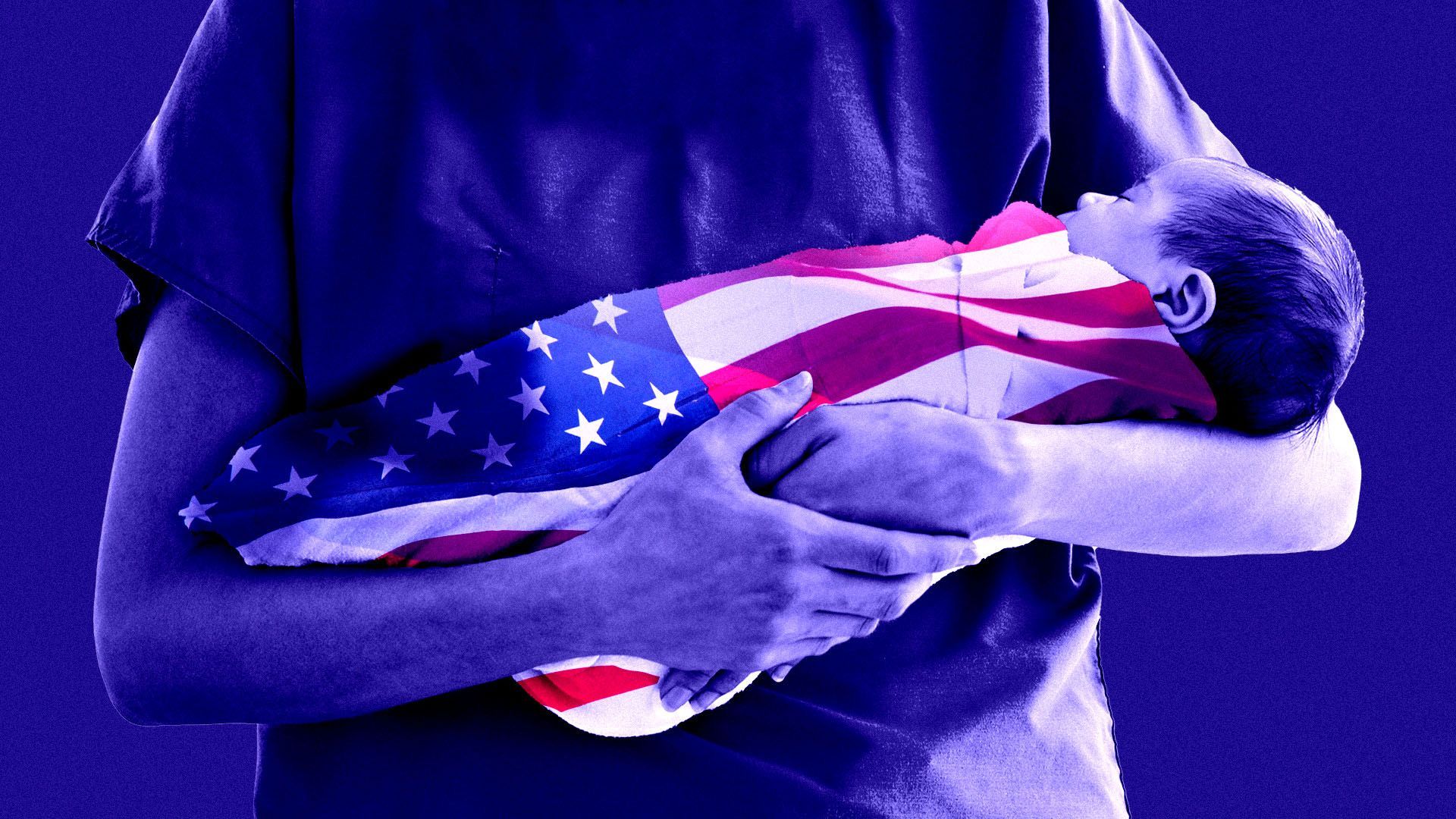
The Supreme Court will decide if President Trump's executive order to end birthright citizenship can stand, the court said on Friday. Sarah Grillo
The Supreme Court is set to decide on President Trump's order to end birthright citizenship next year.
The big picture: Validating the president's executive order barring U.S.-born children of undocumented immigrants from U.S. citizenship would overrule a right guaranteed by the 14th Amendment and upheld by SCOTUS over a century ago.
- The belief that U.S.-born children of undocumented immigrants have no rights to citizenship was once a fringe idea, but Trump has brought the issue into the mainstream.
Catch up quick: Trump's executive order, which he signed on his first day in office, was quickly met with legal challenges, resulting in temporary blocks on the order nationwide.
- A federal court in New Hampshire issued a preliminary injunction indefinitely blocking the order in July, with U.S. District Judge Joseph Laplante ruling that it "likely 'contradicts the text of the Fourteenth Amendment and the century-old untouched precedent that interprets it.'"
- The Trump administration is asking that the Supreme Court overrule that injunction.
The other side: "No president can change the 14th Amendment's fundamental promise of citizenship," Cecillia Wang, the national legal director of the ACLU, said in a news release.
- "For over 150 years, it has been the law and our national tradition that everyone born on U.S. soil is a citizen from birth. The federal courts have unanimously held that President Trump's executive order is contrary to the Constitution, a Supreme Court decision from 1898, and a law enacted by Congress."
- "We look forward to putting this issue to rest once and for all in the Supreme Court this term."
Here's what to know about birthright citizenship and Trump's bid to end it:
What birthright citizenship is
Context: In the U.S., birthright citizenship is automatically granted to people born on U.S. soil, according to the 14th Amendment.
- That's regardless of their parents' citizenship status.
- The Amendment overturned the Supreme Court's 1857 Dred Scott v. Sanford decision, which had found that Black people — free or enslaved — could never become U. S. citizens, and "had no rights which the white man was bound to respect," according to Chief Justice Roger Taney.
- The Amendment, which was ratified in 1868, nullified the decision by granting citizenship to all those born in the U.S., regardless of race.
There are two types in the U.S: jus sanguinis, ancestry-based citizenship, and jus soli, birthplace-based citizenship.
- With jus sanguinis, children born outside of the U.S. to at least one parent who is an American citizen may be entitled to U.S. citizenship if they meet certain requirements.
- Jus soli guarantees citizenship to almost everyone born in the U.S. However, there are some narrow exceptions, such as children born to diplomats or foreign heads of state.
The 1898 Supreme Court case that validated birthright citizenship
Zoom in: The Supreme Court's 1898 decision in United States v. Wong Kim Ark ruled that the 14th Amendment guaranteed U.S. citizenship to any person born on U.S. soil.
- It was a watershed moment for immigrants and descendants of immigrants in the U.S., namely Asian Americans.
- The case concerned Wong Kim Ark, a man born in California to Chinese immigrants, who returned to the U.S. after visiting family in China and was refused re-entry.
- John Wise, the collector of customs in San Francisco who controlled immigration, wanted a test case that would deny U.S. citizenship to ethnic Chinese residents and challenged that individuals born to immigrants were not citizens.
Zoom out: The court's decision led to a dramatic demographic transformation of the U.S.
- It also gave protection to millions of Asian Americans and Latinos. Native Americans weren't granted citizenship through birth until 1924.
What the Trump administration is arguing
Birthright citizenship was added to the Constitution via the 14th Amendment following the Civil War, guaranteeing citizenship for newly freed enslaved people.
What they're saying: The Trump administration is arguing that birthright citizenship only applies to those people.
- "The Citizenship Clause of the Fourteenth Amendment was adopted to grant citizenship to newly freed slaves and their children—not to the children of temporary visitors or illegal aliens," the government argued in its petition for Writ of Certiorari before the court.
- The White House, Department of Homeland Security, Department of Agriculture, Department of State and Centers for Medicare & Medicaid Services did not immediately respond to Axios' request for comment.
How many people would be affected by Trump's order?
In 2018, there were 4.4 million U.S.-born children with at least one parent who is an "unauthorized immigrant," according to a Migration Policy Institute analysis.
- In 2022, Congress defined unauthorized immigrants as "noncitizens who generally have entered the United States without inspection, overstayed a period of lawful admission, or violated the terms of their admission."
The number of children born to immigrants
- In 2021, 21% of U.S. births were attributed to immigrant parents, the same share as in 2000, according to child advocacy group Annie E. Casey Foundation.
- The percentage has fluctuated slightly over the years, rising to 25% in 2006, but has since dropped back down to its previous level.
The likelihood of eliminating birthright citizenship
Michael LeRoy, an immigration law expert and professor of labor and employment relations at the University of Illinois at Urbana-Champaign, told Axios' Avery Lotz that a Supreme Court ruling in Trump's favor would have far-reaching legal repercussions.
- LeRoy said he couldn't predict how the Supreme Court would rule, but striking down a "clear provision in an amendment based on an executive order" could have implications for other parts of the Constitution.
- "The day might come when a president of a different political party issues an executive order to limit or repeal the Second Amendment," he said.
