School shooter hoaxes will only get worse, experts say

Add Axios as your preferred source to
see more of our stories on Google.
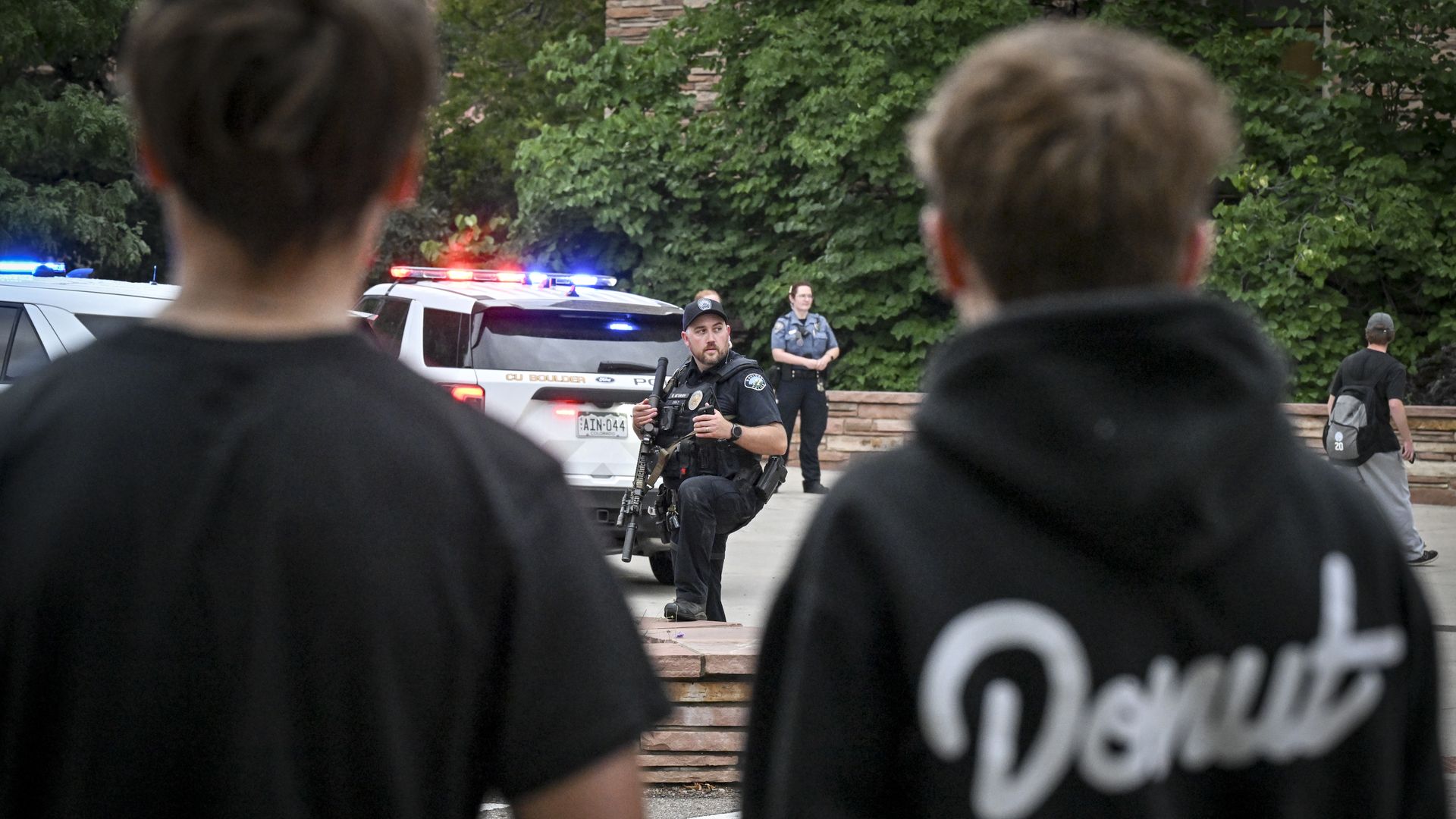
Police secure the University of Colorado Boulder amid a swatting threat. Photo: AAron Ontiveroz/The Denver Post
Bad actors have tricked roughly a dozen colleges and universities into issuing active shooter alerts as students return to campuses for a new school year.
Why it matters: Identifying the actors involved in swatting sprees has become increasingly difficult for law enforcement as the attacks frequently originate online, overseas or by using AI software — and it's only going to get worse, multiple public safety officials told Axios.
State of play: The FBI has seen swatting incidents increase nationwide, similar to the spate of false calls that caused terror in schools during the 2022-23 school year.
- "It's a little like bomb threats," said Mo Canady, executive director of the National Association of School Resource Officers.
- "Over the decades, they've had peaks and valleys, and this one may be coming out of the valley as we're starting back to school."
Here's what we know about all of the swatting calls this August:
How does swatting work?
Swatting is when someone calls first responders with fake emergency reports, often with the intention of eliciting a major law enforcement response.
- Identifying the fake callers can be hard due to new techniques that allow people to mask their identities, such as using AI-generated voices, caller ID spoofing and masking a user's IP address.
- "It's hard for any agency to justify that level of investment in enforcement if at the end of the road your target is going to be someone outside of your jurisdiction," Mark Reddish, a certified master firefighter and the former director of external affairs at the Center for AI Policy, told Axios.
An online group called Purgatory has claimed credit for the alerts issued at the University of Colorado Boulder, Villanova University and the University of Tennessee at Chattanooga campus in recent days, according to Wired Magazine. Axios was unable to independently verify the group's claims.
Why are these swatting incidents targeting schools?
Schools and universities are an easy target for bad actors looking to affect a large number of people as quickly as possible, Reddish said.
- "You can cause significantly more disruption to a community and produce a much more significant threat to life and safety if you go after a high population target, like a school, than an individual residence," Reddish said.
What is law enforcement doing to determine if calls are a hoax?
The FBI works closely with local law enforcement and emergency responders to compile real-time data in a centralized location to help track possible swatting trends.
- Officers are aware that in the event of an active shooter, 911 dispatchers typically receive multiple calls alerting them to the situation. However, swatting incidents are sometimes reported by a single phone call.
- The National Association of School Resource Officers encourages schools to place SROs on campus to help speed up the investigation process by quickly determining if a threat is legitimate.
If there's not an active shooter, isn't it a harmless prank?
Officers have to respond to every call as if it's a real threat until proved otherwise, Canady told Axios.
- A spokesperson for the FBI told Axios that "knowingly providing false information to emergency service agencies about a possible threat to life drains law enforcement resources, costs thousands of dollars, and, most importantly, puts innocent people at risk."
Research shows that students involved in swatting incidents also face significant trauma amid the police presence and required safety protocols. Those overwhelming fears include that they or others could be harmed or may die, and the school will no longer feel like a safe space.
The bottom line: Law enforcement takes swatting seriously, and schools aren't alone in facing false calls.
- Republican and Democratic lawmakers, federal judges and Secret Service agents have also been the targets of swatting attacks in recent years.
Go deeper: New peril of political life: "Swatting"
