Trump signs executive order targeting American flag burning


Add Axios as your preferred source to
see more of our stories on Google.
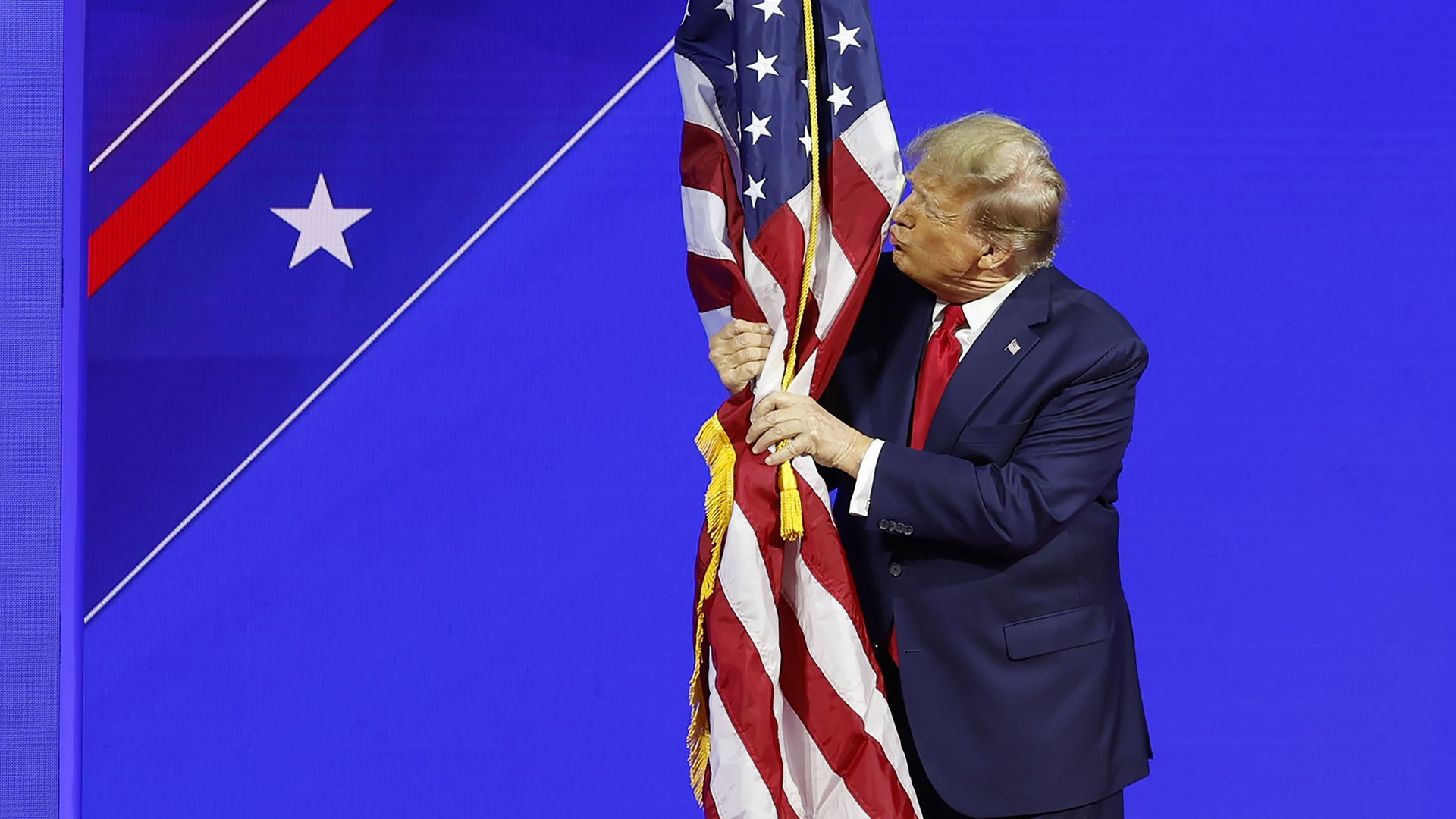
Donald Trump hugs an American flag as he arrives at CPAC on Feb. 24, 2024, in National Harbor, Md. Photo: Anna Moneymaker/Getty Images
President Trump signed an executive order Monday targeting the burning of the American flag, an act of political protest the Supreme Court has ruled is protected under the First Amendment.
The big picture: The order does not outright criminalize burning the American flag but directs Attorney General Pam Bondi to prioritize enforcement against cases of "flag desecration" where existing laws were violated.
- Those could include violent crimes, crimes against property, illegal discrimination and other violations, per the order.
Driving the news: "If you burn a flag, you get one year in jail, no early exits, no nothing," Trump said while signing the executive order.
- The executive order said that the administration will "act to restore respect and sanctity to the American Flag and prosecute those who incite violence or otherwise violate our laws while desecrating this symbol of our country."
- If the Justice Department "or another executive department or agency" concludes that a case where a flag was set ablaze violates state or local law, "such as open burning restrictions," the federal body is directed to refer the matter to state or local authorities.
- "[T]he Attorney General shall vigorously prosecute those who violate our laws in ways that involve desecrating the American Flag, and may pursue litigation to clarify the scope of the First Amendment exceptions in this area," the order reads.
Context: In a landmark 1989 ruling, the high court decided that flag burning constitutes protected symbolic speech.
- An official told NewsNation, which first reported on the order before it was signed, that if someone was injured as a result of the flag burning, for example, then charges could be brought under the order.
Of note: Video posted to X showed a man who appeared to be an Army veteran near the White House burning the U.S. flag in what he said was a protest at Trump's signing of the order hours earlier. Law enforcement officers arrested him after extinguishing the fire.
- A U.S. Park Police spokesperson confirmed in an email that the agency's officers had "arrested one person in Lafayette Park" about 6:30pm Monday for a violation of law concerning lighting fires despite being prohibited to do so.
- "Igniting fires is prohibited within Lafayette Park," added the spokesperson who said the suspect could not be identified until charges were formally finalized.
The other side: Bob Corn-Revere, the chief counsel at the Foundation for Individual Rights and Expression (FIRE), said in a statement that "President Trump may believe he has the power to revise the First Amendment with the stroke of a pen, but he doesn't."
- "You don't have to like flag burning," Corn-Revere's statement read. "You can condemn it, debate it, or hoist your own flag even higher. The beauty of free speech is that you get to express your opinions, even if others don't like what you have to say."
Flashback: Trump has long said that anyone who desecrates the flag should receive a one-year jail sentence.
- "Now, people will say, 'Oh, it's unconstitutional.' Those are stupid people," he said in a 2024 interview on Fox News.
- Those comments followed a protest in Washington, D.C., opposing Israeli Prime Minister Benjamin Netanyahu's speech to U.S. lawmakers where an American flag was burned and several people were arrested.
- Trump revived that call for a year-long sentence during a June speech at Fort Bragg. Soon after, Sen. Josh Hawley (R-Mo.) introduced legislation to enhance penalties for those who burn the flag while committing a federal offense.
Yes, but: "If there is a bedrock principle underlying the First Amendment," Justice William Brennan wrote for the majority in the court's 1989 opinion, "it is that the government may not prohibit the expression of an idea simply because society finds the idea itself offensive or disagreeable."
- Shortly after, in 1990, the court struck down a congressional act that criminalized destroying an American flag.
- The late conservative Justice Antonin Scalia, who Trump honored as "one of the best of all time," told CNN in 2012 that if "I were king, I would not allow people to go around burning the American flag."
- "However, we have a First Amendment, which says that the right of free speech shall not be abridged — and it is addressed in particular to speech critical of the government," he added.
Go deeper: Trump admin cracks down on pro-Palestinian protests at colleges
Editor's note: The story has been updated with additional reporting.
