Vance says redistricting push is a way to make representation "a little bit more fair"

Add Axios as your preferred source to
see more of our stories on Google.
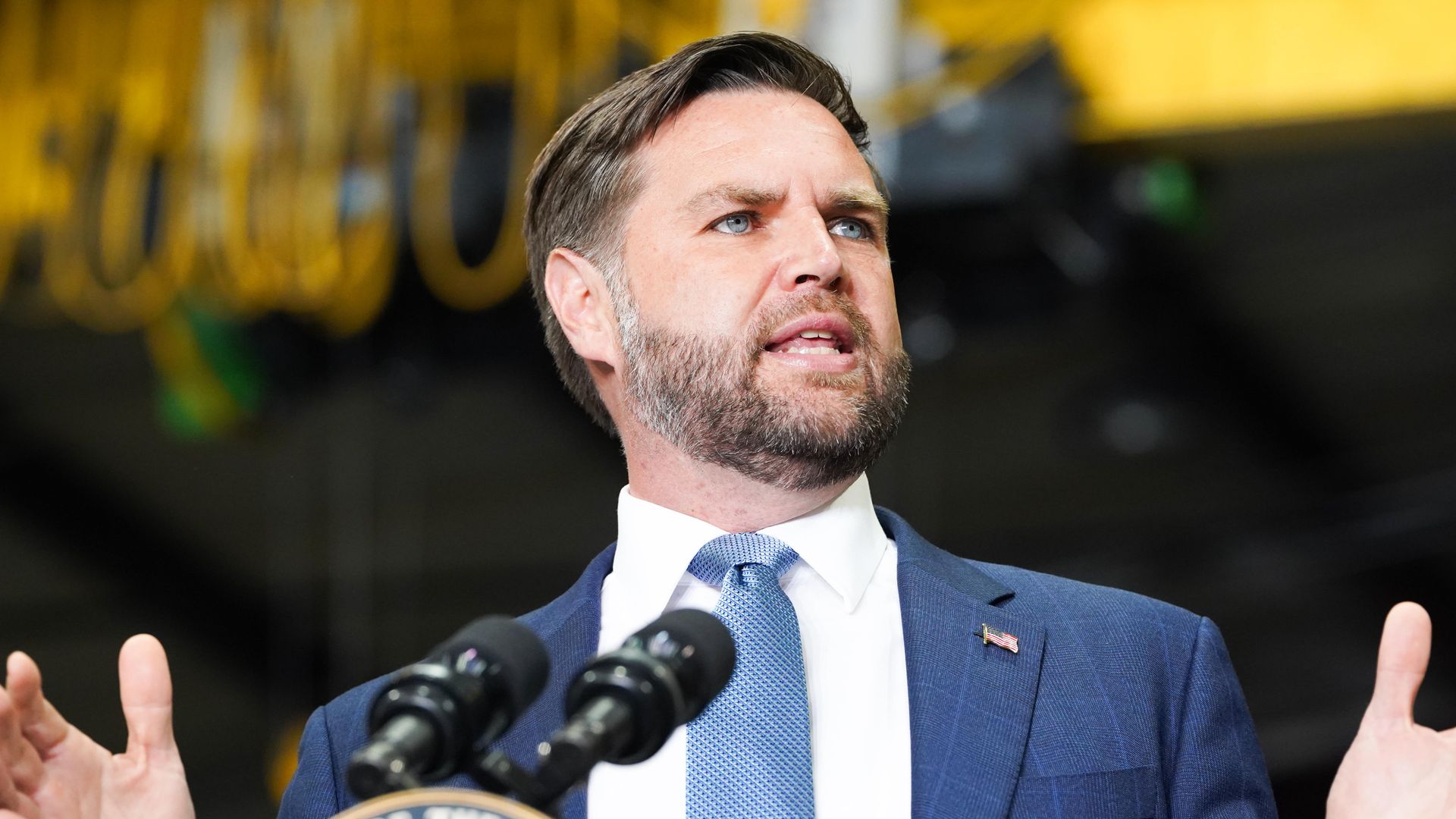
Vice President JD Vance speaks to supporters at an event on August 21 in Peachtree City, Georgia. Photo: Megan Varner/Getty Images
Vice President JD Vance framed President Trump's push for red states to redistrict ahead of the 2026 midterms as an attempt "to make the situation a little bit more fair" in an interview airing Sunday on NBC News' "Meet the Press."
The big picture: The line-redrawing blitz is forging ahead in Texas and California as other states consider drafting new lines — and as Democrats vow to fight fire with fire.
- California Gov. Gavin Newsom (D) signed redistricting bills sent to him by the Democratic-controlled state legislature into law Thursday and declared a Nov. 4 special election for Californians to consider the freshly drawn congressional districts.
Driving the news: Vance has claimed the White House's overt push to pick up additional congressional seats is a response to past gerrymandering by Democrats.
- "We think there are opportunities to push back against that," he told NBC's Kristen Welker. "And that's really all we're doing."
What he's saying: Asked why mid-decade redistricting is necessary if Trump's agenda is popular with voters, as the White House claims, Vance replied, "you have to ask yourself, 'Why have Democrats gerrymandered their states aggressively over the past ten to 20 years?'"
- He bemoaned that Massachusetts has no Republican federal representatives. The current map in the state was signed in 2021 by a Republican, former Gov. Charlie Baker.
- Trump, who has also recently lamented Massachusetts' lack of GOP representation, won 36% of the vote in the state, of which all nine congressional districts are represented by Democrats.
- As The New York Times notes in an analysis of Massachusetts maps, the driving factor is the distribution of partisans across the state, as congressional districts represent the voters of the state's different geographic areas, rather than all voters.
By the numbers: Trump didn't come away with a majority in any of Massachusetts' 14 counties.
- And as highlighted by The Boston Globe, five of Massachusetts' House members ran unopposed in 2024.
The other side: "At the end of the day, we were 24 seats down during Donald Trump's first midterm election in 2018. We won 40 seats in 2018," House Minority Leader Hakeem Jeffries (D-N.Y.) said on CNN's "State of the Union" Sunday.
- He continued, "There's no way that Republicans can mathematically gerrymander their way to an artificial victory next year."
- Both sides have gerrymandered districts, and some analysts have argued that redistricting has essentially become a wash in recent election cycles. But a Brennan Center for Justice analysis published ahead of the 2024 election noted that the effects of gerrymandering leaned in the GOP's favor.
What's next: Texas Gov. Greg Abbott said Saturday he looks forward to signing the "One Big Beautiful Map," which cleared the state's legislature last week after Democratic delays.
Worth noting: Trump's ultimate vision is an audacious one: He said he hopes to see a 100-seat Republican majority.
Go deeper: Redistricting wars spark mad dash of unlikely 2026 candidates
