Supreme Court temporarily pauses rollbacks to Voting Rights Act


Add Axios as your preferred source to
see more of our stories on Google.
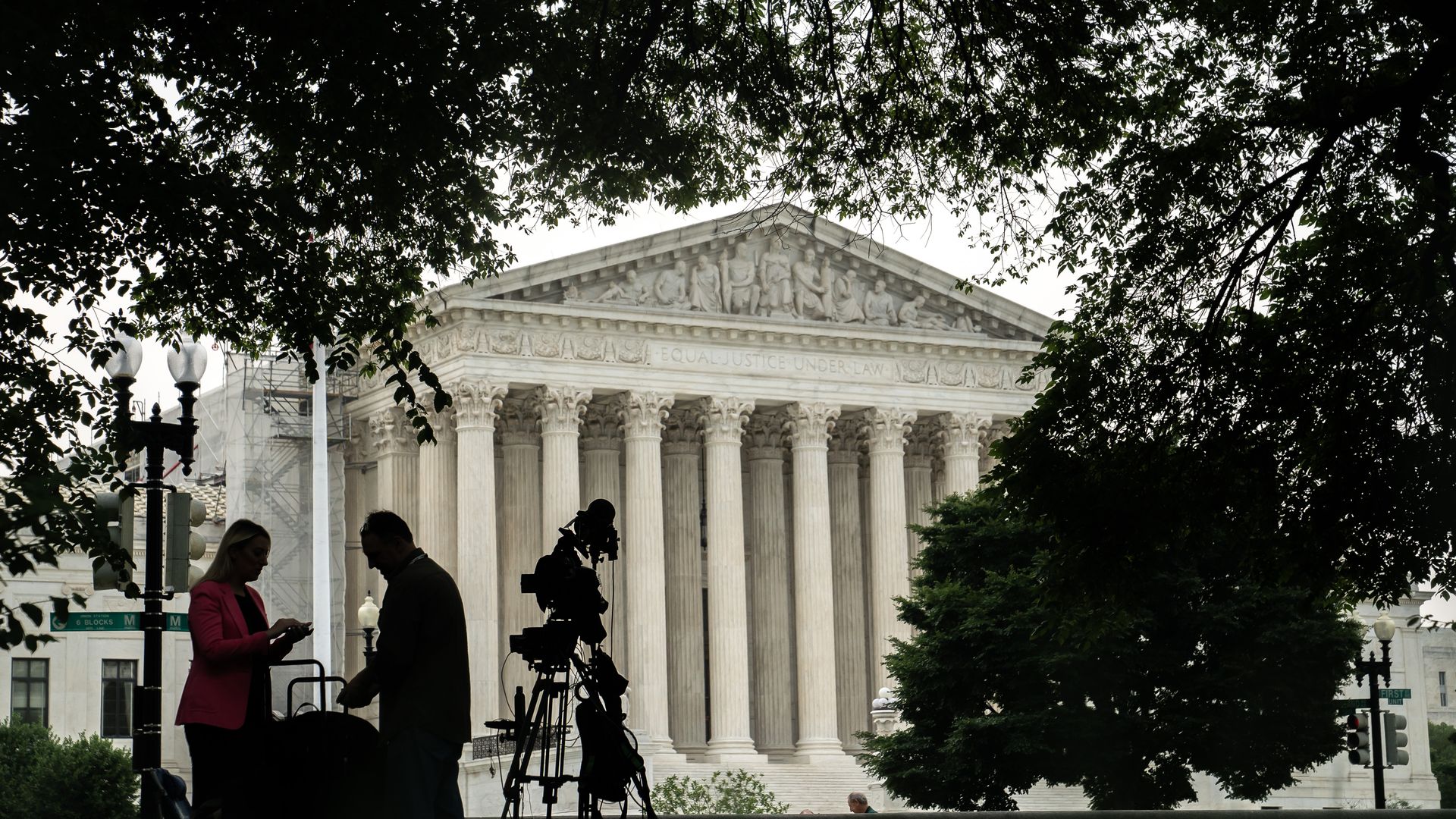
The Supreme Court this month rejected a Republican-drawn congressional map in Alabama and upheld a decision that requires a second majority Black district. Photo: Nathan Howard/Bloomberg via Getty Images.
The Supreme Court paused a lower court's ruling that would have weakened the Voting Rights Act on Thursday, granting Native American groups that brought the suit a temporary win.
Why it matters: If the Supreme Court ultimately sides with the lower court, the legal battle could further diminish the landmark voting rights law when the Trump administration is already moving away from bringing civil rights cases in court.
- Had the lower court's decision been permitted to take effect, it would have prevented private groups in seven states from challenging race discrimination in election maps perceived to be violating the 1965 law.
The intrigue: None of the justices provided reasoning for their votes, but the order did note that Justices Clarence Thomas, Samuel Alito and Neil Gorsuch would have denied the tribal nations' application.
Catch up quick: The Turtle Mountain Band of Chippewa Indians, Spirit Lake Tribe and three Native American voters filed a lawsuit against North Dakota's Secretary of State in 2022, claiming that the state's redistricting plan unfairly diluted Indigenous voting power.
- The groups brought a lawsuit under Section 2 of the Voting Rights Act to allow voters to sue if they think the government has diluted or denied their voting rights on the basis of race or color, according to SCOTUSblog.
- A district court sided in favor of the Indigenous groups and ruled that the redistricting maps violated this section of the act.
- The U.S. Court of Appeals for the Eighth Circuit reviewed the case after the district court, and ruled 2-1 that only the government can bring challenges under Section 2 of the Voting Rights Act.
What we're watching: The two tribal nations are preparing to ask the Supreme Court to complete a full review of their case so that North Dakota can finalize which redistricting plan the state should use for elections in 2026.
The intrigue: The ruling comes just weeks before the 60th anniversary of the Voting Rights Act of 1965 signed by President Johnson following the bloody beatings of civil rights marchers in Selma, Alabama.
- Since the signing of that law, the number of Black Americans elected in the U.S. has shot up from just a few in 1964 to about 9,000.
- A majority of Black Americans are aligned with the Democratic Party, but Black Republicans have won high-profile races in Kentucky, New Mexico and California.
- The bill also helped elect Native Americans, but Indigenous leaders say Native communities continue to face voter suppression, racial discrimination and systemic barriers to the ballot box.
Context: A number of states with GOP-controlled legislatures have passed bills in recent years that critics argue impose new restrictions on Indigenous voters.
- Arizona and Montana have passed new laws barring ballot collection important to Native American voters living in isolated regions, since they lack reliable mail service.
- Arizona also passed legislation limiting where in-person ballots can be cast, despite confusion among many rural Navajo Nation residents whose precincts are a two-hour drive from their homes.
Some GOP proposals seek to impose new address requirements despite many Native Americans lacking addresses.
- Only about 18% of Native American voters in Arizona, outside of the state's two largest counties, have traditional addresses, Patty Ferguson-Bohnee, director of the Indian Legal Clinic at Arizona State, told Axios.
