The latest blow to civil rights in the workplace

Add Axios as your preferred source to
see more of our stories on Google.
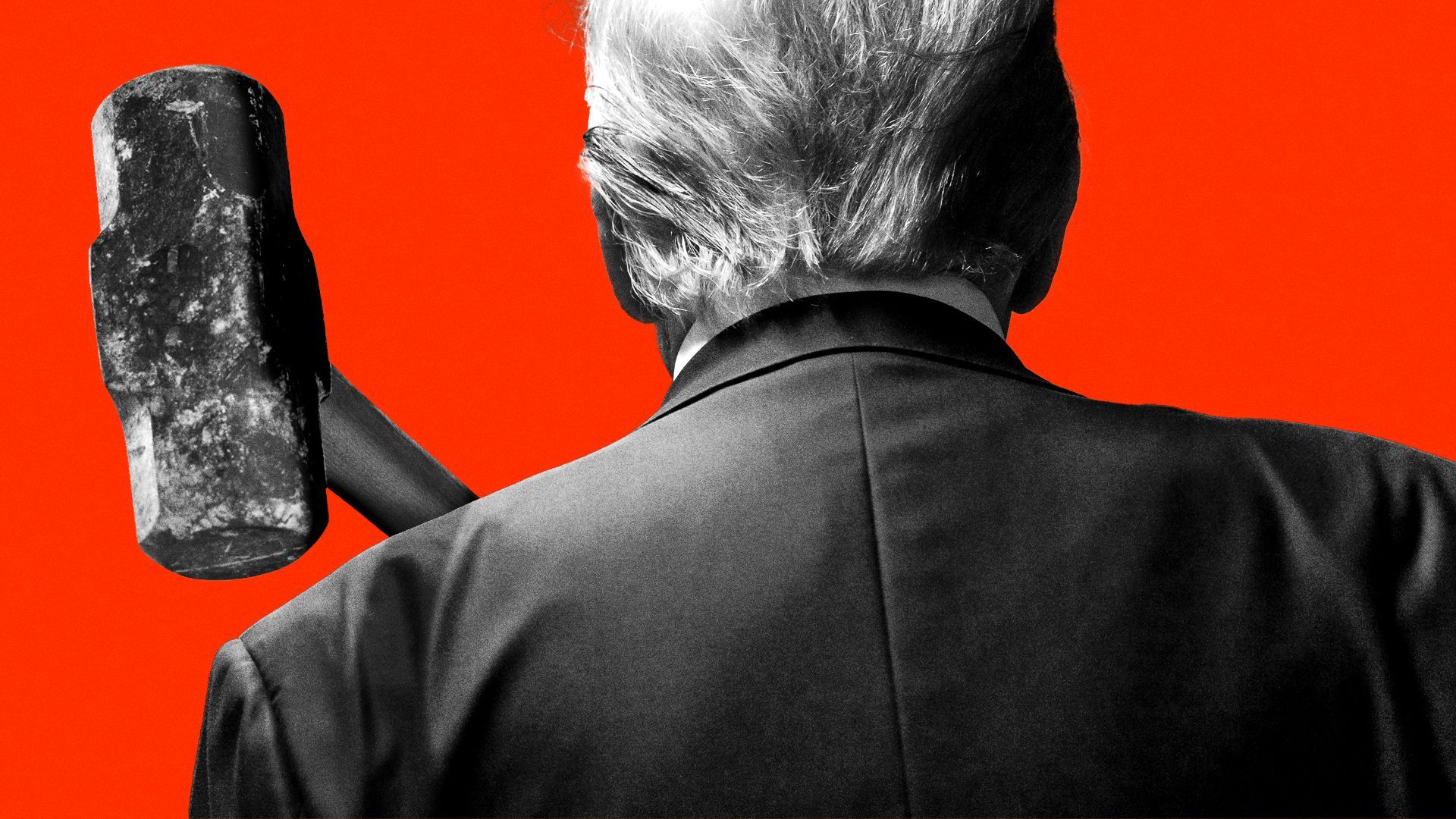
Illustration: Maura Losch/Axios. Photo: Justin Lane/Getty Images.
The Trump administration just gutted a decades-old bedrock of anti-discrimination law in a little-noticed executive order last week, but the fallout could take years to untangle.
Why it matters: The order, called "restoring equality of opportunity and meritocracy," is the latest in a series of blows to longstanding civil rights protections from the White House.
- Civil rights lawyers argue the order will make it more difficult to root out discrimination in the job market, education, the lending world, and even AI.
- It will also make it easier for employers to implement unfair hiring, promotion and pay practices, even unintentionally.
How it works: The directive covers something called "disparate impact."
- It's a way to show that discrimination is happening — in hiring, lending or other areas — due to a practice that seems neutral on its face but winds up leading to unfair outcomes.
- For example, a fire department that's hiring implements a certain height requirement or shoe size — unrelated to the job's responsibilities — that screens out a large percentage of women.
"The reason why disparate impact exists is because for too long, people assumed if you looked a certain way and came from a certain background, you were qualified," says Jenny Yang, the chair of the Equal Employment Opportunity Commission during the Obama administration.
Zoom out: Disparate impact has shaped how companies think about discrimination for decades, says Joelle Emerson, the CEO of culture and inclusion platform Paradigm and a former civil rights lawyer.
- "It's led to practices where employers focus on proven skills, not arbitrary traits or tests that aren't predictive of an employee's performance."
- Disparate impact was first recognized by the Supreme Court in 1971 in a case called Griggs regarding a power company that used an intelligence test and required a high school diploma, neither relevant to the skills needed for the job, to filter out Black workers.
Contrary to what conservatives argue, it's very difficult to prove disparate impact, says Yang, who is now a partner at law firm Outten & Golden.
- Workers must isolate a specific policy or practice and offer strong statistical proof that it leads to unfair outcomes.
- Companies that appear to have generated unfair outcomes can, and do, win these cases. "The key defense to a disparate impact lawsuit is we have a legitimate, merit-based reason for this policy. If you can show that, you win," says Emerson, the diversity consultant.
The other side: "Disparate-impact liability all but requires individuals and businesses to consider race and engage in racial balancing to avoid potentially crippling legal liability," per the order.
- Marc Mandelman, a partner at Epstein Becker Green who typically represents management, says the order "won't necessarily change employer practices," although his firm is considering using it to get current cases, where disparate impact is at issue, tossed out of court.
The intrigue: Disparate impact is particularly important in the tech world, as AI reshapes the ways companies make decisions.
- A growing body of research finds algorithms have discriminated in mortgage lending, health care, and even the criminal justice system where people have been wrongly arrested after facial recognition technology misidentified them.
Those examples predate today's most powerful generative AI systems, as Chiraag Bains, who worked on AI and equity in the Biden administration, explained in a paper last year for the Brookings Institution.
- "They are trained on far more data, have more sophisticated algorithms, and use much more computing power." That puts them even more at risk of "baking in" patterns of discrimination.
- Some tech companies are aware of these problems and testing for it, saying White House action wouldn't change anything.
- "We've built state-of-the-art fairness testing over the years and don't expect to change anything in that regard," says Dave Girouard, the founder and CEO of Upstart, an AI-powered lending company.
For the record: "President Trump's executive order restores the basic truth that every American should be treated equally, without regard to race, sex, or other characteristics," White House spokesman Harrison Fields wrote in an email.
The bottom line: Without disparate impact as a tool, it could be harder to smoke out discrimination across critical areas of Americans' lives.
