Trump administration says U.S. does not seek regime change in Iran

Add Axios as your preferred source to
see more of our stories on Google.
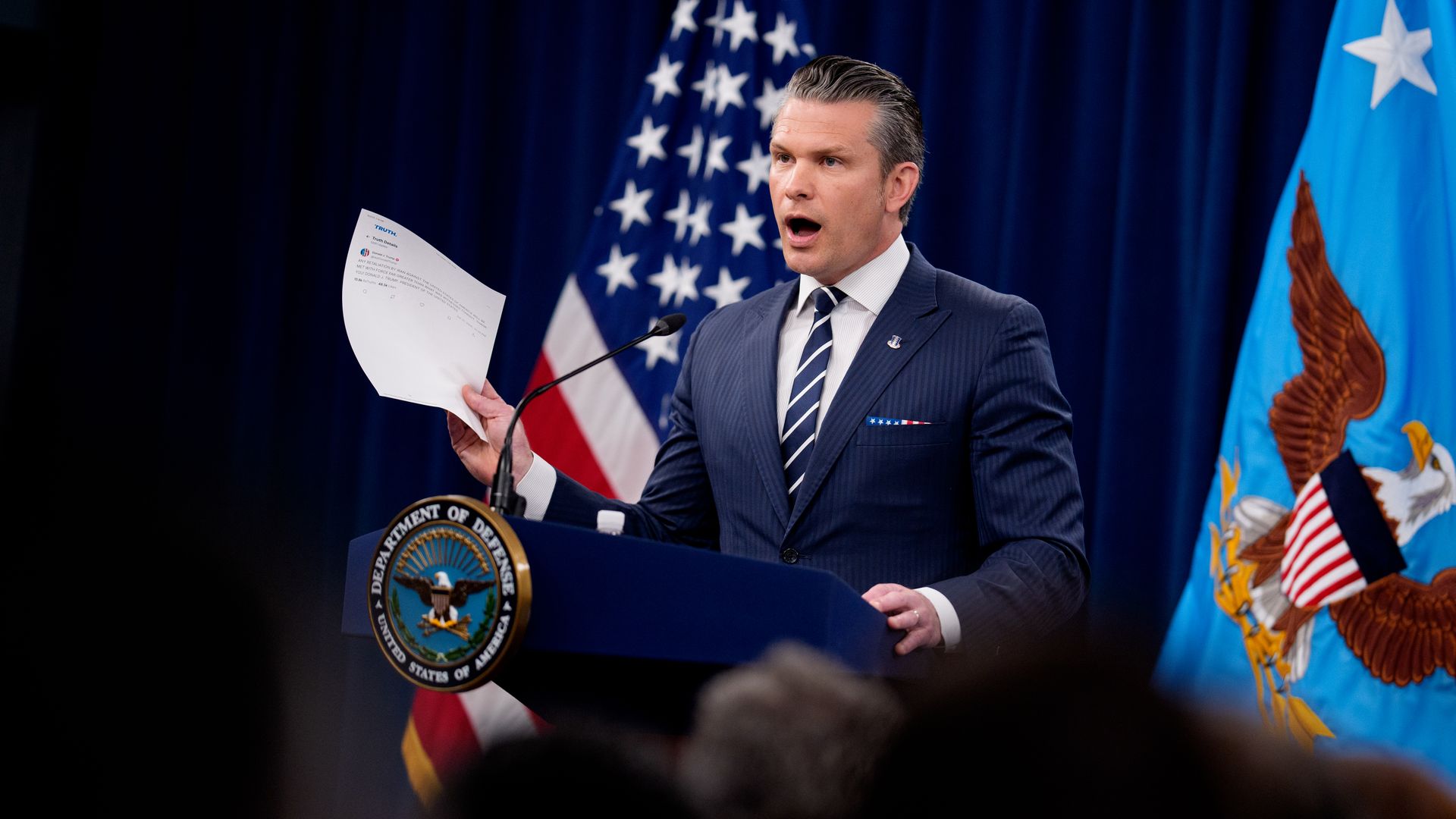
Photo: Andrew Harnik/Getty Images
Defense Secretary Pete Hegseth told reporters the U.S. war against Iran is "not open-ended" and is "not about regime change," stressing that Saturday's U.S. military strikes were strictly targeted at Iran's nuclear program.
- Vice President Vance flatly denied that the U.S. is at war with Iran, telling NBC's "Meet the Press" instead: "We're at war with Iran's nuclear program."
Why it matters: President Trump and his top aides, including Hegseth and Joint Chiefs of Staff Chairman Gen. Dan Caine, have hailed the U.S. bombing of three Iranian nuclear sites as a "spectacular success."
- But the unprecedented U.S. strikes on Iran have plunged both countries — as well as Israel, the Middle East and the wider world — into a state of deep uncertainty and danger.
- "Anything can happen in conflict, and we acknowledge that. But the scope of this was intentionally limited," Hegseth said when asked if the U.S. was prepared for a "protracted" war.
The "capabilities" of the American military, however, are "unlimited," Hegseth added — warning that Iran now has a "choice" on whether to pursue peace or escalation.
- Trump, Vance and Hegseth have called for Iran to come to the negotiating table and voluntarily renounce its nuclear program in order to bring an end to the fighting.
- Trump has also urged Iran not to retaliate, threatening "far greater" U.S. strikes if American assets or troops in the region are targeted.
Zoom in: Hegseth and Caine detailed the extraordinary "Operation Midnight Hammer" in a press briefing at the Pentagon on Sunday morning.
- The "complex and high-risk mission" was carried out primarily by seven B-2 stealth bombers, each with two crew members, who flew 18 hours east from the U.S. and "linked up with escort and support aircraft," Caine said.
- Several B-2 bombers, which were detected by flight radar and reported by the media on Saturday, flew west from Missouri over the Pacific as part of a "deception effort."
At approximately 6:40pm ET, or 2:10am Iran time, the lead B-2 bomber dropped two "massive ordnance penetrators" — 30,000-pound bunker-buster bombs — on Iran's underground Fordow nuclear facility.
- The remaining bombers hit their targets with a total of 14 bunker-busters, with all three Iranian nuclear sites struck between 6:40pm ET and 7:05pm ET.
- Tomahawk missiles from a U.S. submarine also struck the Isfahan nuclear site.
- Caine said the U.S. is "unaware" of any shots fired at the strike team. Iran's fighters "did not fly, and it appears that Iran's surface-to-air missile systems did not see us," the general added.
Between the lines: "This was largest B-2 operational strike in U.S. history, and the second-longest B-2 mission ever flown — exceeded only by those in the days following 9/11," Caine told reporters.
State of play: All three targets sustained "severe damage," but the assessment to determine whether Iran still has some nuclear capability is ongoing, the officials said.
- Trump had claimed last night that Iran's key uranium enrichment sites "have been completely and totally obliterated."
- Hegseth said that the U.S. believes it "achieved destruction of capabilities" at Fordow — a facility built into a mountain and deep underground — but Caine cautioned that it's too early to tell the extent of the damage.
Iran's Islamic Revolutionary Guard Corps has threatened to respond with strikes against U.S. forces in the Middle East.
- Caine said that the U.S. is being "proactive, not reactive," when it comes to protecting and repositioning its assets in the region.
- "Ultimately, wherever it may be — whether it's in Iraq or Syria or bases in the Gulf .... it would be a very bad idea for Iran or its proxies to attempt to attack American forces," Hegseth warned.
This story is breaking news. Please check back for updates.
