Judge denies Mahmoud Khalil's release after Trump admin submits new filing

Add Axios as your preferred source to
see more of our stories on Google.
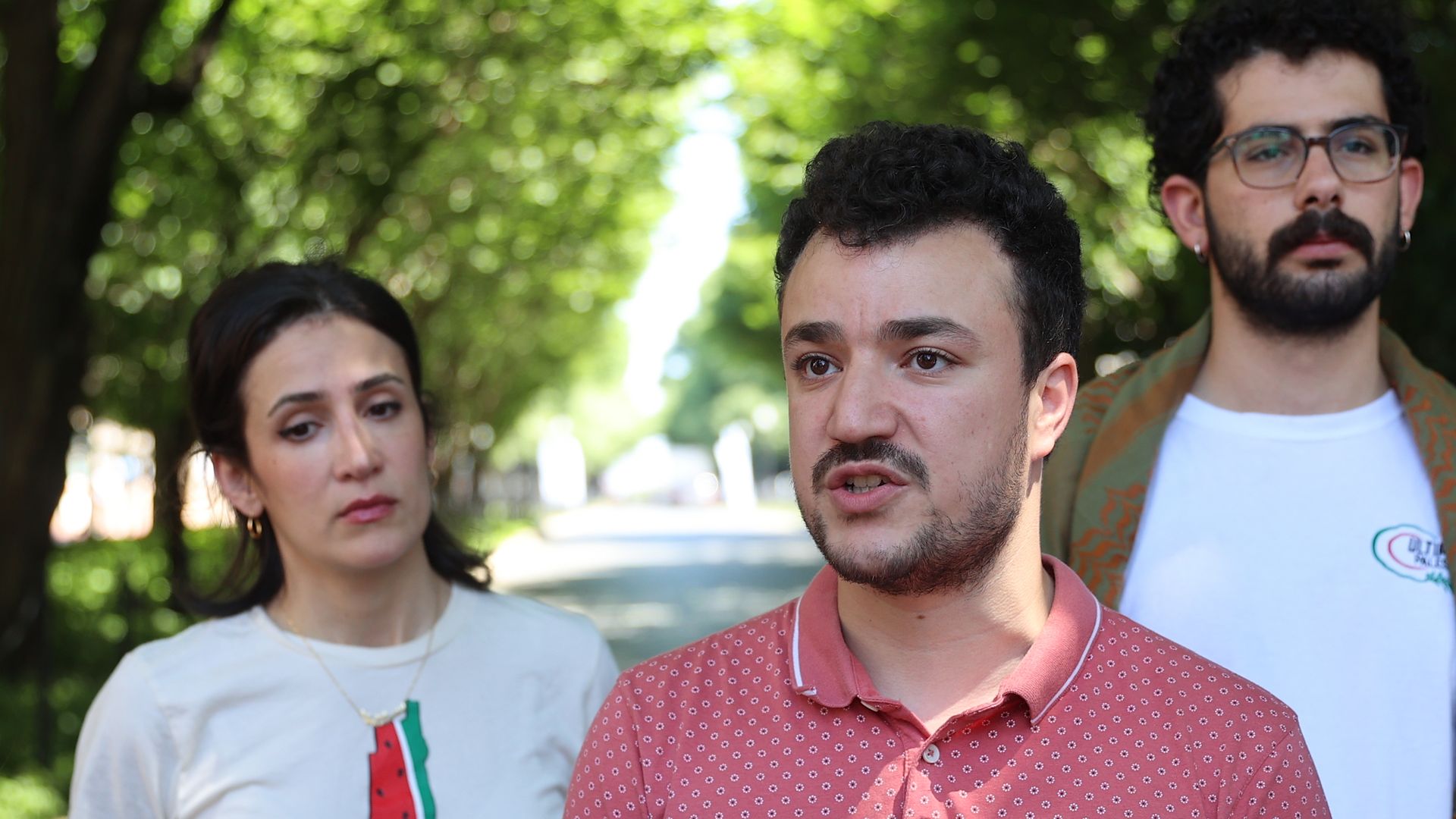
The detention of Mahmoud Khalil, a U.S. green card holder from Syria, triggered nationwide protests. Photo by Selcuk Acar/Anadolu via Getty Images
A federal judge has declined to release Columbia University alumnus Mahmoud Khalil from federal detention after the Trump administration submitted a last-minute filing.
Why it matters: The administration's tug-of-war with courts over Khalil represents a historic test for immigrants' speech rights – namely, those of permanent residents – particularly where they concern pro-Palestinian speech.
Driving the news: The federal government on Friday said that continuing to detain Khalil does not violate the court's Wednesday injunction, because Khalil's detainment is now based on "other grounds," such as being undocumented when he entered the U.S.
- The administration also argued that "an alien like Khalil may be detained during the pendency of removal proceedings regardless of the charge of removability."
- "Khalil may seek release through the appropriate administrative processes, first before an officer of the Department of Homeland Security, and secondly through a custody redetermination hearing before an immigration judge."
Reality check: Judge Michael Farbiarz explicitly refuted this argument in his initial injunction.
- "The evidence is that lawful permanent residents are virtually never detained pending removal for the story of alleged omissions in a lawful-permanent-resident application that the Petitioner is charged with here," Farbiarz wrote.
- "That strongly suggests that it is the Secretary of State's determination that drives the Petitioner's ongoing detention --- not the other charge against him."
State of play: Despite Judge Farbiarz's refutal, he ruled that Khalil's preliminary injunction did not ask the court to block him from being detained on other grounds.
- The judge also suggested Khalil to seek for release through "a bail application to the immigration judge."
- "The deadline has come and gone and Mahmoud Khalil must be released immediately," Khalil's lawyers said in a statement to Axios after the initial deadline elapsed.
- The Department of Homeland Security did not respond to Axios' immediate request for comment.
Catch up quick: The detention of Khalil, a leader in Columbia's pro-Palestinian protests and a U.S. green card holder from Syria, triggered nationwide protests.
- Caving to President Trump's targeting of the school's federal funding, Columbia suspended and expelled other students and alumni involved in pro-Palestinian protests.
- Other student protesters have been arrested, but Khalil's detainment has become a flashpoint across the country for immigrants' free speech rights and pro-Palestinian activism in the U.S.
Zoom in: The administration has argued it can remove noncitizens whose presence in the U.S. would "compromise a compelling U.S. foreign policy interest," referencing a determination by Secretary of State Marco Rubio.
- Rubio, in a memo, cited as evidence what he described as Khalil's roles in "anti-Semitic protests and disruptive activities."
- An immigration court judge had earlier found the administration's argument — that Khalil's posed threats to U.S. foreign policy — was "facially reasonable."
Aaron Terr, director of public advocacy at the Foundation for Individual Rights and Expression, said in a statement that Wednesday's court ruling confirms "Khalil was targeted not for his actions, but for his opinions."
- The "idea that a college student's peaceful participation in pro-Palestinian protests could seriously compromise U.S. foreign policy was always far-fetched," said Terr, whose foundation is not part of Khalil's legal team but has filed an amicus brief in support of his case.
The other side: White House spokesperson Abigail Jackson said in a Wednesday statement that Khalil obtained his student visa "by fraud and misrepresentation."
- The law "authorizes the Secretary of State to revoke green cards of individuals who pose a threat to American foreign-policy interests," she added in the email that claimed he had harassed Jewish students and pointed to his role in the campus protests.
- "The district court order, entered without jurisdiction, will not be the final word."
DHS assistant secretary Tricia McLaughlin said Wednesday that the ruling "delays justice" and undermines the president's powers.
- "We expect a higher court to vindicate us in this. We have the Constitution, the facts, and common sense on our side," McLaughlin said.
Editor's note: This story has been updated with additional statements.
