Trump issues travel ban for 12 countries

Add Axios as your preferred source to
see more of our stories on Google.
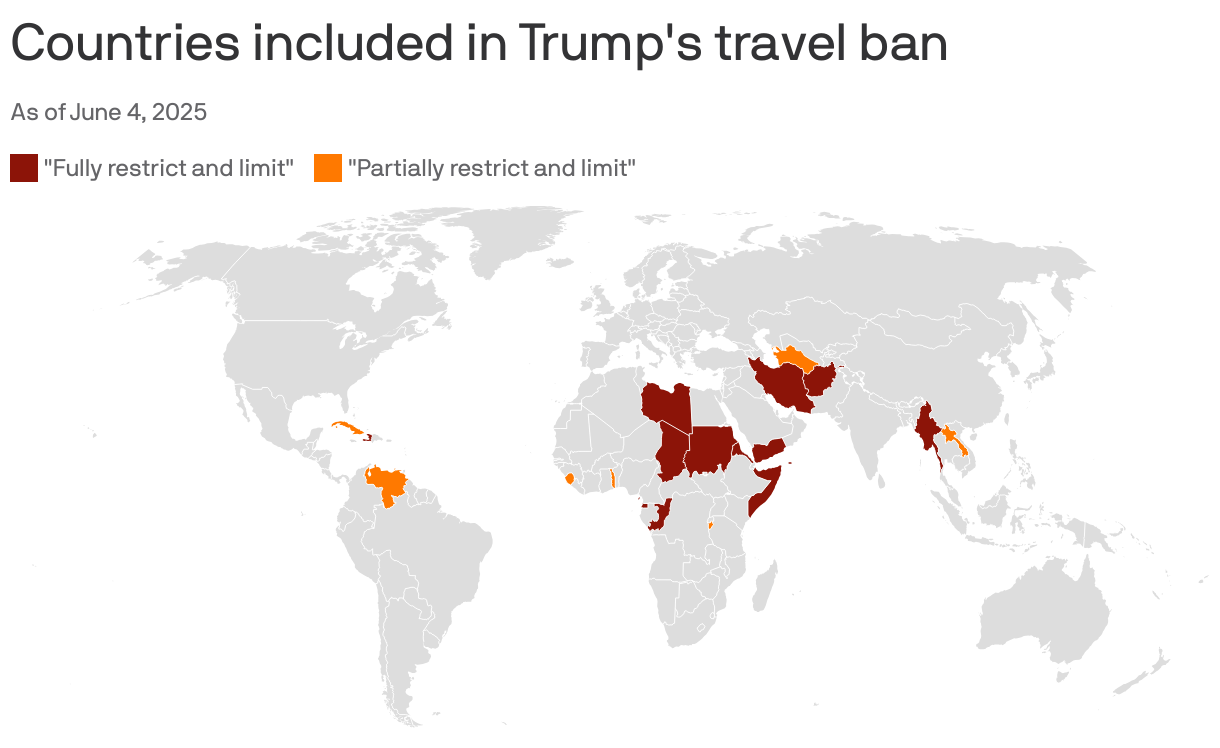
President Trump issued a proclamation Wednesday restricting the entry of people from a dozen countries into the U.S., citing national security concerns.
The big picture: Trump's order states that he has decided to "fully restrict and limit" entry from Afghanistan, Myanmar, Chad, Republic of the Congo, Equatorial Guinea, Eritrea, Haiti, Iran, Libya, Somalia, Sudan and Yemen.
- He is also partially restricted and limited entry of nationals from seven countries: Burundi, Cuba, Laos, Sierra Leone, Togo, Turkmenistan, and Venezuela.
- "These restrictions distinguish between, but apply to both, the entry of immigrants and nonimmigrants," the order states.
Driving the news: The order that was made moments before he directed an investigation into President Biden, goes into effect Monday, per the proclamation.
- It includes exceptions for lawful permanent U.S. residents, existing visa holders, other special visas, adoptions, and for athletes traveling for the World Cup, Olympics or other major sporting events.
- Exceptions will be made "case-by-case for individuals for whom the Secretary of State finds, in his discretion, that the travel by the individual would serve a United States national interest," the order states.
What he's saying: "The recent terror attack in Boulder, Colorado, has underscored the extreme dangers posed to our country by the entry of foreign nationals who are not properly vetted," Trump said in a video posted on Truth Social Wednesday evening.
- "We don't want 'em," the president said, blaming his predecessor, Biden, for "his open door policies."
- Trump added, "We cannot have open migration from any country where we cannot safely and reliably vet and screen those who seek to enter the United States."
Context: The proclamation comes after Trump issued an executive order on Jan. 20 directing the State Department, Homeland Security and the Director of National Intelligence to draft a report on whether there's a national security risk posed by entry to the U.S. from certain countries.
Flashback: Trump issued a similar executive order during his first term, banning travel to the U.S. by citizens of predominantly Muslim countries, including Iraq, Iran, Libya, Somalia, Sudan, Syria and Yemen.
- The order, often referred to as a "Muslim ban," was highly controversial and was met with legal challenges. The administration was forced to revise the order and the Supreme Court ultimately upheld a version of it.
- Biden reversed the ban on his first day in office.
Editor's note: This article has been updated with new details throughout.
