U.S. will stop bombing Yemen after Houthis "capitulated," Trump says

Add Axios as your preferred source to
see more of our stories on Google.
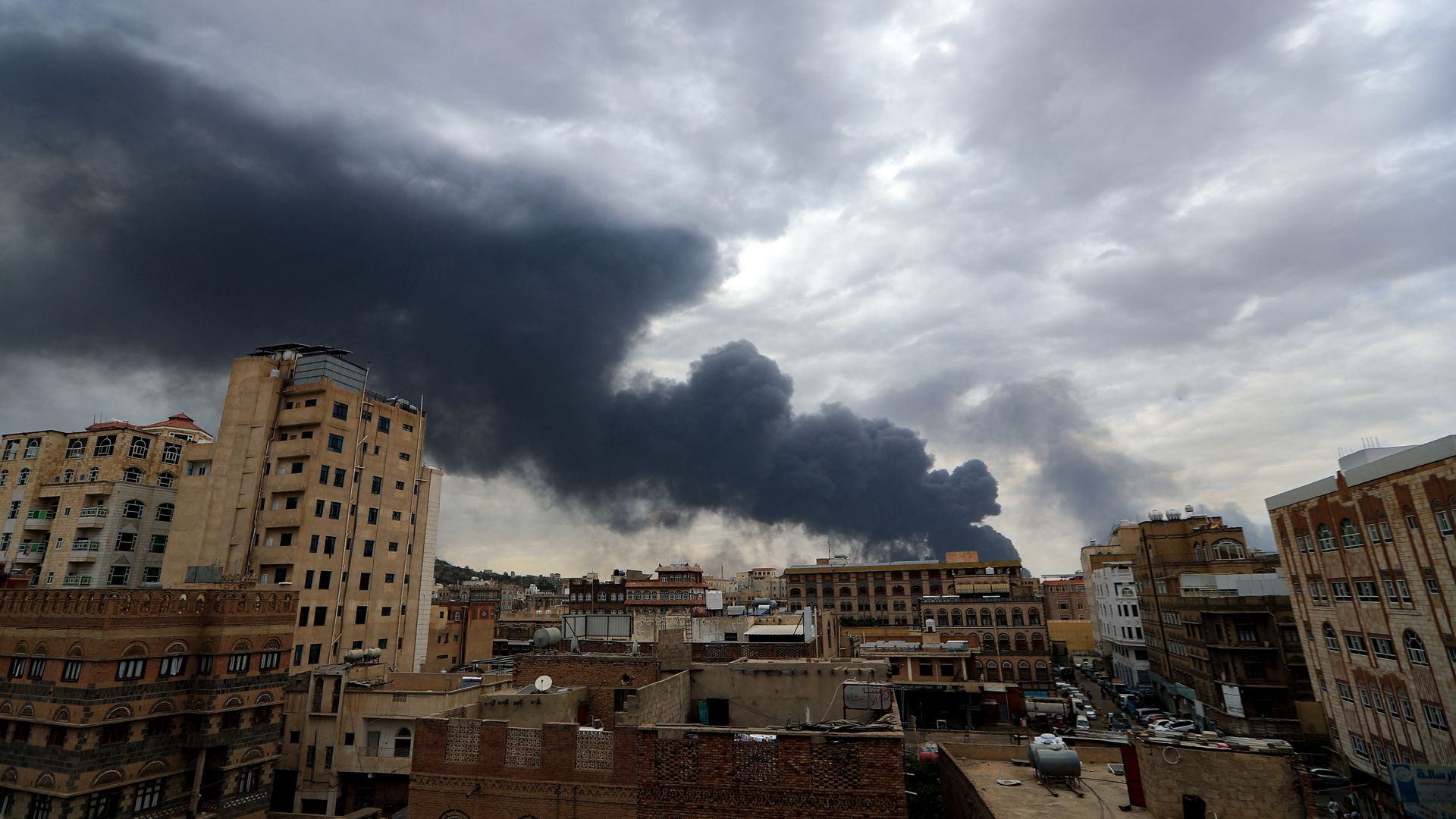
Smoke billows over Yemen's capital, Sa'ana following an airstrike. Photo: Mohammed Huwais/AFP via Getty
President Trump said Tuesday that Yemen's Houthi rebels had "capitulated" and told the U.S. they will stop attacking ships in the Red Sea. The Houthis refuted that characterization.
Why it matters: The Houthi attacks had snarled global shipping, and Trump ordered nearly two months of relentless strikes on Yemen targeting the group. Trump said the U.S. would "accept their word" and stop its attacks in Yemen as a result.
What he's saying: Trump said the Houthis had informed the U.S. "they don't want to fight anymore" and "we will honor that."
- "We will stop the bombings. They have capitulated... we will take their word that they will not be blowing up ships anymore, and that's the purpose of what we were doing," Trump said.
- Secretary of State Marco Rubio added that "this was always a freedom of navigation issue. You had a band of individuals with advanced weaponry that were threatening global shipping, and the job was to get that to stop, and if it's going to stop, then we can stop."
The other side: Mohammed Ali Al-Houthi, a senior member of the rebel group, said Trump's announcement about suspending U.S. strikes in Yemen "will be evaluated on the ground first.'
- He said Trump's statement is a victory for the Houthis who managed "to separate" the U.S. and Israel.
- Deifullah al-Shami, a member of the Houthis political bureau told Al-Mayadeen television Trump's statement shows "he wants to save face because of the failure of U.S. aggression against Yemen."
- Al-Shami said Trump "is lying" in order to get out of the situation he found himself in. "Whatever he says — we will not allow any ship, any Israeli ship, to arrive to its port until the aggression against Gaza is stopped and the siege is lifted."
Behind the scenes: A source familiar with the issue said a truce with the Houthis had been negotiated in recent days by White House envoy Steve Witkoff through Omani mediators.
- An Omani Foreign Ministry spokesperson said those "efforts have resulted in a ceasefire agreement between the two sides."
- "In the future, neither side will target the other, including U.S. vessels, in the Red Sea and Bab al-Mandab Strait, ensuring freedom of navigation and the smooth flow of international commercial shipping," the Omani statement said.
- The Omanis are also mediating between the U.S. and Iran in the nuclear talks.
Between the lines: Many international vessels now take a far longer route around the southern coast of Africa in order to avoid the maritime chokepoints targeted by the Houthis.
- It's unclear if Trump's claim will give them confidence to transit the Red Sea, particularly given the Houthi response.
Split screen: The announcement comes as the Houthis have been increasing their ballistic missile attacks in Israel over the past two weeks.
- A senior Israeli official told Axios the U.S. didn't notify Israel in advance of Trump's announcement of a truce with the Houthis.
- "We didn't know about this. Trump surprised up," the official said.
- Asked what he would do if the Houthis continued to attack Israel, Trump said he would "discuss" it.
Driving the news: On Sunday, a Houthi missile hit the Tel Aviv international airport after both U.S. and Israeli missile defense systems failed to intercept it. U.S. airlines suspended flights to Tel Aviv for several days as a result.
- Israel struck the port of Hodeidah on Monday and the international airport in Sa'ana on Tuesday. Israeli officials said the airport isn't functioning as a result of the strike.
- Israeli officials said both strikes were conducted in coordination with U.S. Central Command.
Zoom out: The U.S. conducted more than 1,000 strikes in Yemen during the campaign. The Houthis also shot down several U.S. drones during the operation.
This is a developing story and has been updated throughout.
