U.S. press freedom falls to historical low

Add Axios as your preferred source to
see more of our stories on Google.
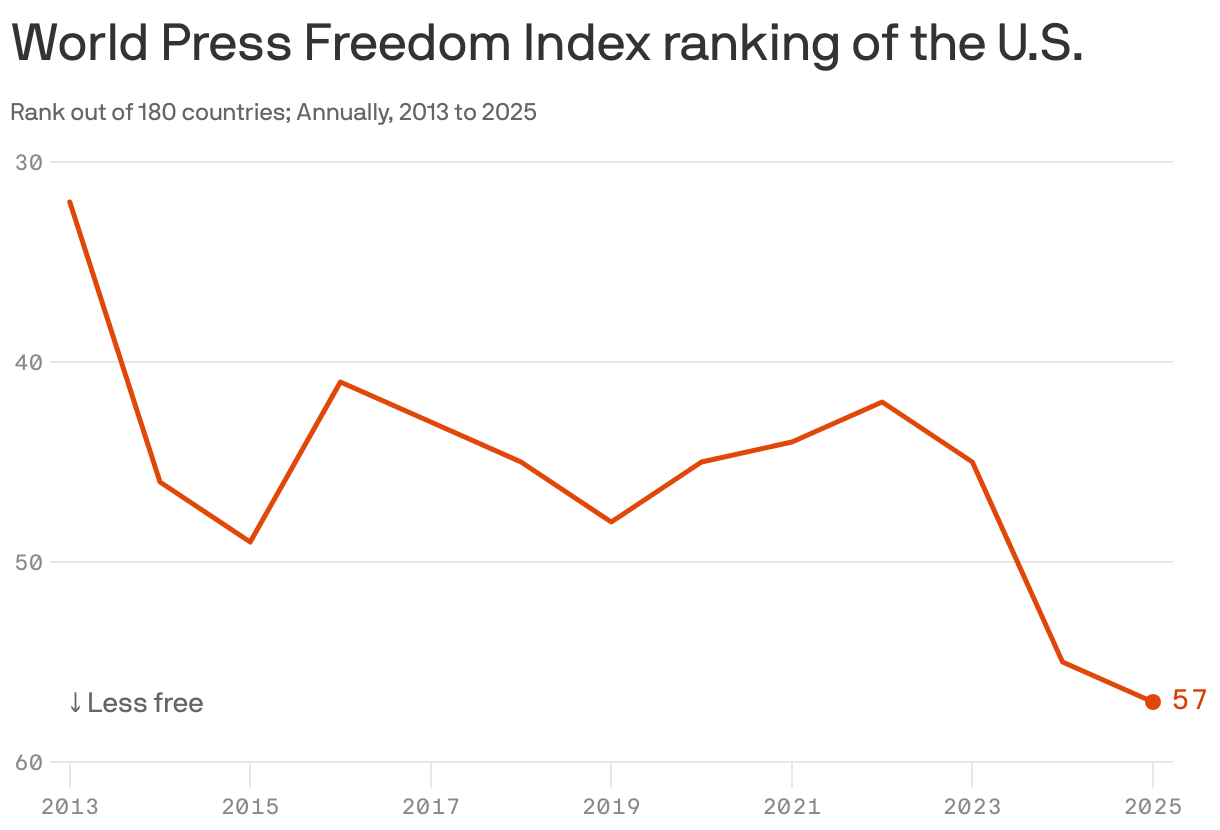
Press freedom in the United States has hit a record low, according to the latest World Press Freedom Index published annually by Reporters Without Borders.
Why it matters: For years, American press freedom was generally considered "satisfactory" by Reporters Without Borders' standards. As of last year, it's now "problematic."
- Press freedom in the U.S. now falls in line with developing countries, such as Gambia, Uruguay and Sierra Leone.
The big picture: While physical threats against journalists are often a clear sign of eroding press freedoms, Reporters Without Borders cites economic strains on the media as the biggest driver of declines globally.
- This is especially in autocratic nations, such as Nicaragua, Belarus and Iran, as well as unstable democracies such as Turkey and Hungary.
Between the lines: Economic strain is increasingly tied to government efforts to financially undermine critical or independent outlets.
- Reporters Without Borders cites the Trump administration's efforts to cut funding to public broadcasters, such as Voice of America and Radio Free Europe/Radio Liberty, as an example of this trend.
- It also cites non-government factors as threats to funding journalism, such as the dominance of major internet platforms over the advertising economy.
- Such constraints have led to record consolidation globally amongst media outlets, which has led to more media ownership being highly concentrated or controlled by the state.
Startling stat: Reporters Without Borders has been surveying press freedom globally for over a decade across five indicators — political, legal, economic, sociocultural and safety.
- The economic indicator worldwide has reached a new low point, with 160 of the 180 nations surveyed experiencing "difficult" or "no" financial stability.
- In the U.S. economic hardship is most prevalent amongst local news outlets, leading to an unprecedented number of news deserts for such a powerful country.
Zoom out: The report, published Friday ahead of World Press Freedom Day on May 3, also underscores how much global instability impacts quality journalism.
- It cites conflict in areas like Gaza and Haiti as examples where political instability "has plunged the media economy into chaos."
- The gutting of the United States Agency for International Development, it says, has thrown "hundreds of news outlets into a critical state of economic instability and some to shut down — particularly in Ukraine."
The big picture: More than half of the world's population now lives in countries where press freedom is entirely absent and practicing journalism is considered dangerous, according the the index.
- Countries like China, Uganda and Ethiopia are now classified as "very serious" in terms of press freedom threats, as opposed to difficult.
