Senate adopts budget plan for passing Trump's agenda

Add Axios as your preferred source to
see more of our stories on Google.
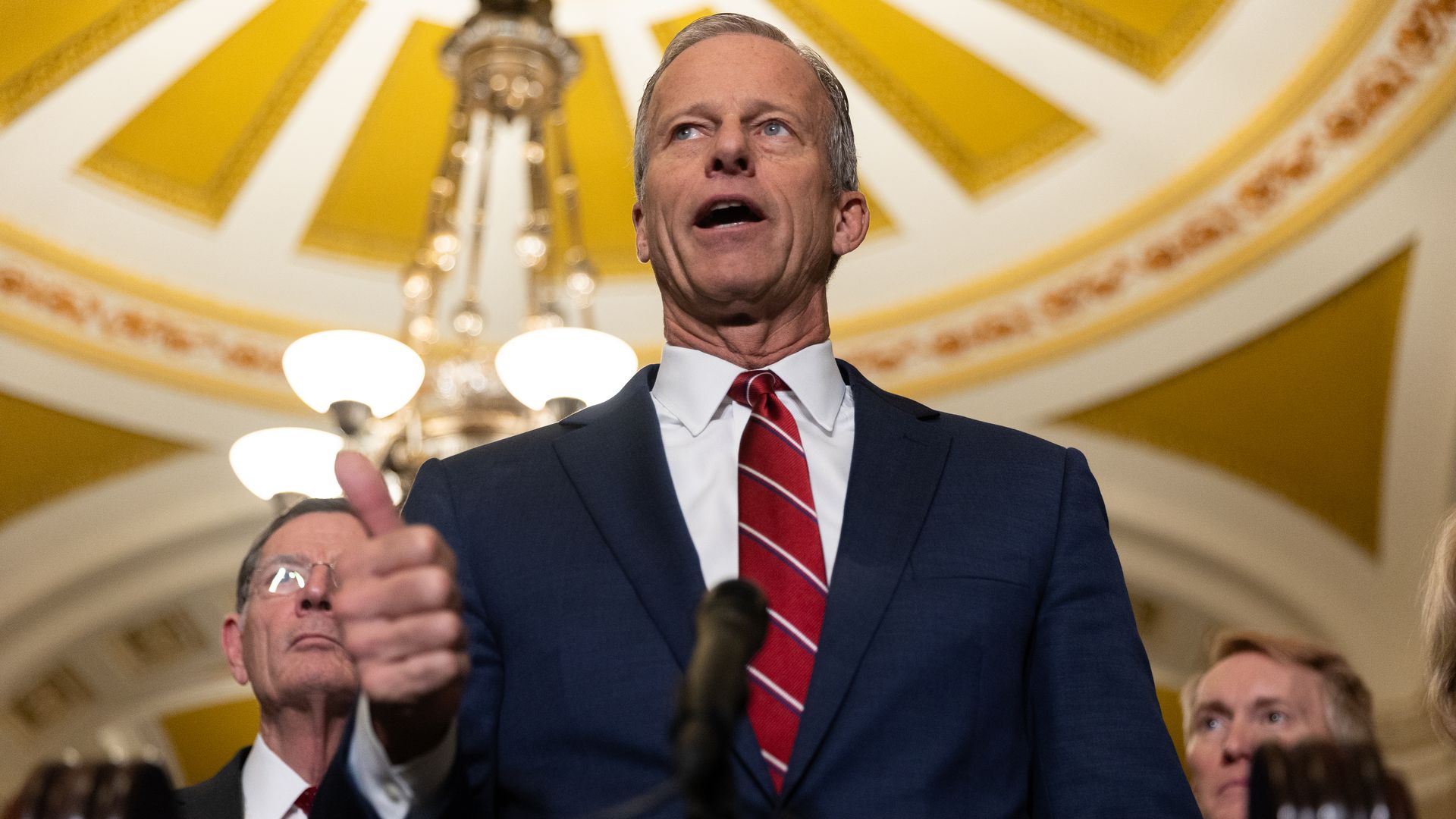
Senate Majority Leader John Thune: Tierney L. Cross/Bloomberg via Getty Images
The Senate approved a budget resolution early Saturday morning following a grueling overnight session with forced votes on more than 20 amendments.
Why it matters: It's an important step for Congressional Republicans seeking to pass President Trump's ambitious agenda on taxes, energy and the border. But the hard part is still to come.
- The resolution passed by a vote of 51-48. Sens. Rand Paul (R-Ky.) and Susan Collins (R-Me.) voted against it, along with Democrats.
- Now it’s in the hands of House Speaker Mike Johnson (R-La.).
Between the lines: The reconciliation process allows the Senate to skirt the filibuster to pass budget-related measures.
- It also allows Senate Democrats to make the process miserable through unlimited amendment votes.
- The so-called vote-a-rama began Friday evening and lasted until after 2am on Saturday morning, with Democrats forcing Republicans to take tough votes on everything from tariffs to Medicaid cuts.
Democrats nearly succeeded in winning adoption of an amendment to strike House directions for the Energy and Commerce Committee to cut $880 billion, reductions that would most likely impact Medicaid.
- The amendment failed 49-50, having won the support of three Republicans: Collins, Josh Hawley of Missouri and Lisa Murkowski of Alaska.
Zoom in: The budget resolution would raise the debt ceiling by up to $5 trillion.
- It would make Trump's 2017 tax cuts permanent. It does so by relying on a current policy baseline, an accounting maneuver that zeroes out the otherwise $4 trillion cost.
- Some Republicans have been wary of the move, concerned that it could ultimately get rejected by the Senate parliamentarian, who serves as the chamber's rule-keeper.
- The resolution includes an extra $1.5 trillion for other tax priorities, such as Trump's promised "no tax on tips." It provides $175 billion for the border and $150 for defense.
What to watch: One major fight to come will be over how to pay for the new spending, with conservatives — and DOGE — pushing for serious cuts.
- The resolution instructs Senate committees to find a minimum of $4 billion in savings. The House's version set the minimum at $1.5 trillion.
- Some Republicans will be pushing for even more than $1.5 trillion in cuts.
- At the same time, there is bipartisan concern that such levels of spending reductions will require significant cuts to Medicaid.
Editor's note; This story has been updated with additional reporting.
