The ghosts of trade wars past

Add Axios as your preferred source to
see more of our stories on Google.
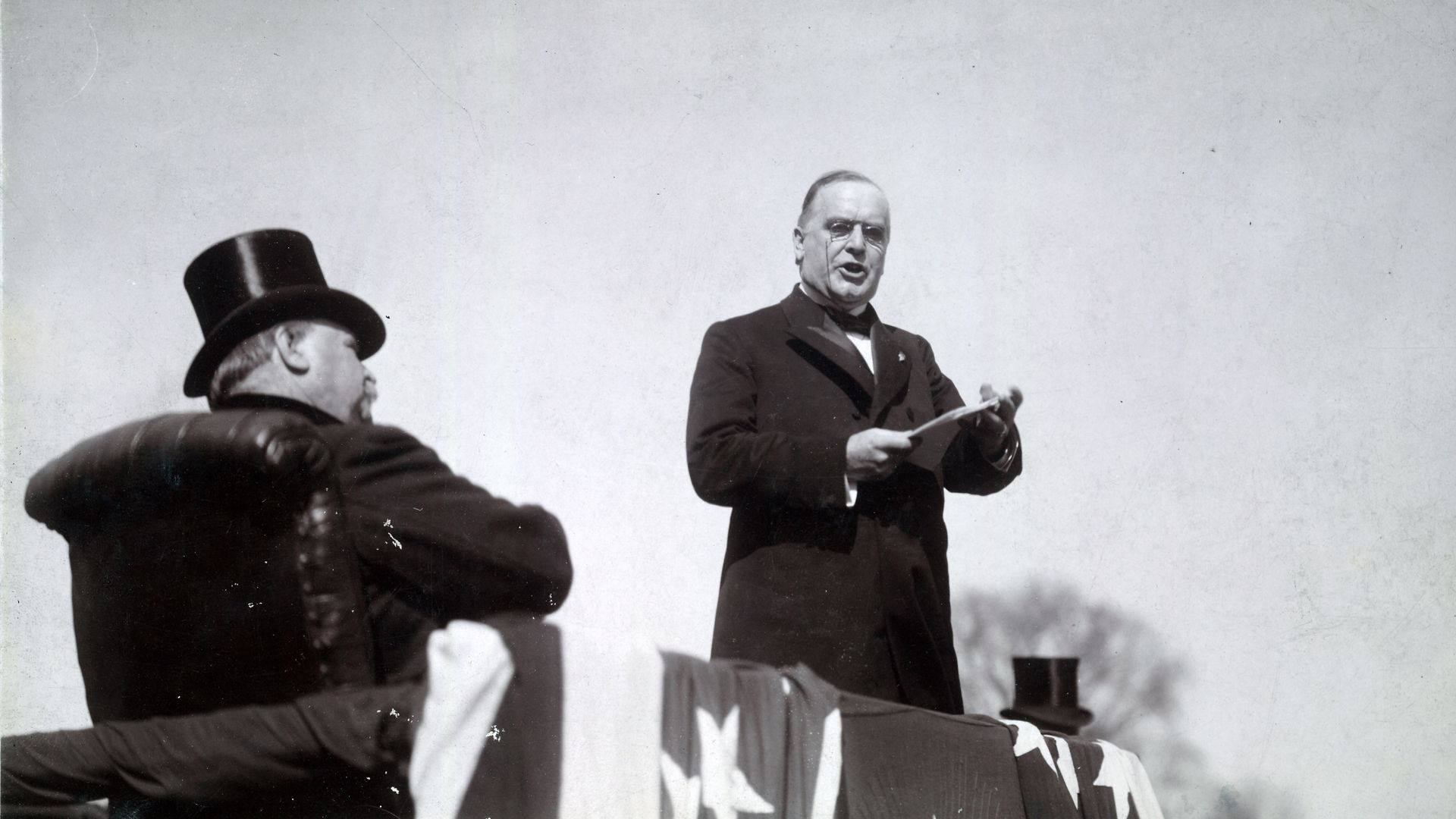
President McKinley in 1897. Photo: Universal History Archive/UIG via Getty images
History, they say, may not repeat but it rhymes. America's periods of high tariffs dating back to the 1800s carry eerie similarities to today's trade war escalation.
Why it matters: The history of post-tariff higher prices and weaker economic conditions offers some perspective for what might happen in the months and years ahead.
- Tariffs have historically resulted in retaliation, pain for agricultural interests, higher consumer costs, political backlash and currency chaos, according to a new briefing by a trade group that represents companies responsible for nearly all of U.S. footwear sales.
What they're saying: "Regardless of the era, the consequences of high tariffs and retaliations remain largely the same," Andy Polk, senior vice president of the Footwear Distributors and Retailers of America, tells Axios.
- "You could swap the names of the main actors and their quotes, justifications, and politics would remain basically the same."
- "Almost like a blind taste test, if you lay out the quotes, it would be hard to guess which person said what and when," adds Polk, who says he's a descendant of President Polk — who lowered tariffs in the mid-1800s.
Flashback: The 1890 McKinley Tariff imposed levies of roughly 50% on almost all imports, a policy aimed at protecting domestic industry from foreign industry.
- Several nations, including Canada, retaliated with tariffs on agricultural goods. The briefing cites a go-to expert on trade history, Douglas Irwin, whose book notes that Canada created stronger trade ties with Britain.
- Many economists had expected Canada would be so economically damaged that it would join the United States — a parallel to President Trump's "51st state" rhetoric.
The Smoot-Hawley Tariff, which raised the average tariff to almost 60%, resulted in higher sugar prices for the American public, to the tune of hundreds of millions of dollars, while tariffs on imported eggs soared, the briefing notes.
- The Trump 1.0 trade war in 2018 resulted in higher prices from a slew of consumer goods, including washing machines, clothing and furniture.
The intrigue: Rather than shy away from the history, Trump has openly admired former President McKinley for his trade policy. The 1890s were indeed a time of rapid industrialization.
- "President McKinley made our country very rich through tariffs and through talent," Trump, who recently restored McKinley's name to the nation's highest mountain peak, said last year.
- McKinley ultimately regretted imposing such high tariffs.
"We had no real income tax so tariffs were the main source of revenue, but it was a rather small federal government at the time," UC Davis economics professor Christopher Meissner, who wrote a recent paper on tariffs and manufacturing in the Gilded Age, tells Axios.
- But now "it's not necessarily the most efficient way of raising revenue to meet a modern economy's objectives," Meissner adds, noting that tariffs "would never" cover America's revenue needs.
What to watch: The embrace of trade protectionism might be too strong to completely reverse — one difference from years past.
- Trump's tariffs from 2018 held over into the Biden administration, though it's unclear what happens in a post-Trump era: The White House has already imposed more tariffs than in the entirety of Trump's first term.
