Vance's new Greenland pitch: Independence then partnership


Add Axios as your preferred source to
see more of our stories on Google.
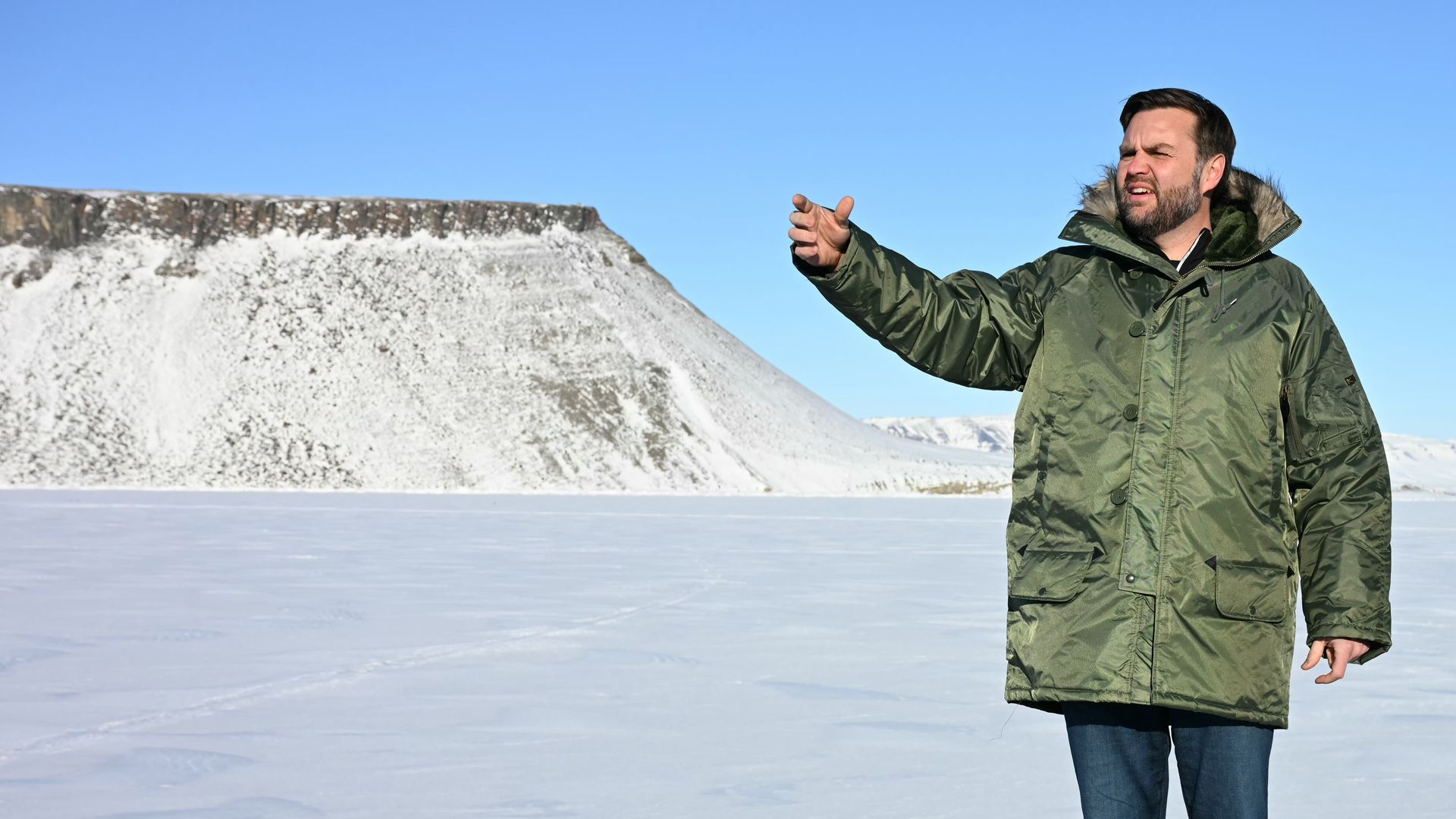
Vice President Vance in Pituffik, Greenland. Photo: Jim Watson/Pool via Getty
Vice President Vance claimed in a brief Greenland visit on Friday that Denmark had failed to keep Greenland safe, and that President Trump is prepared to make the Arctic island "much more secure" and stronger economically.
Why it matters: Trump reiterated his argument before Vance's trip that "we need Greenland," with the added warning that "we'll go as far as we have to go" to get it. But the future Vance seemed to propose was not of U.S. ownership but of an independent Greenland opting into a new security and economic partnership with the U.S.
- Greenlanders overwhelmingly reject the notion of joining the U.S.
What he's saying: "What we think is going to happen is that the Greenlanders are going to choose, through self-determination, to become independent of Denmark, and then we're going to have conversations with the people of Greenland from there," Vance said.
- Vance claimed the U.S. would "respect [the] sovereignty" of an independent Greenland — a message undercut by Trump's latest comments — and help with economic development.
- He said the U.S. would not use military force to take Greenland but could use its military to protect against incursions from Russia or China, America's rivals in the Arctic.
- "Our message to Denmark is very simple: You have not done a good job by the people of Greenland," Vance said. "You have underinvested in the people of Greenland, and you have underinvested in the security architecture of this incredible, beautiful landmass filled with incredible people."
The big picture: Greenland has the right to call a referendum on independence, and multiple polls show the pro-independence camp with a clear majority.
- Greenland's incoming prime minister, Jens-Frederik Nielsen, favors independence, though on a more gradual timetable.
- Many pro-independence Greenlanders are open to a partnership with the U.S., the NYT's Jeffrey Gettleman reported on a visit to the island, home to just 56,000 people.
- A pact in which the U.S. has a larger military presence in Greenland, invests in the island and helps develop its mineral resources could conceivably be mutually beneficial.
Friction point: By offering to buy the island, threatening to take it by force, and even through its handling of this week's visit, the Trump administration has not laid the groundwork for a trusting and cooperative relationship.
- When Nielsen announced a unity government on Friday, hours before Vance arrived, he seemed to be calling not for closer relations with the U.S. but for solidarity against U.S. pressure.
- "It is very important that we put aside our disagreements and differences," he said, "because only in this way will we be able to cope with the heavy pressure we are exposed to from outside."
Behind the scenes: Vance's visit was a scaled back version of the original itinerary.
- Second Lady Usha Vance originally announced a three-day trip, together with national security adviser Mike Waltz and Energy Secretary Chris Wright. The plan was for the U.S. delegation to attend the Avannaata Qimussersu, Greenland's national dogsled race, and meet Greenlanders.
- But that announcement caught the governments of Denmark and Greenland by surprise, sources with direct knowledge tell Axios.
- Greenlandic officials expressed dismay because the planned visit fell in the midst of coalition negotiations and was seen as intervention in domestic politics. The Danish government also voiced concern.
Instead, Vance went to Greenland with his wife but only for a brief stop at Pituffik Space Base, the northernmost U.S. military installation.
- A source with direct knowledge of the issue said the governments of Greenland and Denmark saw that as a U.S. response to the criticism and a positive step by the White House.
- A U.S. official said the change was partially logistical, given the difficulties of planning a high-level visit on short notice.
- But the official acknowledged the White House was aware of the negative response in Greenland when it decided to scale back the itinerary.
