Behind the Curtain: Trump's mind control


Add Axios as your preferred source to
see more of our stories on Google.
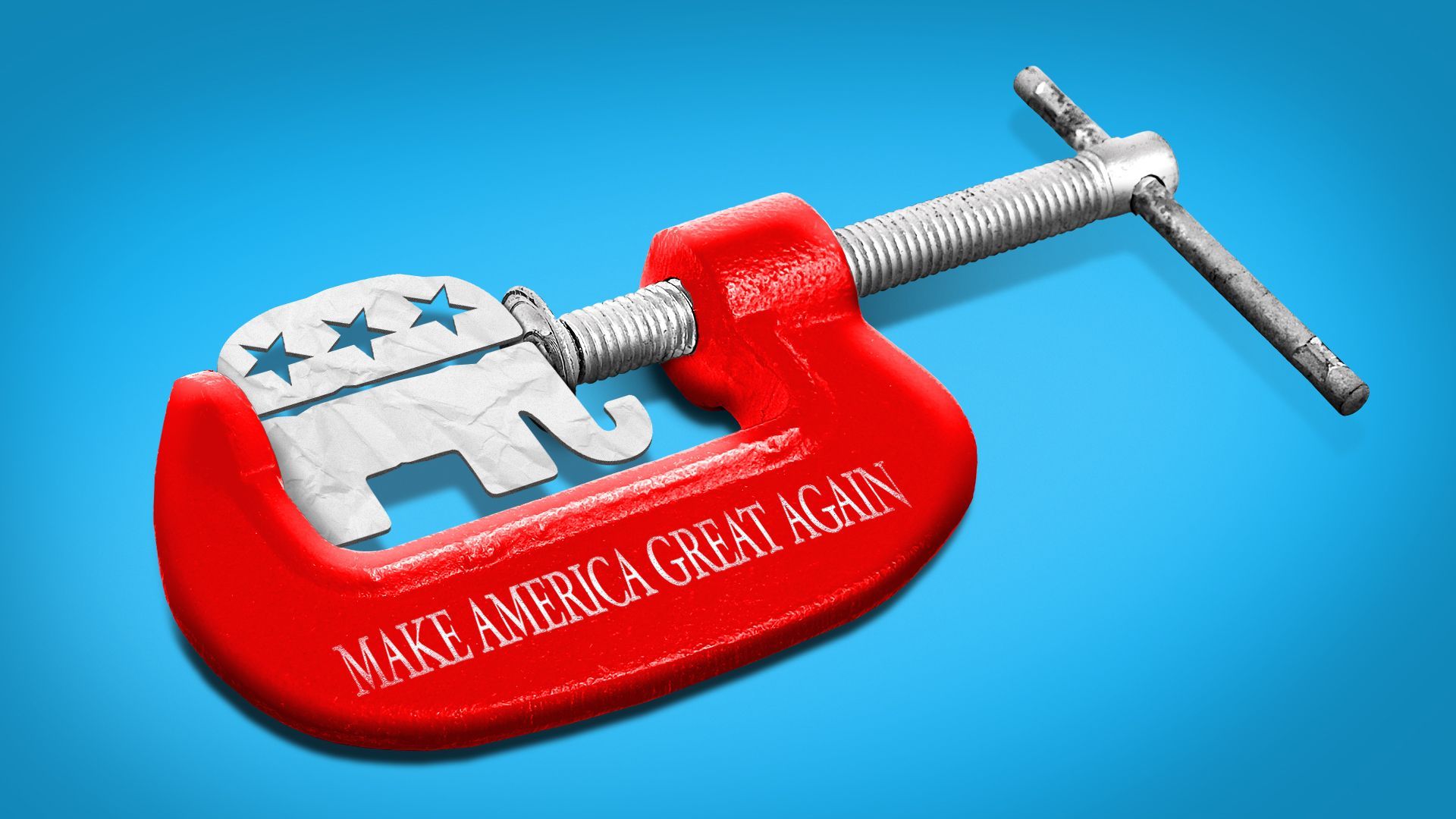
Illustration: Sarah Grillo/Axios
To fully appreciate President Trump's mesmerizing control over Republicans, consider their scant public dissent over ideas many of them privately disdain:
- Support for Vladimir Putin.
- Support for on-again, off-again tariffs, and a worsening economy.
- Support Elon Musk's haphazard budget-cutting.
- Making Canada the 51st state.
- Pardoning most Jan. 6 defendants.
Why it matters: It's the worst-kept secret in town. Most elected Republicans are staying silent on issues they find dubious, dumb or destructive.
In private, they're more forthcoming about their concerns and their mixed motivations for zipping their lips — genuine support for Trump and genuine fear of crossing him.
- Almost universally, Republicans have convinced themselves that by winning a second time, Trump earned whatever Cabinet he wants, and the freedom to pursue the policies of his choice.
They see no upside — or good reason — to oppose him because Trump, Musk and others would torch them publicly and on social media, and almost certainly threaten a primary challenge.
- Just ask Sen. Joni Ernst (R-Iowa), who faced constant harassment back home for merely raising questions about Defense Secretary Peter Hegseth. She wound up voting to confirm him.
- Or Sen. Thom Tillis (R-N.C.), who voted to confirm Hegseth, has gotten repeated death threats since the election.
- Or the exception, Rep. Tom Massie (R-Ky.): Trump has threatened him with a primary challenge for being "an automatic 'NO' vote on just about everything." But Massie continues to vote against Trump priorities, and recently wrote on X: "POTUS is spending his day attacking me and Canada. The difference is Canada will eventually cave."
Most GOP lawmakers dutifully defend things they might ridicule if they were done by a Democrat or weaker Republican.
- This ritual plays out all day, every day on X and cable news. Republicans pick up tricks from each other to duck and weave, or simply defend things they might find intellectually indefensible.
- "It's part of the gig, right?" said Rep. Blake Moore of Utah, vice chair of the House Republican Conference. "I haven't been asked about a Trump tweet in a while."
Sen. Josh Hawley (R-Mo.) — an outlier in the GOP who's an actual fan of tariffs — called the Republican chorus "an acquiescence to reality."
- Hawley says that although there are plenty of Republicans who don't like tariffs or Trump's approach to Ukraine, "I haven't heard what the alternatives would be."
- "He's the undisputed leader of the party," Hawley added. "I think people are, like: 'OK, let's give him a shot' — even those who probably, privately, would do it differently."
Sen. Kevin Cramer (R-N.D.) — who endorsed Trump back in early 2016, when Cramer was a House member — told Axios' Stef Kight that when Trump won the popular vote, Americans "signed off on his broader plan — and the things he's been doing are things he said he was going to do."
- "At this point, this early, we're best to let him do it and see how it turns out," Cramer said. "I think he needs a little room and some time ... to change big things in a short time. ... We've learned not to so quickly second-guess him. His instincts are often right — usually right."
One popular trick: Quietly articulate your differing views back home, without even the mildest hint of criticizing Trump.
- Another tactic is to deflect and express outrage, as several Republicans have done when questioned about the administration ignoring a judge's order while deporting two planeloads of alleged Venezuelan gang members: "So you want murderers and rapists to stay in the U.S.?"
The bottom line: Politics is all about incentives. And every Republican incentive is to back Trump — and make sure he and MAGA media know it.
- Stef Kight and Andrew Solender contributed reporting.
Go deeper: Trump plays with fire — by choice.
