At least 40 killed as tornadoes, severe weather threaten multiple states

Add Axios as your preferred source to
see more of our stories on Google.
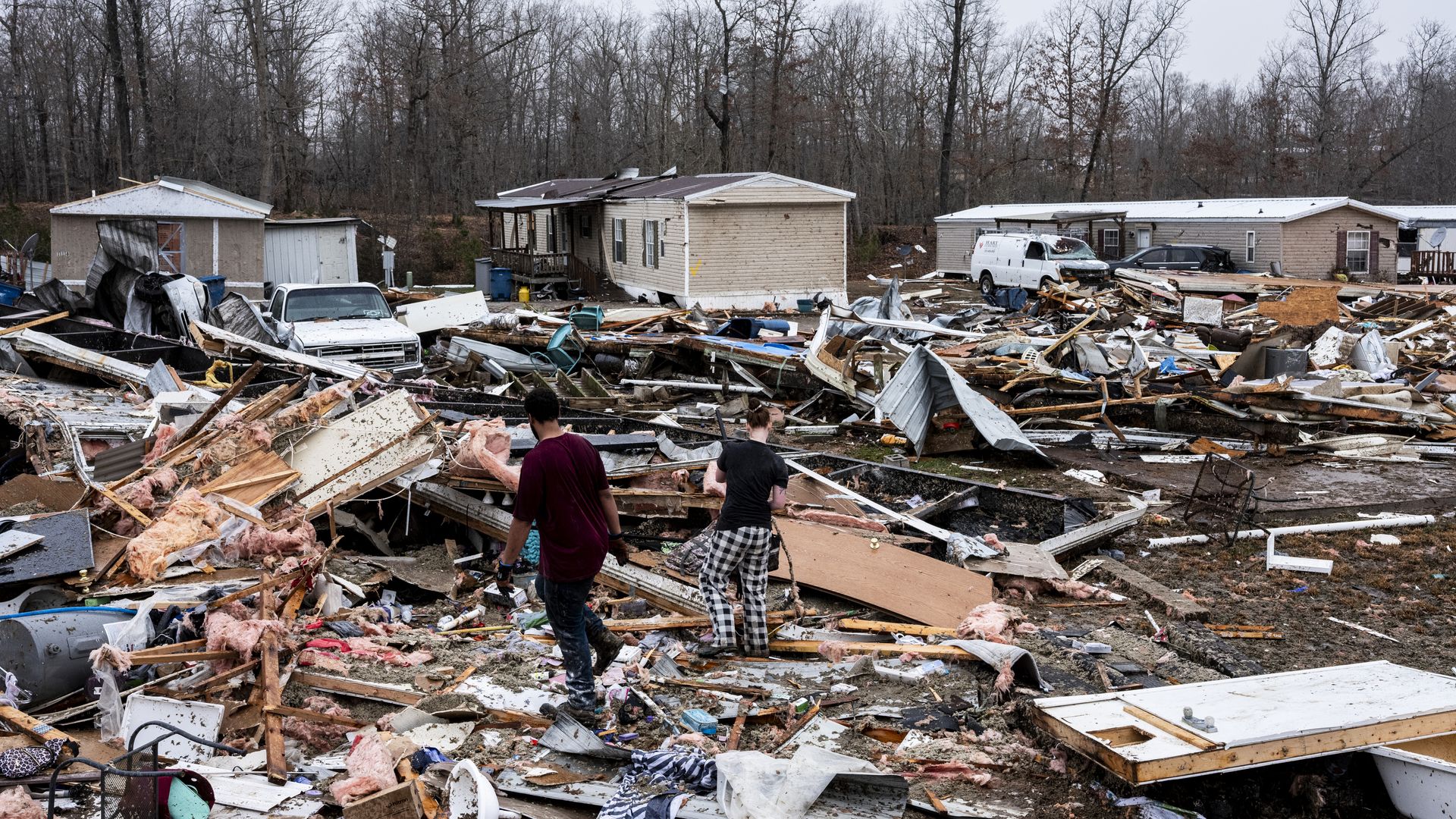
Anthony Hudson, left, helps his sister, Kelsey Webb, right, search through her destroyed home inside of Harmony Hills trailer park on March 15 in Poplar Bluff, Missouri. Photo: Brad Vest/Getty Images
At least 40 people are dead after tornadoes, high winds and wildfires hit more than a half-dozen states since Thursday.
Threat level: Although the Sunday outlook was less dire, more severe thunderstorms with potential tornadoes were expected from Pennsylvania to Florida.
- Fatalities occurred in Georgia, Mississippi, Arkansas and Alabama from tornadoes that raced at highway speeds on Friday through Saturday night and into Sunday morning.
- States of emergency were in effect due to storms in Georgia, Mississippi, Alabama and Arkansas, where President Trump said in a Sunday statement the National Guard had been deployed.
- The storms had prompted the National Weather Service to issue a rare "high risk" threat designation for Mississippi and Alabama on Saturday, as multiple rounds of intense thunderstorms swept across these states.
- Hard-hit communities include Taylorsville, Miss., and Calera, Ala., among many others, after tornadoes struck at night.
- The storms even targeted at least one NWS office, with forecasters at NWS Birmingham forced to take shelter as a tornado passed close to their building Saturday evening.
Situation report: The extreme storms have resulted in at least 12 deaths reported in Missouri, six in Mississippi and three each in Alabama and Arkansas.
- Dust storms that caused low visibility on Friday resulted in road crashes that killed at least eight people in Kansas and four others in Texas.
- Oklahoma officials confirmed at least four deaths due to "dangerous" wildfires with "straight-line-winds" that saw Gov. Kevin Stitt declare an emergency in 12 counties on Saturday.
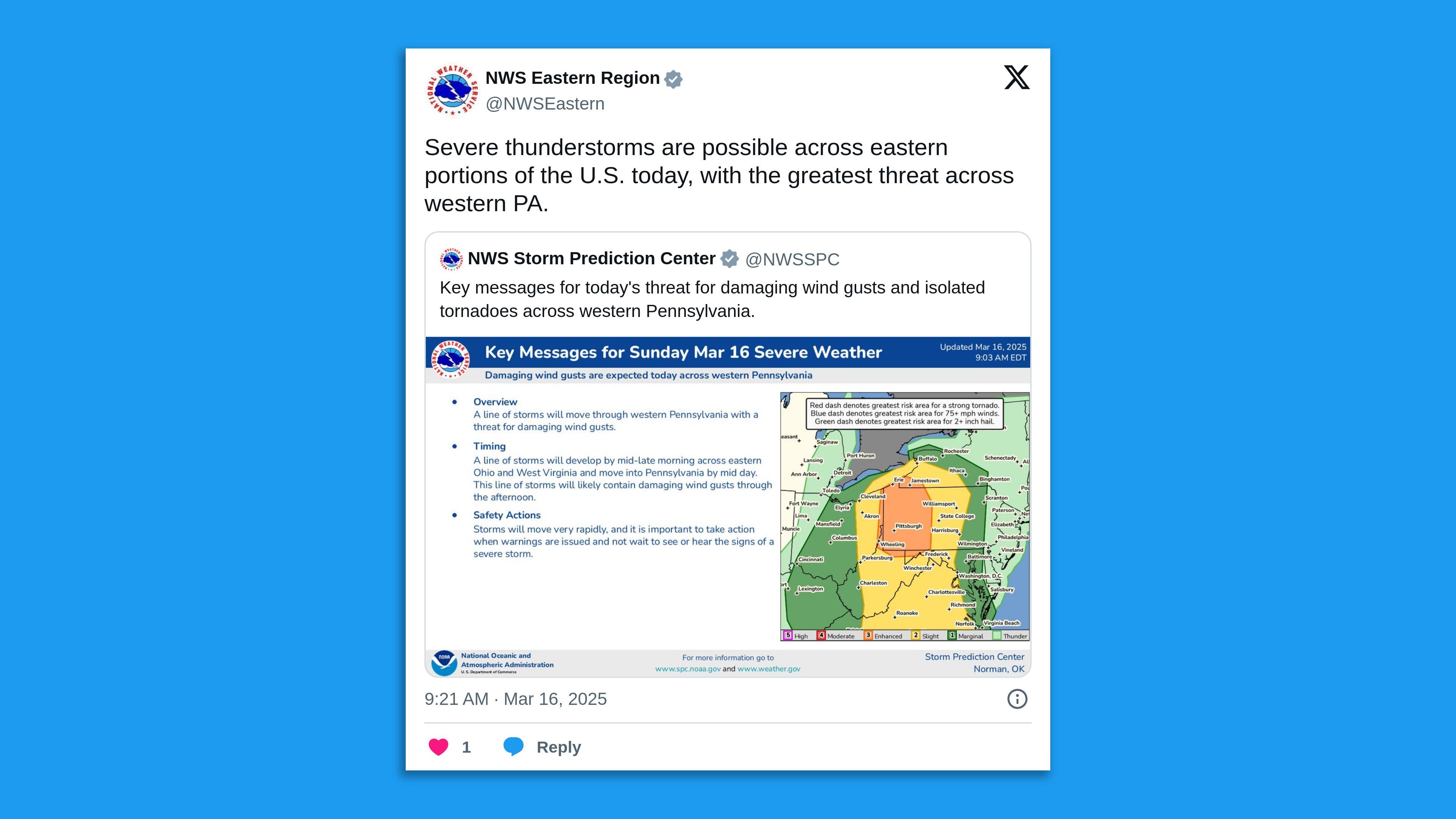
State of play: Severe thunderstorms were bringing scattered damaging wind swaths and some tornadoes into Sunday evening across parts of the Ohio Valley into the Mid-Atlantic and Southeast.
- Tornado warnings were in effect for parts of Florida and North Carolina, and watches for other portions of N.C. and southern Virginia as of Sunday night.
- About 38 million people live in areas designated at "slight" to "enhanced" risk of severe thunderstorms on Sunday.
- Dozens of tornadoes, many of them confirmed by the NWS, have been reported from the Midwest to the Southeast since Friday.
- These numbers are likely to increase on Sunday, despite the lower overall risk level.
Yes, but: As damaging and deadly as this event was, it was not the historic outbreak feared in some states, particularly Alabama.
- Meteorologists are likely to spend years studying what set this storm apart from past landmark outbreaks in order to better forecast them ahead of time.
Context: Climate change is altering the environment in which severe thunderstorms and tornadoes form.
- Studies show that while some ingredients, such as humidity and atmospheric instability, are likely to increase with a warming climate, others may do the opposite.
Yes, but: When the right mix of ingredients are present, as they have been during the past few days, climate change may lead to larger severe weather outbreaks.
The intrigue: The Southeast, home to so-called "Dixie Alley," has been particularly hard-hit by tornado outbreaks in recent years beginning during March.
Between the lines: This severe weather outbreak has been testing NOAA's ability to handle a large-scale, deadly weather event in the wake of laying off about 800 staff, including more than 100 meteorologists, in late February.
- These layoffs reduced staffing at some local weather forecast offices to threadbare levels, causing some to reduce their services.
- More layoffs of up to around 1,000 NOAA employees are possible in coming weeks, though it's not clear if those would fall at other parts of the agency than NWS.
The bottom line: The tornado and damaging straight-line wind threat is not over yet, as this long-lasting outbreak stretches into another day.
More from Axios:
- Wildfires threaten homes in Texas, Oklahoma
- What we know about how climate change affects tornado outbreaks
- NOAA cuts could ground some Hurricane Hunter flights
- 2nd judge orders agencies to reinstate thousands of fired federal workers
Editor's note: This a breaking news story. Please check back for updates.
