Russia gloats about shift in U.S. relations with Ukraine

Add Axios as your preferred source to
see more of our stories on Google.
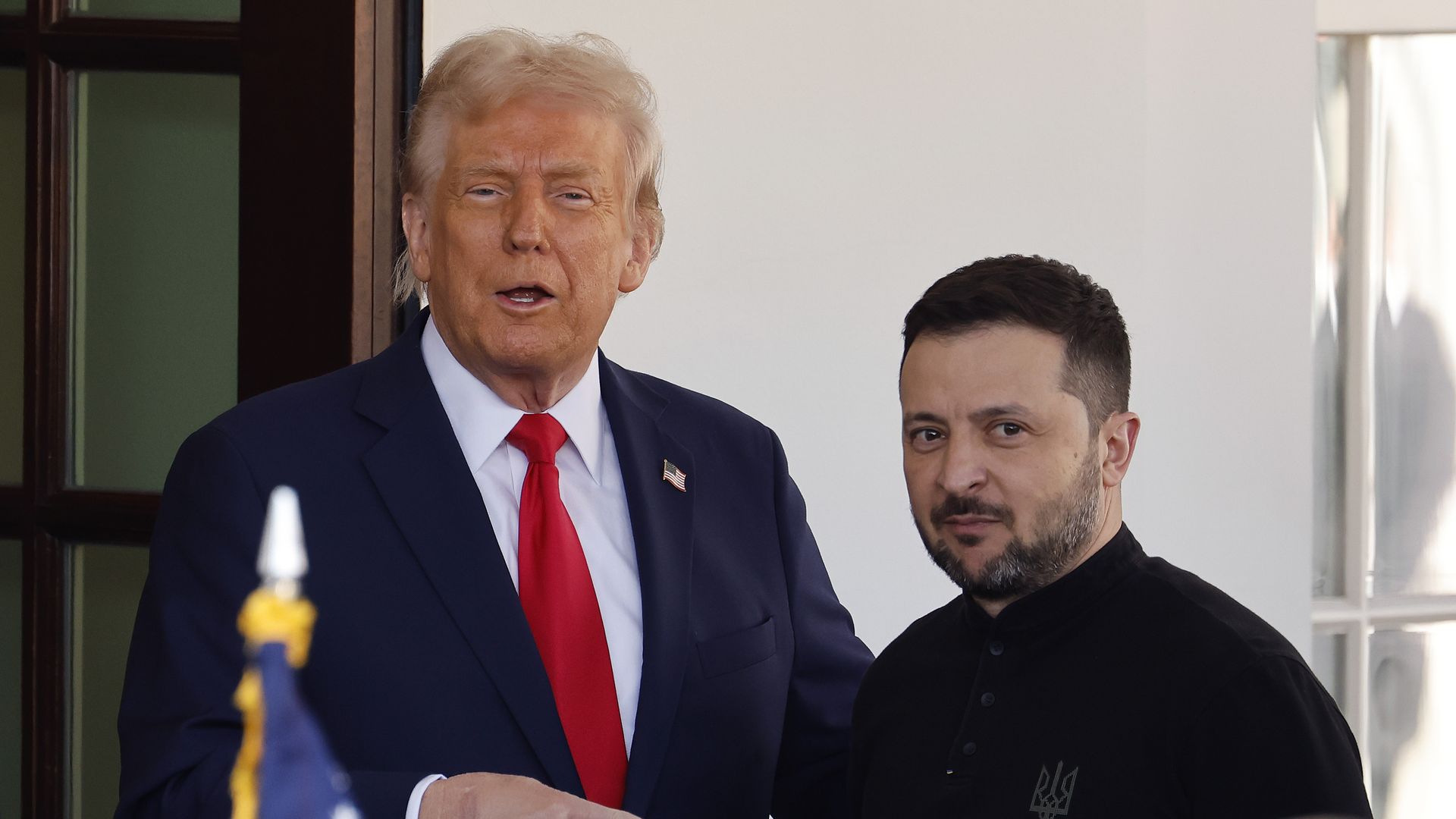
President Donald Trump greets Ukrainian President Volodymyr Zelensky as he arrives at the White House on Feb. 28 in Washington, DC. Photo: Chip Somodevilla/Getty Images
Moscow is welcoming the apparent shift in U.S. relations with Ukraine following last week's tense Oval Office meeting between Ukrainian President Volodymyr Zelensky, President Trump and Vice President Vance.
The big picture: Kremlin officials commended the U.S. on Sunday, with spokesperson Dmitry Peskov saying the United States' "rapidly changing" foreign policy configurations "largely coincides with our vision."
- Russian Foreign Minister Sergei Lavrov also praised Trump for his "common sense," even if the U.S. and Russia are not aligned on everything.
- A spokesperson for Russia's foreign ministry said after the Oval Office meeting that it was a "miracle of restraint" that Trump and Vance didn't hit Zelensky.
- Former Russian President Dmitry Medvedev, now deputy chair of Russia's security council, crowed that "the insolent pig finally got a proper slap down in the Oval Office."
Driving the news: For at least one Republican, the idea of the U.S. walking away from its allies is stomach-turning. But others in the GOP have dismissed the commentary from Moscow — and have taken their turn heaping on criticism for Zelensky.
What they're saying: Sen. Lisa Murkowski (R-Alaska) wrote in a Saturday X post that she is "sick" as the Trump administration "appears to be walking away from our allies and embracing [Russian President Vladimir] Putin, a threat to democracy and U.S. values around the world."
- Her condemnation followed weeks of rhetoric from the White House signaling a softer approach to Putin and a brewing hostility toward Zelensky, whom the president called a "dictator" before walking it back last week.
Sen. Chris Murphy (D-Conn.) said Sunday on CNN's "State of the Union" that the "White House has become an arm of the Kremlin."
Yes, but: The Trump administration has largely dismissed the concerns from some in Congress, instead praising Trump for bringing Putin to the bargaining table and arguing the president is the only person who can end the war.
- "They're going to say what their position is," Tulsi Gabbard, the director of national intelligence, said in response to Russian reactions on "Fox News Sunday." "What we should pay attention to here in the United States of America is the American people."
Secretary of State Marco Rubio also waved off Murkowski's criticism.
- ''We're a free country. People have a right to these opinions," he said on ABC's "This Week" in response to her statement, later arguing if a Democrat had handled recent talks as Trump had, "everyone would be saying, well, he's on his way to the Nobel Peace Prize."
- House Speaker Mike Johnson (R-La.) argued Trump has been "very clear" that Putin was the aggressor in the war (Trump has falsely blamed Ukraine for starting the conflict), saying Murkowski's view is "plainly wrong."
What's next: While U.S. leaders seem to suggest the ball is in Kyiv's court in the wake of the spat, European leaders quickly organized to contain the damage.
- "We have to find a way where we can all work together," UK Prime Minister Keir Starmer, who met with Trump the day before Friday's clash, told the BBC Sunday.
- He said the UK will work with other European nations to develop a plan to end the war supported by a "coalition of the willing" and present it to Trump, who Starmer says still wants a "lasting peace."
- But the seas between the U.S. and its European allies grow choppier — threatening to sink a longstanding bridge.
Go deeper: Inside the Oval: How Trump sent Zelensky home with no deal and no meal
