Courts become the final guardrail against Trump

Add Axios as your preferred source to
see more of our stories on Google.
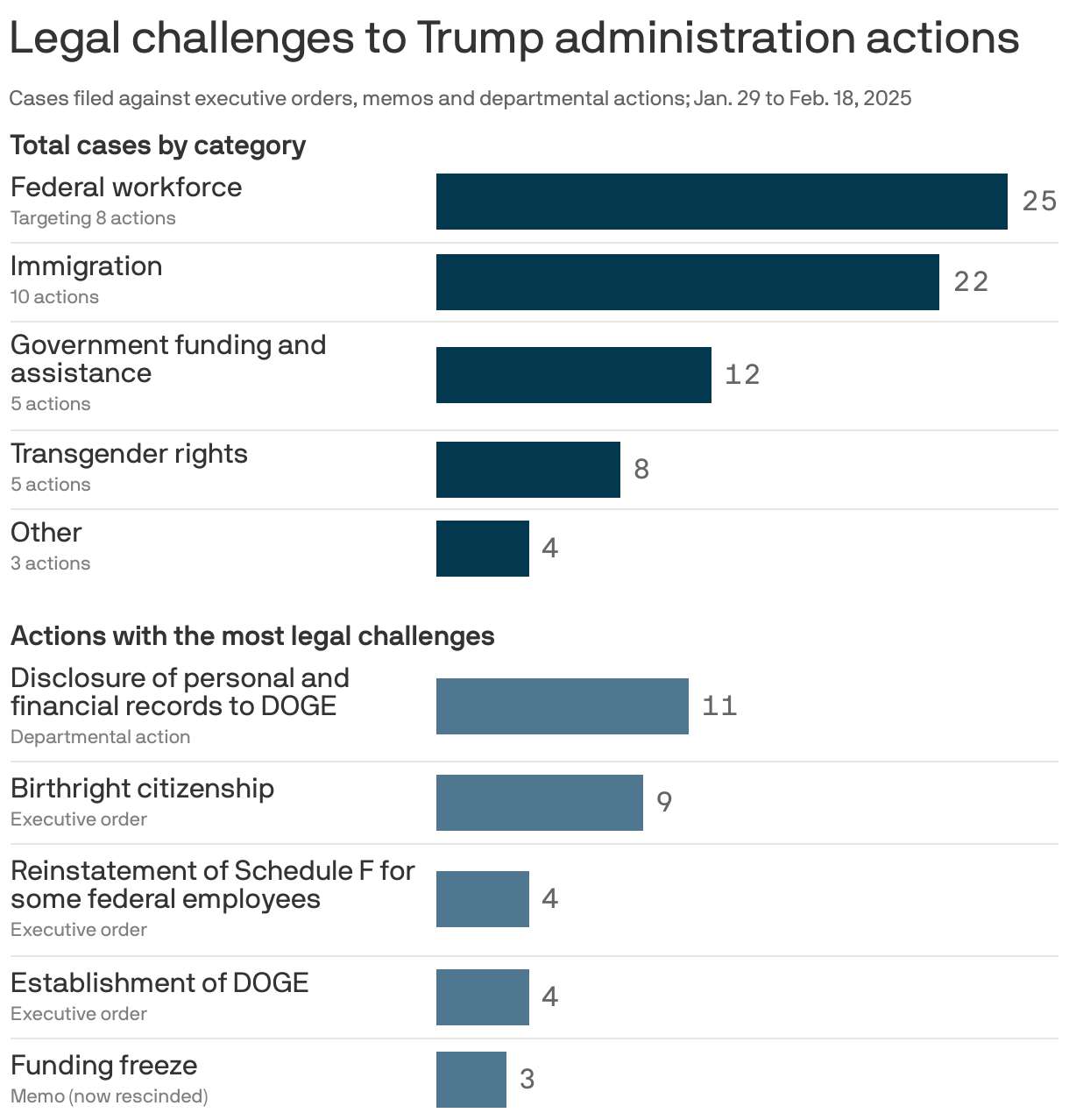
With a compliant Republican-led Congress virtually in President Trump's pocket, the courts appear to be the main guardrail for his push to remake government and boost his presidential power.
Why it matters: Trump's most sweeping executive orders have drawn a series of legal challenges — which his administration has vowed to fight, even as it sends mixed signals over whether it will abide by court decisions.
- More than 70 lawsuits now have been filed against aspects of Trump's agenda, and more than two dozen court rulings have paused some of Trump's executive orders.
- Trump already has filed an appeal to the Supreme Court in a dispute over whether the president can fire the head of an independent agency. It's the first of what's likely to be many challenges that will wind up at the doorstep of the nation's highest court.
- Last summer, the high court granted presidents broad immunity for "official acts" they carry out.
Driving the news: Trump's actions related to the major parts of his presidential agenda — immigration, DOGE, federal workforce changes and trans rights — have drawn the bulk of the legal challenges.
- Three federal judges have ordered a freeze on Trump's Day 1 executive order to end birthright citizenship.
- A judge on Tuesday kept the order paused, rejecting a bid from Trump to halt one of several federal injunctions against it, per Bloomberg Law.
Elon Musk's role in transforming the government has come under scrutiny in recent legal filings, as unions and private citizens seek to block the billionaire SpaceX founder's access to potentially private information.
- In a win for Musk, a federal judge on Tuesday declined, at least for now, to block DOGE from firing federal employees or gaining access to certain government databases.
- A different federal judge this month temporarily blocked DOGE's access to data systems at the Treasury Department.
- Some cases over Musk and his team's access to different databases are pending.
Other aspects of the Trump administration's efforts to upend the federal government workforce also have drawn legal challenges, including some still awaiting a judge's decision.
- Judges have temporarily blocked Trump's decision to put thousands of employees at the U.S. Agency for International Development (USAID) on leave and freeze funding for some government programs.
- A different judge, meanwhile, has let stand Trump's offer to pay federal employees through Sept. 30 if they resign.
Trump's efforts to roll back rights for transgender people also have drawn legal challenges, increasing the chances that a high-profile suit ends at the Supreme Court.
- A federal judge has temporarily blocked Trump's order that would transfer incarcerated transgender women to men's prison facilities, and would block them from receiving medical treatments for gender transitions.
- A judge has not yet issued a ruling on lawsuits challenging Trump's orders saying the U.S. government would recognize only two sexes, male and female, and ban transgender people from serving in the military.
What to watch: As the courts become the battleground for challenges to Trump's sweeping executive orders, Trump has said he'll follow court orders — though some of his top allies have cast doubt on that.
- Vice President Vance said this month that "judges aren't allowed to control the executive's legitimate power," a sentiment that has since been echoed by Musk and other Republicans.
- Democrats on Capitol Hill are bracing for Trump to flout a major court ruling — and they're meeting with state attorneys general, top lawyers, litigation firms, constitutional experts and advocacy organizations to prepare their response, Axios' Andrew Solender reported.
Go deeper: Tests of Trump's power on fast tracks to the Supreme Court
