Polar vortex-tied Arctic blast breaks cold weather records

Add Axios as your preferred source to
see more of our stories on Google.
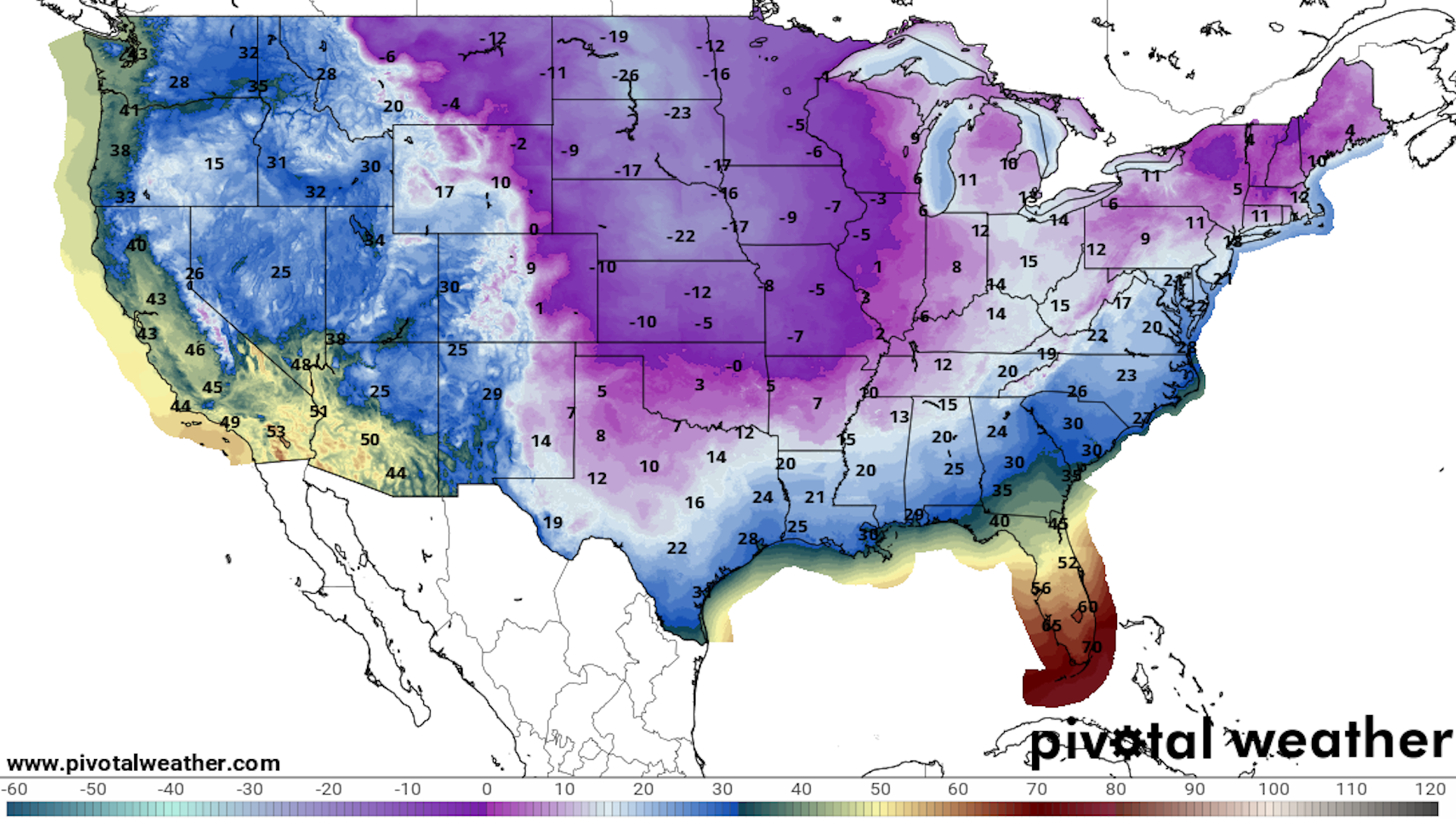
Map showing forecast low temperatures on Thursday morning. Image: Pivotal Weather
An Arctic blast tied in part to the polar vortex is driving record frigid air south from the Northern Plains toward the Gulf Coast Wednesday in a cold snap that will last the entire week.
Threat level: This event is setting daily record cold temperatures and is forecast to bring for the coldest temperatures on record for this late in the season.
- It will bring below-zero Fahrenheit wind chills as far south as Texas, Arkansas and Tennessee.
- As of Wednesday morning, more than 100 million people were under "extreme cold warnings" and advisories, from the Canadian border south to New Orleans.
By the numbers: The National Weather Service (NWS) is forecasting wind chills as cold as minus-35°F to minus-60°F across the northern Plains for multiple days.
- Conditions this cold can cause frostbite to exposed skin in just a few minutes, and hypothermia soon after that.
- The NWS is warning that its forecasters have "High confidence of widespread, record-breaking cold" with the coldest conditions lasting through Friday.
- Temperatures are running at least 40 degrees Fahrenheit below average for this time of year in the Plains and Upper Midwest on Wednesday.
This cold air, in slightly moderated form, will spill east later this week on the heels of a storm system that is bringing a swath of snow and ice to the Mid-South, Carolinas and southern Mid-Atlantic.
Zoom in: Here's how some cities will be affected this week on their coldest days, from the NWS:
- Minneapolis: A high of 5°F with a low of minus-13°F on Feb. 19.
- Des Moines: A high of 4°F and a low of minus-6°F on Feb. 19.
- Omaha: A high of 3°F and a low of minus-8°F on Feb. 19.
- Dallas: A high of 27°F and a low of 18°F on Feb. 19.
- Chicago: A high of 15°F and a low of 2°F on Feb. 19.
Bismarck and Minot, N.D. set daily records for their coldest temperatures on Feb. 18, at minus-39°F and minus-33°F, respectively. Parts of Montana saw temperatures plunge into the minus-40s°F on Wednesday morning, while in Texas, Dallas reached a low temperature in the teens.
- In north Texas, wind chills were below zero Fahrenheit on Wednesday morning, including the Dallas metro area.
Between the lines: Cold weather of this magnitude and duration is likely to increase energy demand as well as costs.
- It may also lead to another month in which the U.S. is the world's most unusually cold spot on an unusually hot planet, as it was in January.
The intrigue: The Arctic outbreak is consistent with events that some studies have shown to be more likely due to rapid Arctic climate change.
- It is tied to how multiple weather systems are lined up in the Far North, including a stretched polar vortex that has shifted south somewhat.
- Other factors include a strong area of high pressure over Alaska and parts of the Arctic, forming what is known as a "blocking pattern."
- These features are combining to drive frigid conditions southward, into the Lower 48 states.
