The economic state of Black America


Add Axios as your preferred source to
see more of our stories on Google.
As the nation marks a turbulent Black History Month, the economic state of Black America has much improved over the last few decades but is still nowhere near parity.
Why it matters: Economic hardships define people, families and communities for generations; breaking those cycles is the key to broader prosperity.
By the numbers: These are some of the most important indicators that tell the story of the Black community's financial progress and challenges.
- It's worth noting that some of this data is already becoming harder to come by, as the Trump administration purges various federal datasets that touch on issues like race.
- In some charts below, we look at the statistics solely for the Black community, while in others we compare to some or all races and ethnicities — in part to illustrate just how stark some of the gaps are.
The unemployment gap
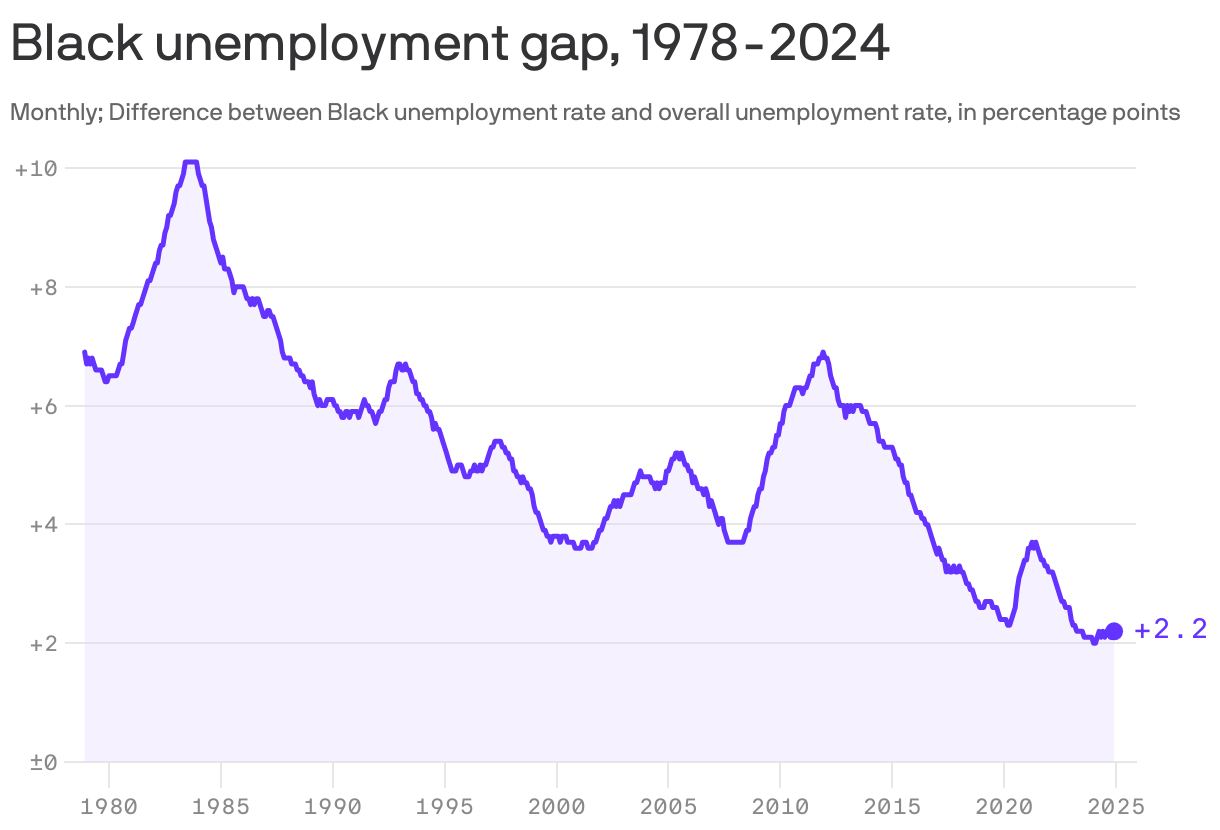
The gap between the Black and general unemployment rates is less pronounced than in previous decades.
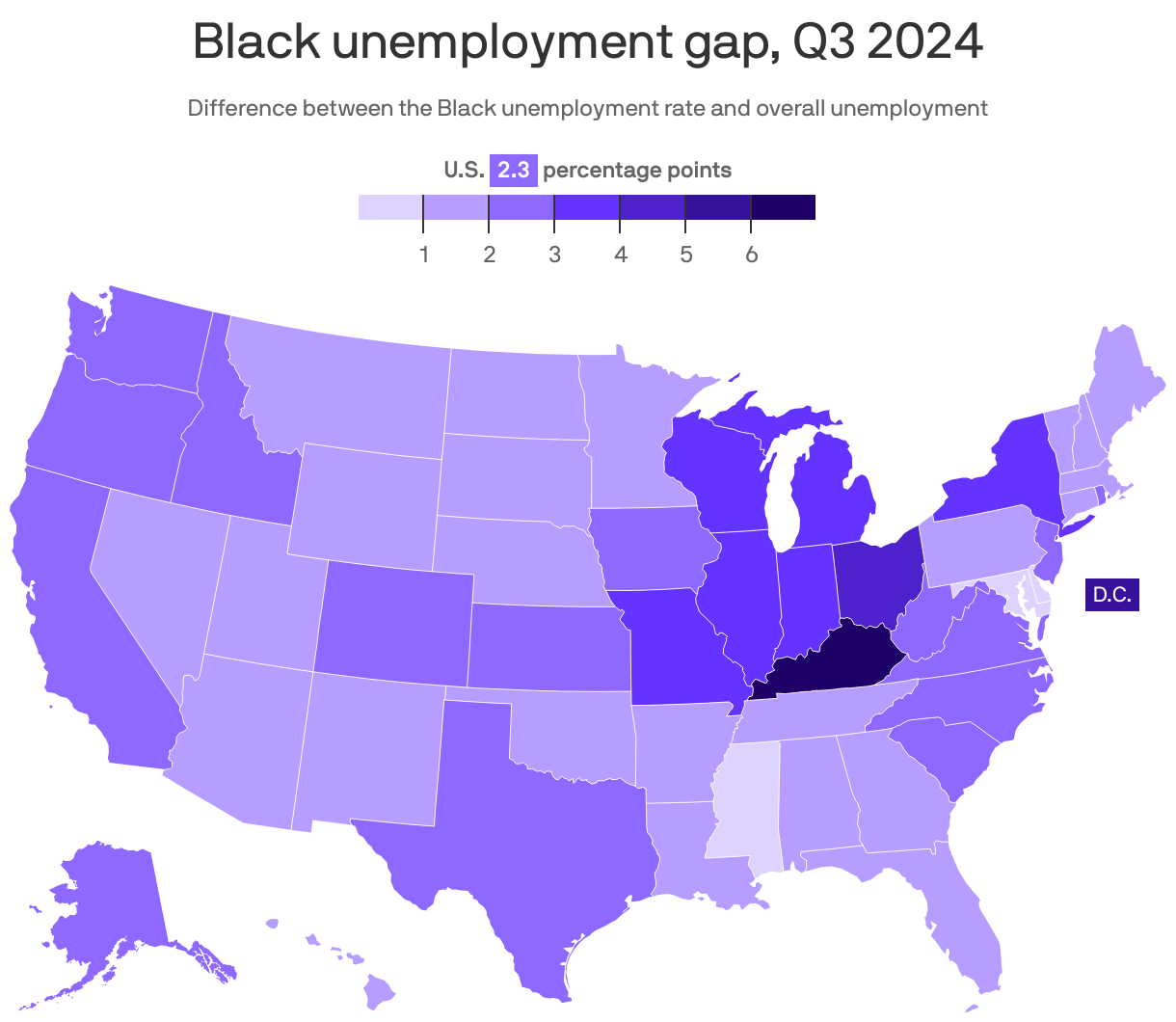
Yes, but: Disparities in the workforce abound from state to state and across regions of the countries. The gap is quite narrow in some places, like Delaware and Maryland, but in places like Kentucky, systemic racial barriers continue to hold people back.
The wealth gap
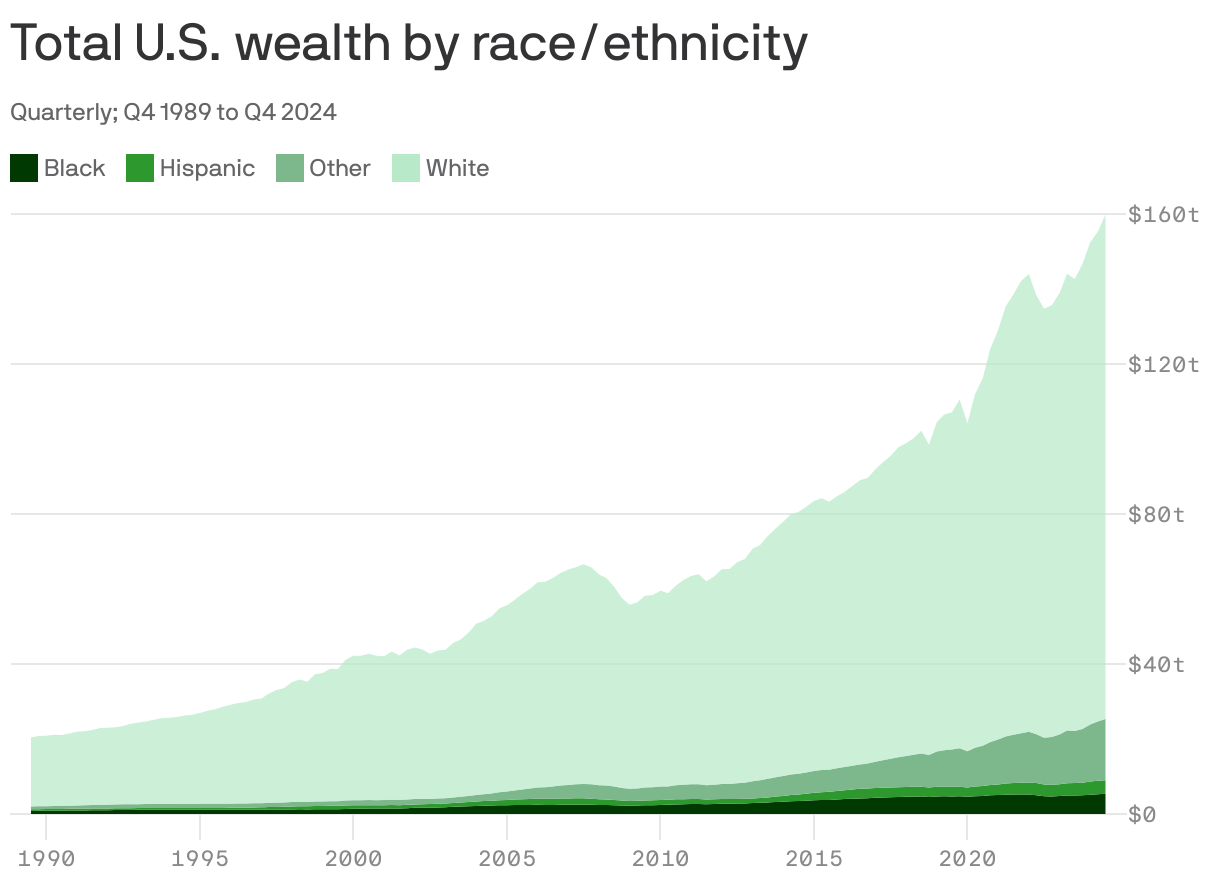
Black people consistently hold a tiny sliver of the overall wealth of the United States.
Why it matters: Non-Hispanic whites account for about 62% of Americans, but control 84% of the nation's wealth, per the Federal Reserve.
- Black Americans, who represent more than 12% of the population, own only 3.4% of the country's wealth, per the Federal Reserve. That's down sharply from 4.7% in 2017.
Follow the money: Black Americans had just $313 billion in stocks and mutual funds as of the third quarter of 2024, up a mere 3.4% in seven years.
- White Americans, by contrast, have $41 trillion of stock-market wealth — up 91% over the same time period.
The bottom line: On an absolute level, in nominal dollars, Black Americans have more wealth than ever — some $5.4 trillion in total. But their share of the total is not only tiny but also shrinking.
Business ownership


The share of U.S. businesses with Black owners has increased steadily in recent years, though it's still relatively small compared to the share for white or Hispanic owners.
By the numbers: The U.S. Census Bureau's Annual Business Survey shows 3.31% of all U.S. businesses were Black-owned in 2022, the last year for which data is available.
- That's an increase from 2.16% just five years ago.
- Over that time, Black-owned businesses grew 57%, far outpacing total business growth of just over 2%.
Workforce representation
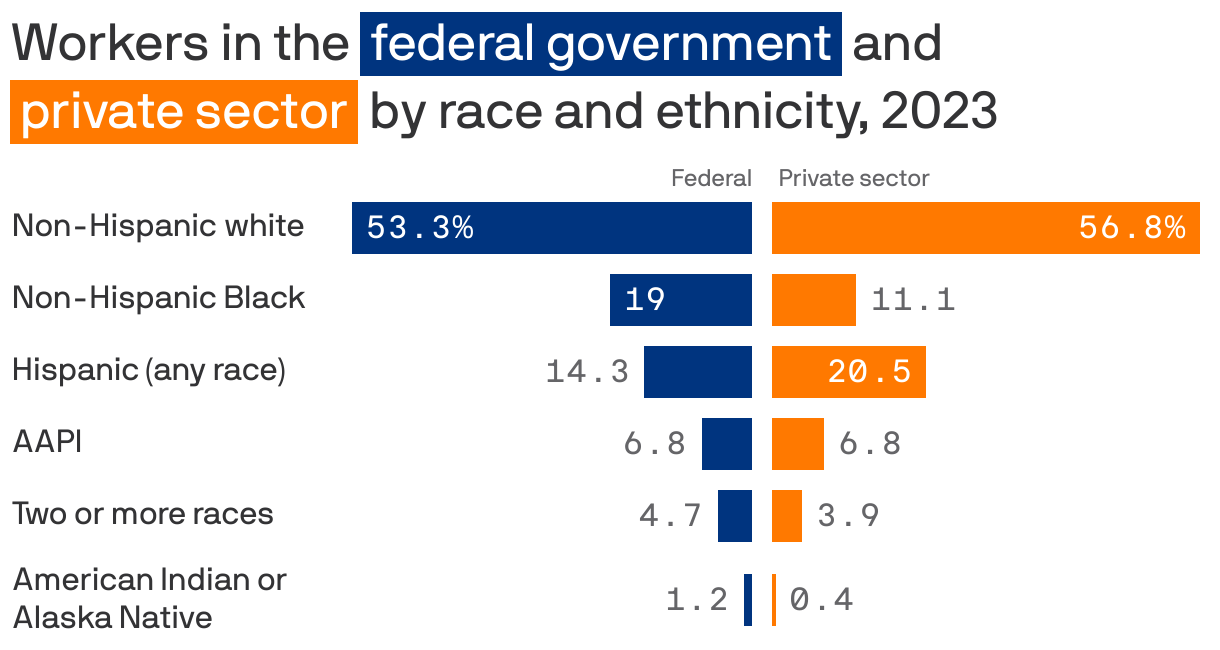
The Black community is under-represented in the private sector, but does somewhat better when it comes to government employment.
Yes, but: That also means the Trump administration's efforts to shrink the federal workforce could disproportionately affect the community.
Banking access
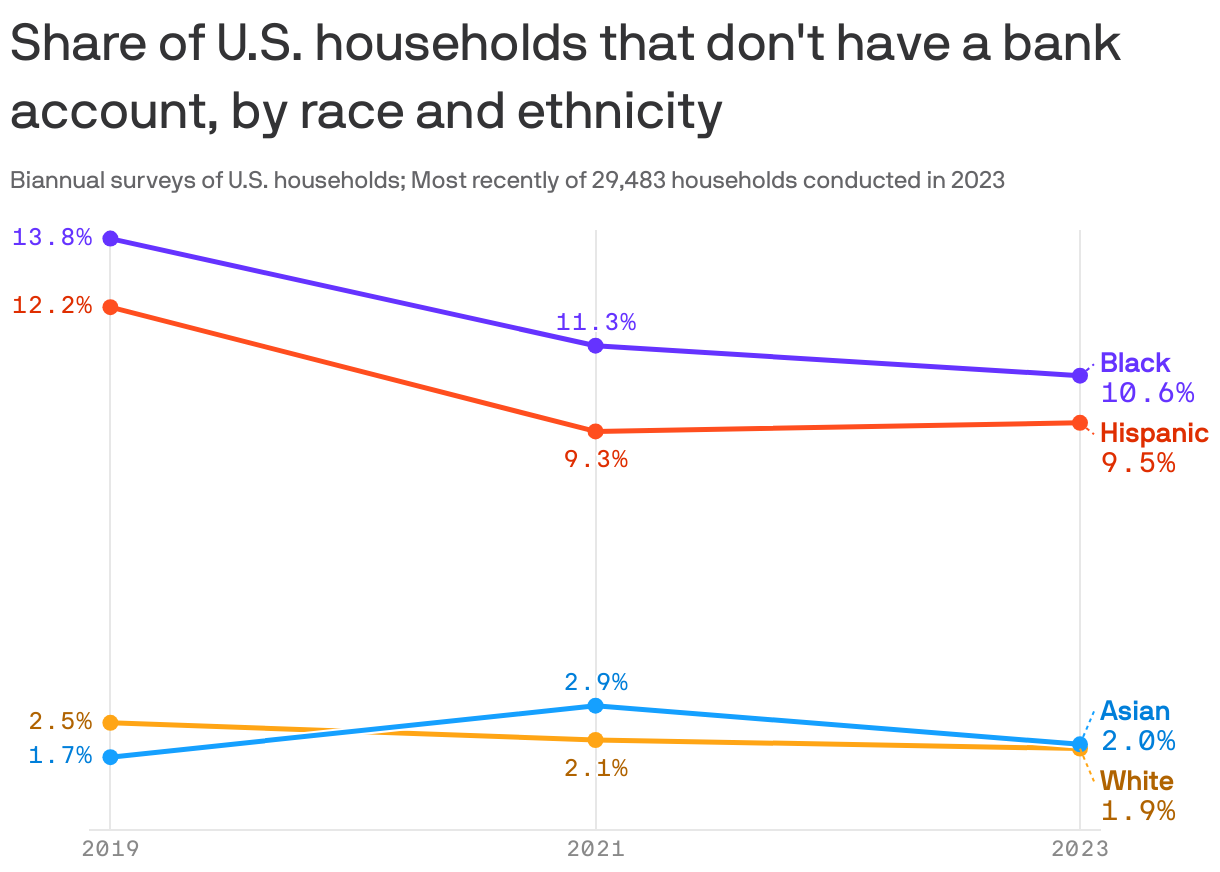
Black households continue to be unbanked (in the traditional sense) at a higher rate than any other race or ethnicity, per FDIC data.
The big picture: While the rates have improved steadily, a double-digit percentage of Black households still don't have bank accounts.
Yes, but: A major caveat here is that the FDIC has a conservative view of what counts as being "banked" (a member of the household has to have a checking or savings account at a federally insured bank or credit union).
- Many people have alternative products, like Cash App, that offer many of the same features, albeit with fees and other limits.
Educational attainment
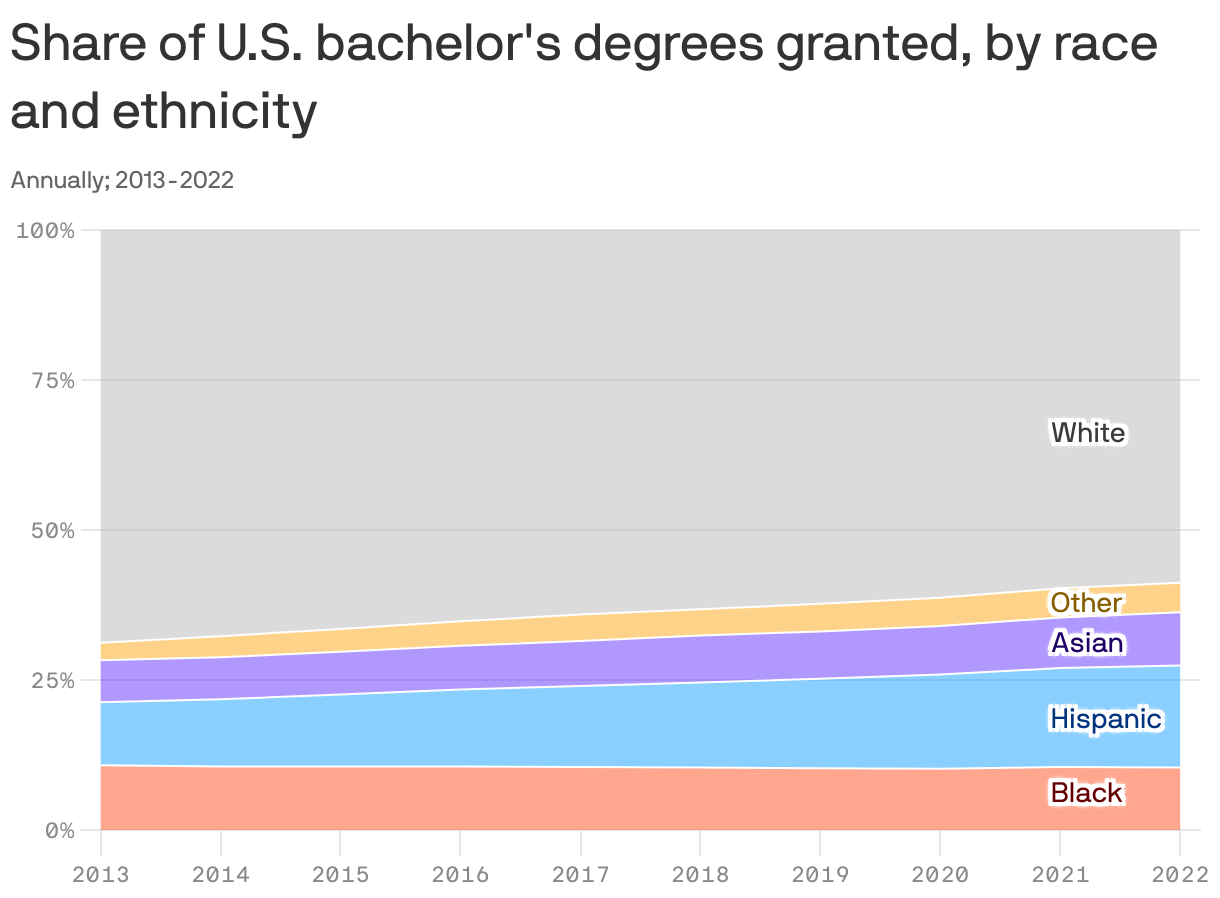
The share of all Bachelor's degrees awarded to Black people in recent years has held steady — even as other ethnic groups posted robust gains.
By the numbers: Of all Bachelor's degrees awarded in the 2021-2022 school year, 10.4% went to Black students, down from 10.8% in the 2012-2013 year.
- Over that same period, the share that went to Asian students rose to 8.9% from 7%, while for Hispanic students it rose to 17% from 10.5%.
- The share of degrees awarded to white students fell sharply, but Black students didn't participate in that offsetting growth.
Homeownership


There is a massive gap between homeownership rates for Black and white households, one that is not narrowing appreciably.
Why it matters: Homeownership is how most Americans build wealth and pass it on to the next generation.
Household income


The median household income for Black families has risen steadily over the last 20 years but is still nowhere near that of white households.
By the numbers: While the growth trends are roughly the same, the median household income for a Black family in 2023 was less than that for a white family in 2014.
Maternal mortality
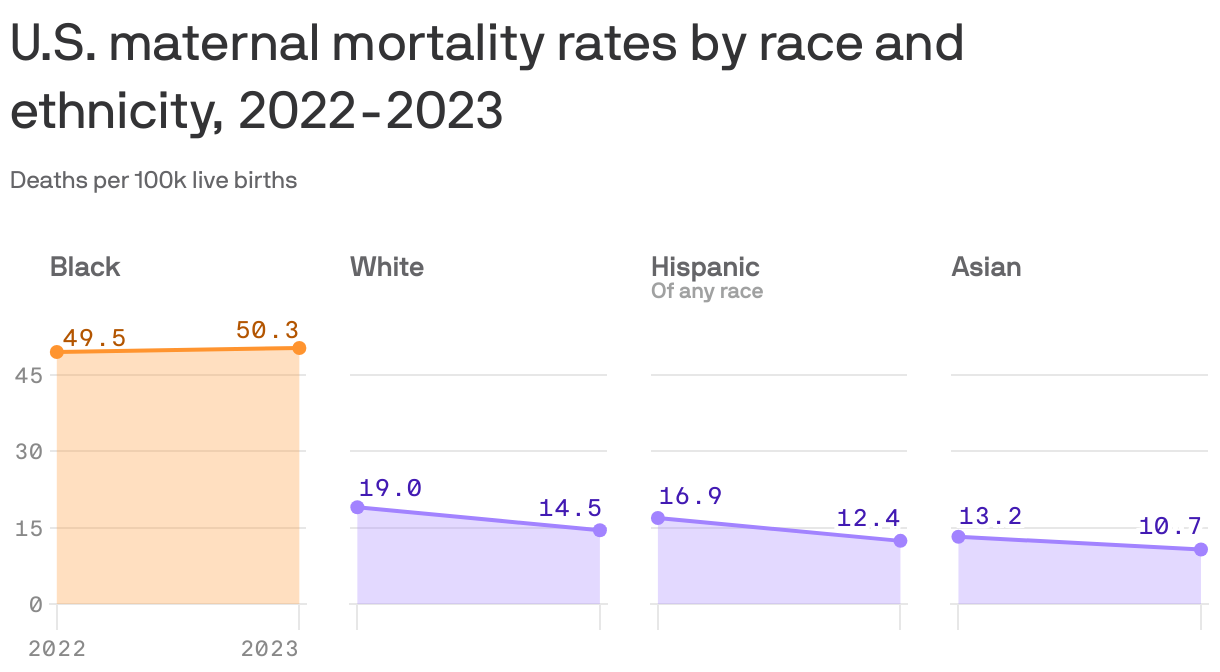
Maternal mortality rates in the Black community were significantly higher than in other communities — and now they are increasing while rates in different groups are declining.
The big picture: The long-term costs of mothers dying in and near childbirth are devastating.
- The immediate financial impacts are immense — funerals, travel, etc.
- However, the long-term destructive impact on families and their ability to grow and thrive is far worse.
Medical debt


Those high rates of maternal mortality contribute, at least in part, to medical debt. Black adults carry such debts at much higher rates than any other ethnicity — roughly one in every eight, per Census data.
The big picture: Medical debt contributes in some way to about three in every five consumer bankruptcies and about half of all debt collections, leaving the Black community at much higher risk.
