Trump spreads autism misinformation in RFK Jr. confirmation push

Add Axios as your preferred source to
see more of our stories on Google.
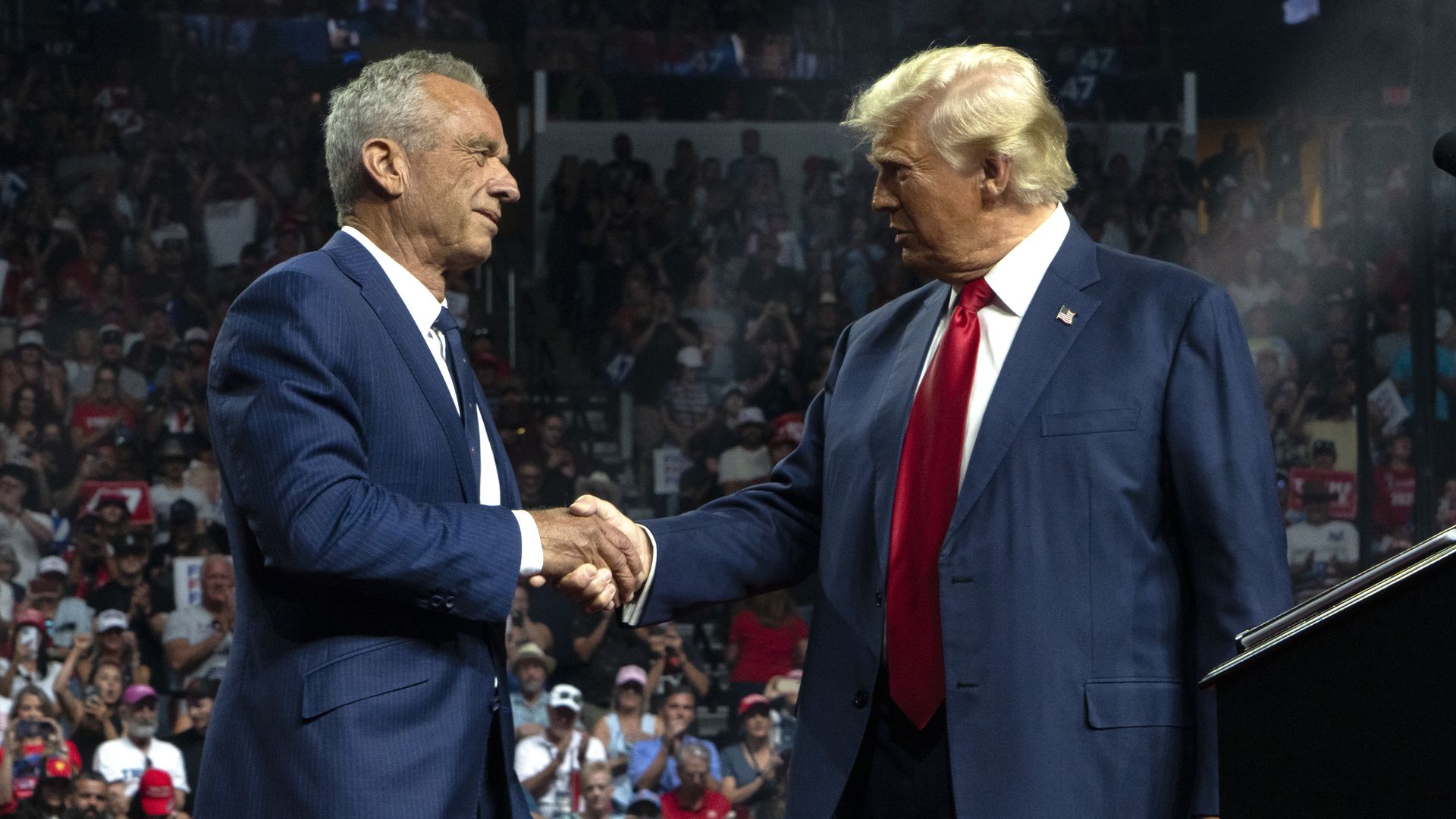
Robert F. Kennedy Jr. and Donald Trump shake hands during a campaign rally at Desert Diamond Arena on August 23, 2024, in Glendale, Arizona. Photo: Rebecca Noble/Getty Images
President Trump on Tuesday cited inaccurate figures of autism diagnoses as a reason why the Senate should confirm Robert F Kennedy Jr., his controversial pick to lead the Department of Health and Human Services.
Why it matters: Kennedy, a long-time anti-vaccine advocate who survived a closely watched committee confirmation vote Tuesday, has been a leading proponent of a debunked theory linking autism and vaccines.
Driving the news: "20 years ago, Autism in children was 1 in 10,000. NOW IT'S 1 in 34. WOW! Something's really wrong," Trump wrote on Truth Social.
- That social media post wasn't the first time Trump has floated misinformation about autism spectrum disorder (ASD).
- In a December interview with TIME magazine, Trump said he'd have a "big discussion" with Kennedy about potentially ending childhood vaccination programs, noting the "autism rate is at a level that nobody ever believed possible."
- While Trump did not insinuate a tie between autism and vaccines in his Tuesday post, he has in the past.
Reality check: Andrew Wakefield's 1998 study — which built the foundation for debunked theories tying vaccines to autism — was deemed fraudulent and retracted by the medical journal that published it.
- Many studies conducted since have shown that vaccines are not associated with ASD.
- Experts say broadening diagnostic criteria and rising awareness of the disorder has contributed to an uptick in autism diagnoses — rather than something being "really wrong."
By the numbers: In 2020, the CDC estimated that among U.S. 8-year-olds, the rate identified with autism spectrum disorder (ASD) was around 1 in 36, not the 1 in 34 Trump wrote about.
- Twenty years prior, according to the CDC, the rate was around 1 in 150, not 1 in 10,000.
Context: The changing numbers reflect shifting diagnostic criteria and improvements for diagnosing autism, said Peter Hotez, the co-director of the Center for Vaccine Development at Texas Children's Hospital.
- The way doctors diagnose autism has shifted through past decades, eventually broadening to autism spectrum disorder, which puts what were once separate diagnoses under the same label, Hotez said.
- Hotez, a vaccine scientist, has raised alarms for years about Kennedy's anti-vaccine comments — and has on multiple occasions spoken with Kennedy and given him evidence debunking his claims.
- Hotez also published a book in 2018 combatting false ties between vaccines and autism, titled "Vaccines Did Not Cause Rachel's Autism" chronicling his experience with his daughter's diagnosis.
Zoom in: In 2006, the American Academy of Pediatrics implemented new recommendations that all children receive autism-specific screenings at 18 and 24 months.
- That was the "big game changer," Hotez said. "Before these kids totally escaped, especially those with milder forms of autism."
Zoom out: There's also been an increase in ASD diagnoses among minority groups that traditionally demonstrated lower prevalence than white children.
- But in 2020, 8-year-old Asian or Pacific Islander, Hispanic and Black children were found for the first time to have a higher percentage of ASD than white children, per the CDC.
- Hotez predicts overall rates may increase again as more women and girls on the autism spectrum are diagnosed.
The bottom line: Hotez fears that conspiracy-driven, negative rhetoric about children with autism and their families will lead to the diagnosis being "demonized."
- "The way RFK Jr. talks about kids on the autism spectrum, he treats them like mental defectives, so that will stigmatize both the kids and families with autism," he said.
Go deeper: Trump says "big discussion" over childhood vaccine programs is coming
