Mapped: Birthright citizenship around the world

Add Axios as your preferred source to
see more of our stories on Google.
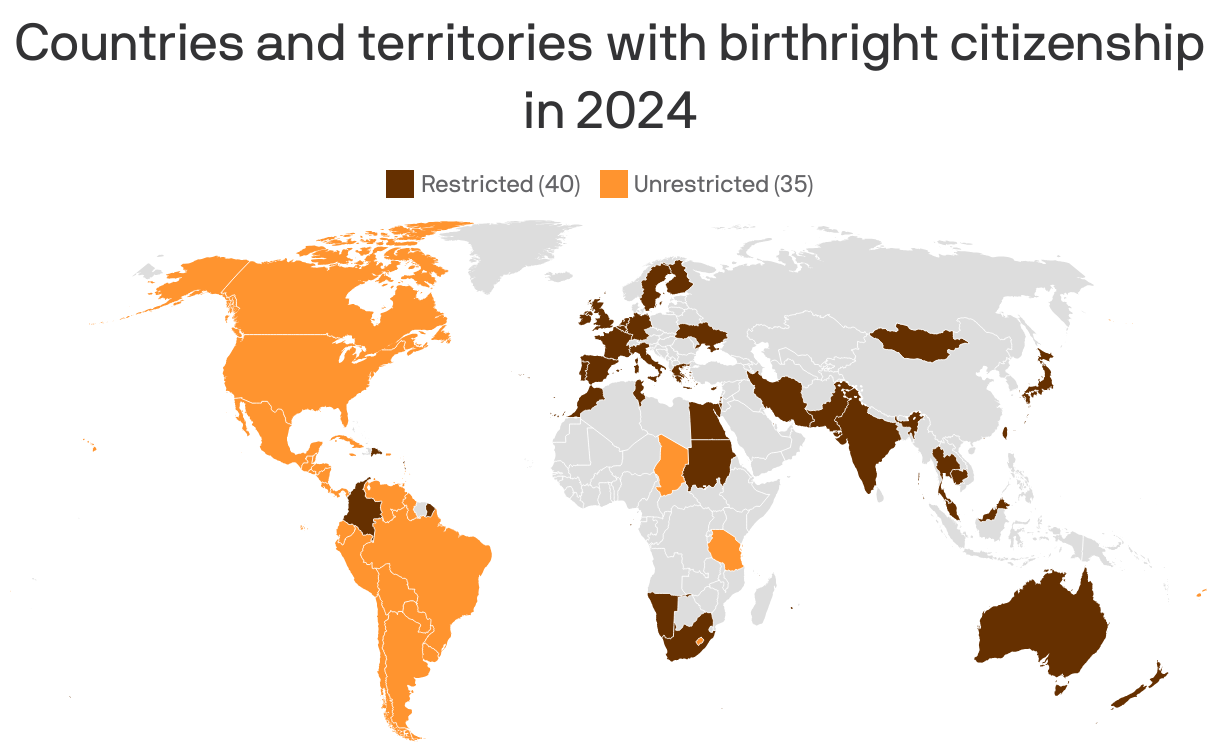
President Trump's challenge to birthright citizenship, a 19th-century constitutional doctrine, reached the Supreme Court on Thursday as it weighs courts' restrictions on Trump's executive orders.
The big picture: Though a core part of American citizenship, unrestricted birthright citizenship is mostly a facet of the Western Hemisphere.
- Many other nations make citizenship conditional on the legal status of the parents or a person's length of residency in the country, per the Library of Congress.
- In Africa, Asia and Europe, most countries either don't offer birthright citizenship or offer it conditionally, some through an application process.
- The 14th Amendment, which addresses citizenship, was added to the U.S. Constitution after the Civil War to protect freed slaves.
What we're watching: The Justice Department on Thursday will argue to the Supreme Court that lower courts shouldn't be able to halt Trump's plan to end birthright citizenship — or other executive actions, Axios' Sam Baker writes.
- Three courts have blocked the birthright policy from taking effect nationwide.
- Every district court to consider Trump's order said it was likely unconstitutional, and every appeals court has allowed injunctions to stay in place.
What they're saying: "The historical foundation of this principle in the U.S. reflects its aim to eliminate legal inequalities and promote inclusivity," the American Immigration Council said.
- Another explanation of its foundation is colonialism, John Skrentny, a sociologist at the University of California, San Diego, told Politifact in 2015 when Trump first raised his qualms with birthright citizenship.
- European colonizers, he said, wanted to build populations in North and South America to outnumber Indigenous populations.
- "Getting people to move in was a good way to establish authority," Skrentny added.
- He pointed out that birthright laws remain in South America, which has historically had fewer immigrants.
Zoom out: Universal birthright citizenship was restricted or abolished in Britain, Ireland, Australia, New Zealand and India in recent decades, the New York Times reported.
- Ireland in 2004 ended unrestricted birthright citizenship after 79% of voters supported a constitutional amendment that hinges citizenship on parents' residence and history.
- The Dominican Republic's abolition of birthright citizenship in 2013 denationalized about 200,000 people, largely of Haitian descent, according to the Center for Migration Studies.
- It was a decision the Inter-American Commission on Human Rights condemned and the Open Society Justice Initiative said was "part of a long history of discrimination against Dominicans of Haitian descent."
Catch up quick: Trump has faced criticism for rhetoric used to push for more limits on immigration and promote mass deportations.
- States and civil rights groups immediately sued his administration after the president signed the birthright citizenship order, which was set to take effect on Feb. 20.
- A U.S. district judge sided with four Democratic state attorneys general who argued in lawsuits that the order was unconstitutional, and the decision in January temporarily blocked the order nationwide.
- Trump's defense of the order was that children whose parents aren't citizens are "not subject to" American jurisdiction as envisioned in the 14th Amendment.
Go deeper:
- "Blatantly unconstitutional": Judge blocks Trump's birthright citizenship order
- Trump offers first defense of birthright citizenship order in court filing
- Tracking: States suing to block Trump's birthright citizenship order
Editor's note: This story has been updated to note that President Trump's challenge to the policy has reached the Supreme Court.
