Trump 2.0 softens on China


Add Axios as your preferred source to
see more of our stories on Google.
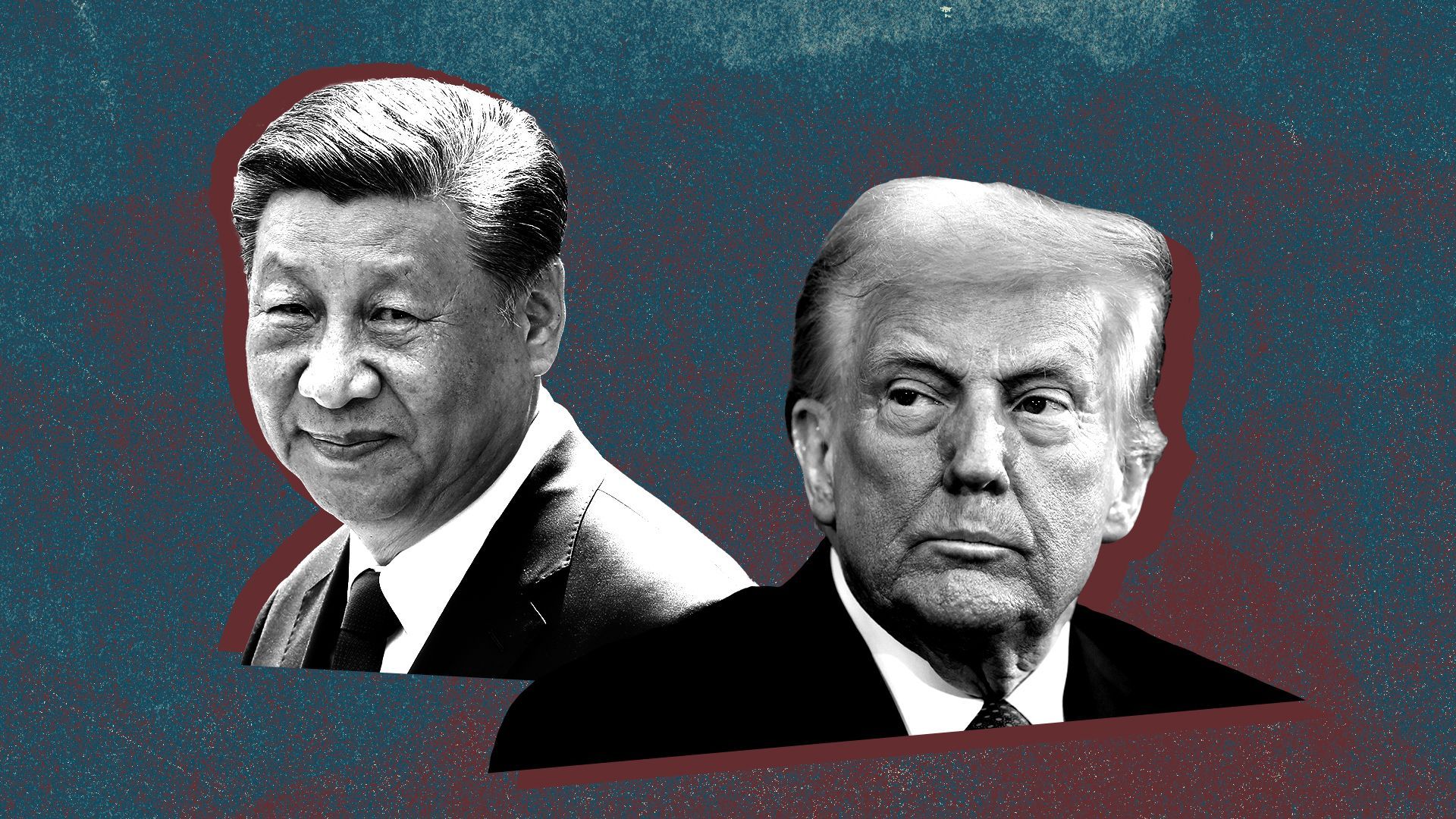
Photo illustration: Brendan Lynch/Axios. Photos: Getty Images
President Trump left Washington four years ago touting a revolutionary new consensus on the threat posed by China.
- He returned this week seeming to downplay that threat — signaling a potential thaw in relations between the world's two leading superpowers.
Why it matters: The stakes are enormous. How Trump deals with Chinese President Xi Jinping over the next four years will have sweeping implications for the global economy, AI, climate change, national security and more.
The big picture: After mentioning China just once in his inauguration address, Trump revealed he's considering 10% tariffs on Chinese products — far lower than the 60% duties he had threatened during the campaign.
- Trump held a phone call with Xi just days before the inauguration to discuss trade, fentanyl and TikTok — the Chinese-owned app that the president is now seeking to protect from a U.S. ban.
- Beijing's readout of the call was exceedingly warm, with state media declaring the two superpowers "can become partners and friends ... prosper together, and benefit both countries and the world."
Trump has struck a similar tone with his own rhetoric, even while insisting on the need for trade "fairness" and criticizing China for its operations near the Panama Canal.
- "I like President Xi very much. I've always liked him. We always had a very good relationship," he said at the World Economic Forum in Davos, acknowledging tensions ran high during the COVID pandemic.
- Trump went on to say he hopes China "can help us stop the war" in Ukraine, citing Beijing's close ties with Russia — and even suggested the three countries could work together on "denuclearization."
What they're saying: Trump's early actions undoubtedly signal a "more restrained" approach to Beijing, Jacques deLisle, a China scholar at the University of Pennsylvania Carey Law School, tells Axios.
- In a remarkable moment on Fox News, Trump was pressed by interviewer Sean Hannity on why he has defended TikTok given its reputation as a "spying app for the Communist Chinese."
- "You can say that about everything made in China," Trump shot back, citing cell phones and other imports. "Is it that important for China to be spying on young people, on young kids watching crazy videos?"
Flashback: It was Trump who first signed an executive order in 2020 warning China could use TikTok to conduct disinformation campaigns, build data dossiers for blackmail, and conduct corporate espionage on U.S. soil.
Between the lines: Investors like the sound of what Lu Zhou, CEO of investment firm Vanquor, called "a more pragmatic economic approach towards China."
- Zhou predicted Trump would "artfully implement certain tariffs on China" to satisfy the American people and his voters, but potentially hold back on blanket tariffs to satisfy certain Chinese officials.
- Mark Malek, chief investment officer of Siebert.NXT, agreed that Trump appears to be moderating his stance toward China — a dynamic that Wall Street and the bond markets "would love to see" continue.
The intrigue: Some experts believe Elon Musk could be a moderating influence on Trump's approach to China.
- Tesla has a factory in Shanghai and gets about 37% of its sales from China, according to Evercore ISI estimates, and Musk rarely criticizes Beijing —while constantly railing against "censorship" in Western countries.
- So if China were to retaliate against the U.S. over tariffs, TikTok or other Trump policies, Tesla would make a convenient target — especially now that Musk is so close to the new president.
- Chinese officials have also privately discussed the possibility of selling TikTok to Musk to allow the app to keep operating in the U.S., Bloomberg and The Wall Street Journal reported last week.
Reality check: Trump's Cabinet is stocked with China hawks like Secretary of State Marco Rubio and national security adviser Michael Waltz.
- Few experts view Trump's first week as a full retreat from his previous policy views, especially his plans for tariffs.
- "If the question is, 'Are we going to be back to sunshine and puppies?', the answer is definitely not," deLisle says.
What to watch: Trump's policies toward Taiwan, which Beijing has vowed to bring under its control, could be the ultimate indicator of where U.S.-China relations are heading.
- "Taiwan doesn't give us anything. Taiwan is 9,500 miles away. It's 68 miles away from China," Trump told Bloomberg Businessweek when asked whether the U.S. would come to the island's defense.
- "They did take about 100% of our chip business," he added. "I think, Taiwan should pay us for defense."
