TikTok is Trump's problem now

Add Axios as your preferred source to
see more of our stories on Google.

Illustration: Sarah Grillo/Axios
Years of debate, months of procrastination and weeks of panic have brought the U.S. to the brink of banning TikTok — a bipartisan achievement that top politicians suddenly want nothing to do with.
Why it matters: On the eve of his inauguration, President-elect Trump is facing an enormous challenge to his popularity, his executive power and his word. He has vowed to save TikTok — but failed to explain how he can do so without violating U.S. law.
The latest: The Supreme Court on Friday upheld the law passed by Congress last year that forces Chinese parent company ByteDance to divest from TikTok by Jan. 19, or else face a ban in the U.S.
- The decision was unanimous, with all nine justices shrugging off a brief from Trump asking the court to delay the ban so that his administration could "pursue a negotiated resolution."
- President Biden, who signed the TikTok bill into law, will not enforce the ban — saying in a statement Friday that "actions to implement the law simply must fall" to the Trump administration, given the timing.
- TikTok, meanwhile, said the app "will be forced to go dark" on Sunday unless the Biden administration "immediately provides a definitive statement to satisfy the most critical service providers assuring non-enforcement."
State of play: Trump is now in a serious bind.
- It was his administration that spearheaded the initial push to ban TikTok via executive order in 2020, citing the national security threat posed by Beijing's potential influence over the app and its user data.
- Trump became a defender of TikTok once he realized how powerful it could be as a campaign messaging tool, especially among young people.
- Now, for many of the platform's 170 million American users, Trump's first day in office threatens to be overshadowed by — or worse, forever tied to — the disappearance of TikTok from app stores.
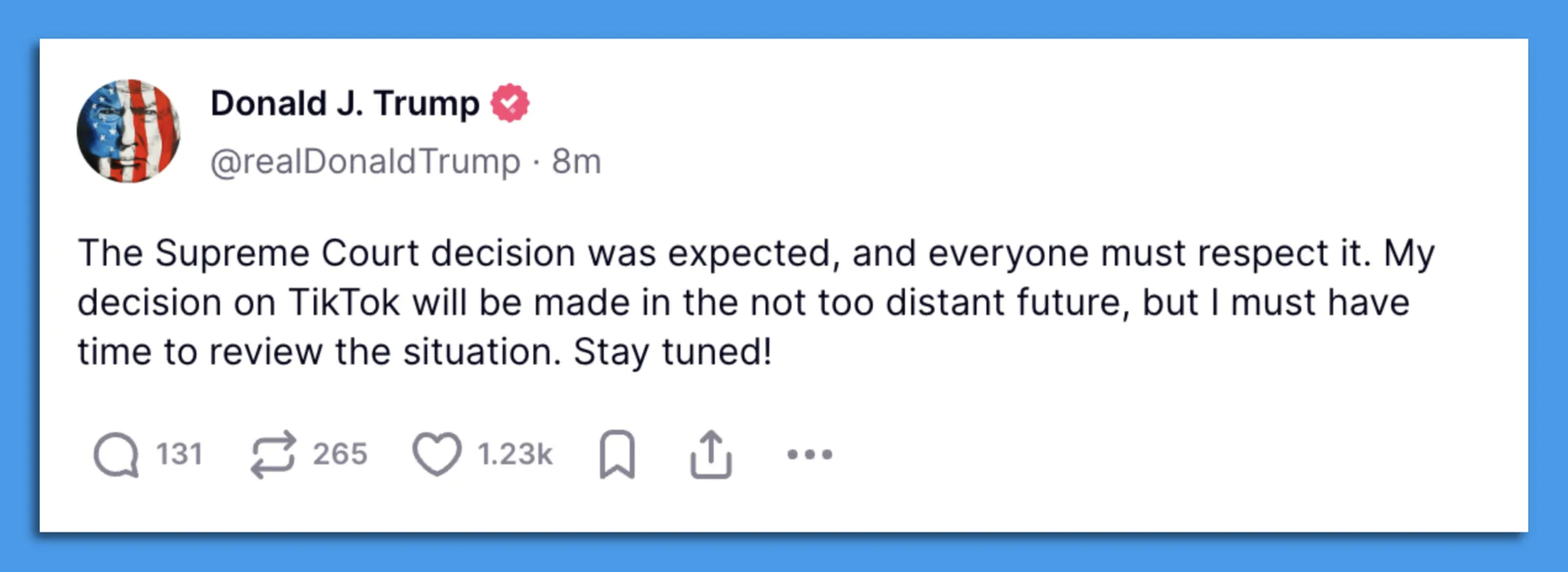
What to watch: Trump is considering an executive order delaying enforcement of the TikTok ban to give the administration time to find a U.S. buyer, despite ByteDance's refusal to sell for the past eight months.
- It's unclear how the executive order could bypass the letter of the law, and app stores run by Google and Apple could face fines and liability risk if they ignore the Supreme Court's ruling.
- Still, Trump is trying: He discussed TikTok with Chinese President Xi Jinping in a phone call Friday, and has invited TikTok CEO Shou Zi Chew to be a VIP at Monday's inauguration.
The intrigue: One of the biggest obstacles to Trump's salvation mission is his own party.
- Sen. Tom Cotton (R-Ark.), the chair of the Intelligence Committee, blocked Democrats' attempt to extend the deadline for the ban on Thursday.
- "Let me be crystal clear: there will be no extensions, no concessions, and no compromises for TikTok," Cotton said, echoing the hawkish language typical of most Republicans before Trump's change of heart.
- Sen. Marco Rubio (R-Fla.), Trump's nominee for secretary of state, was among the very first lawmakers to raise the alarm about TikTok in October 2019 — though he has indicated he will now defer to Trump.
Between the lines: In many ways, the dynamics around banning TikTok are a microcosm of the broader debate over the U.S.-China competition.
- "Decoupling" the two economies may sound like the shrewd national security approach, but the practical consequences — and potential for public backlash — are staggering.
- In the days leading up to the ban, hundreds of thousands of self-described "TikTok refugees" have downloaded the Chinese app RedNote — its name believed to be a reference to Mao Ze Dong's "Little Red Book."
- The cross-pollination has led to an unprecedented cultural exchange between young Americans and Chinese users — and an anti-U.S. propaganda coup that Beijing could only have dreamed of.
