The 118th Congress passed the fewest bills in decades

Add Axios as your preferred source to
see more of our stories on Google.
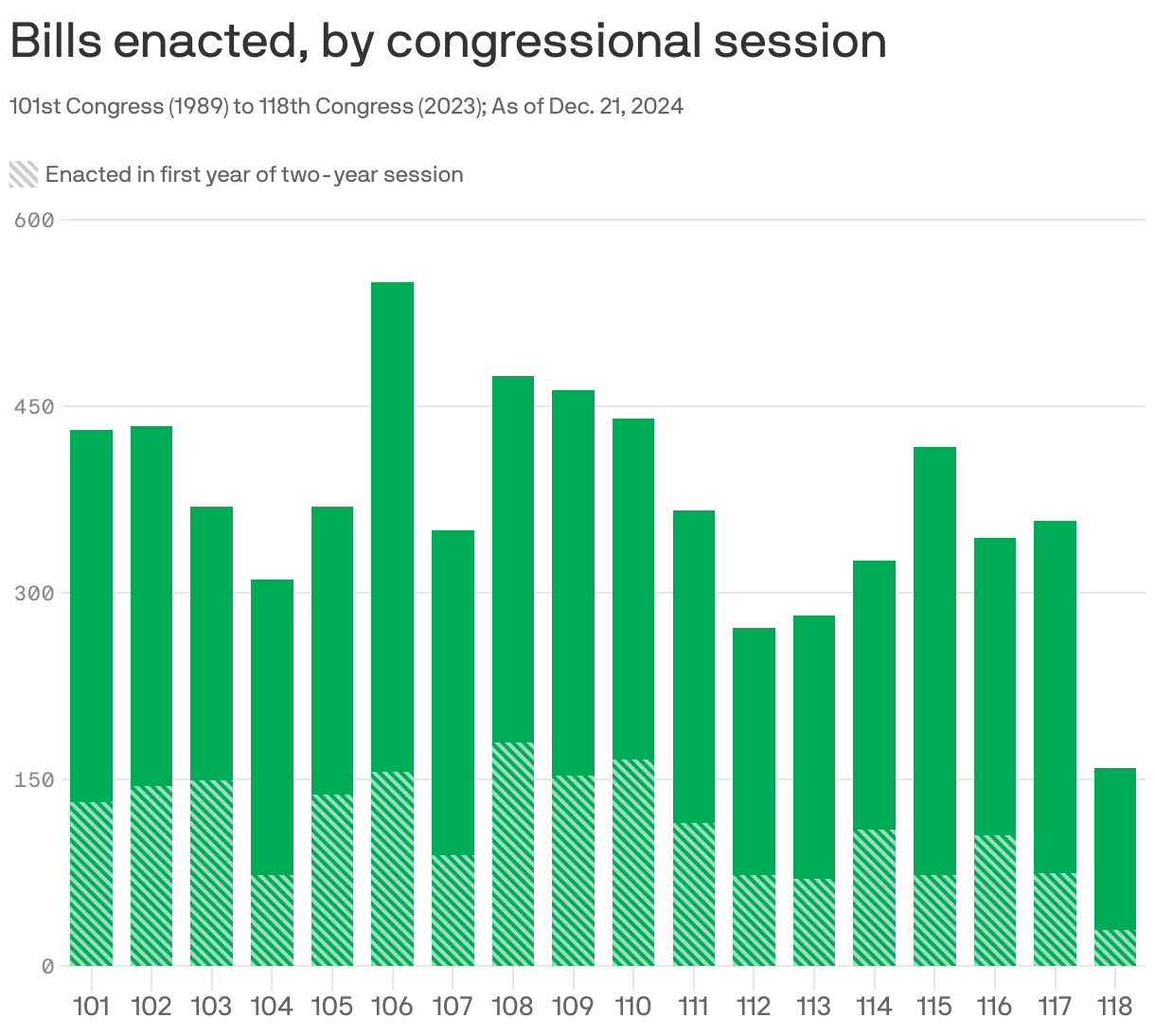
If measured by the number of bills signed into law, the 118th Congress was by far the most unproductive since at least the 1980s, according to data from public affairs firm Quorum.
Why it matters: That is not the only metric of success, but the stunning stat is a marker of how difficult the chaos of the last two years made actual legislating.
- Every fiscal deadline led to brinksmanship between the Republican House and the Democratic Senate and White House.
- House Republicans were also beset by infighting and palace intrigue, most notably the ouster of former House Speaker Kevin McCarthy.
- Throughout the disarray, trust between House Democrats and Republicans reached a low ebb— making bipartisan compromise rare.
By the numbers: The 118th Congress passed just under 150 bills over the last two years, according to the Quorum data provided to Axios.
- That's down from more than 350 passed in the previous Congress — in which Democrats held control of both chambers and the White House.
- The 17 Congresses since the start of George H.W. Bush's presidency in 1989 have passed an average of more than 380 bills.
Zoom in: Split partisan control of Congress and the White House can account for much of the disparity.
- Aside from this Congress, the previously most unproductive sessions were the 112th and 113th — in which Republicans controlled the House and clashed bitterly with President Obama.
- After that, it was the 104th, in which President Clinton faced a similar dynamic with a Republican-controlled Congress.
- Still, those Congresses passed more than 270, 280 and 310 bills, respectively, making them far more productive than the 118th.
Between the lines: There is more than one way to pass a law, as this month's government funding fight demonstrated.
- A nearly 1,550-page stopgap spending bill was packed to the gills with tangential legislation on health care, U.S. investment in China, RFK Stadium in D.C. and congressional pay and benefits.
- Those measures — called "riders," because they ride a larger, must-pass package — would have counted as one law for the purpose of this statistic.
- Congress ended up passing a trimmed-down package, and some of the excluded bills got passed anyway while others were left on the cutting room floor.
What to watch: The big test for House Speaker Mike Johnson (R-La.) next year will be to prove that this Congress' lack of legislative productivity was the result of split partisan control and not GOP infighting.
- Republicans are set to control the House, Senate and White House, but Johnson's agonizingly small majority will afford him at times one or even zero defections on party-line bills.
- His first test will come on Jan. 3, when Congress elects the speaker. Rep. Thomas Massie (R-Ky.) has said he won't vote for Johnson, while many other right-wingers remain undecided.
Editor's note: This story's headline has been updated to reflect the 118th Congress passed the fewest bills (not laws) in decades.
