Trump's conspiracy cabinet is about to take over the deep state

Add Axios as your preferred source to
see more of our stories on Google.
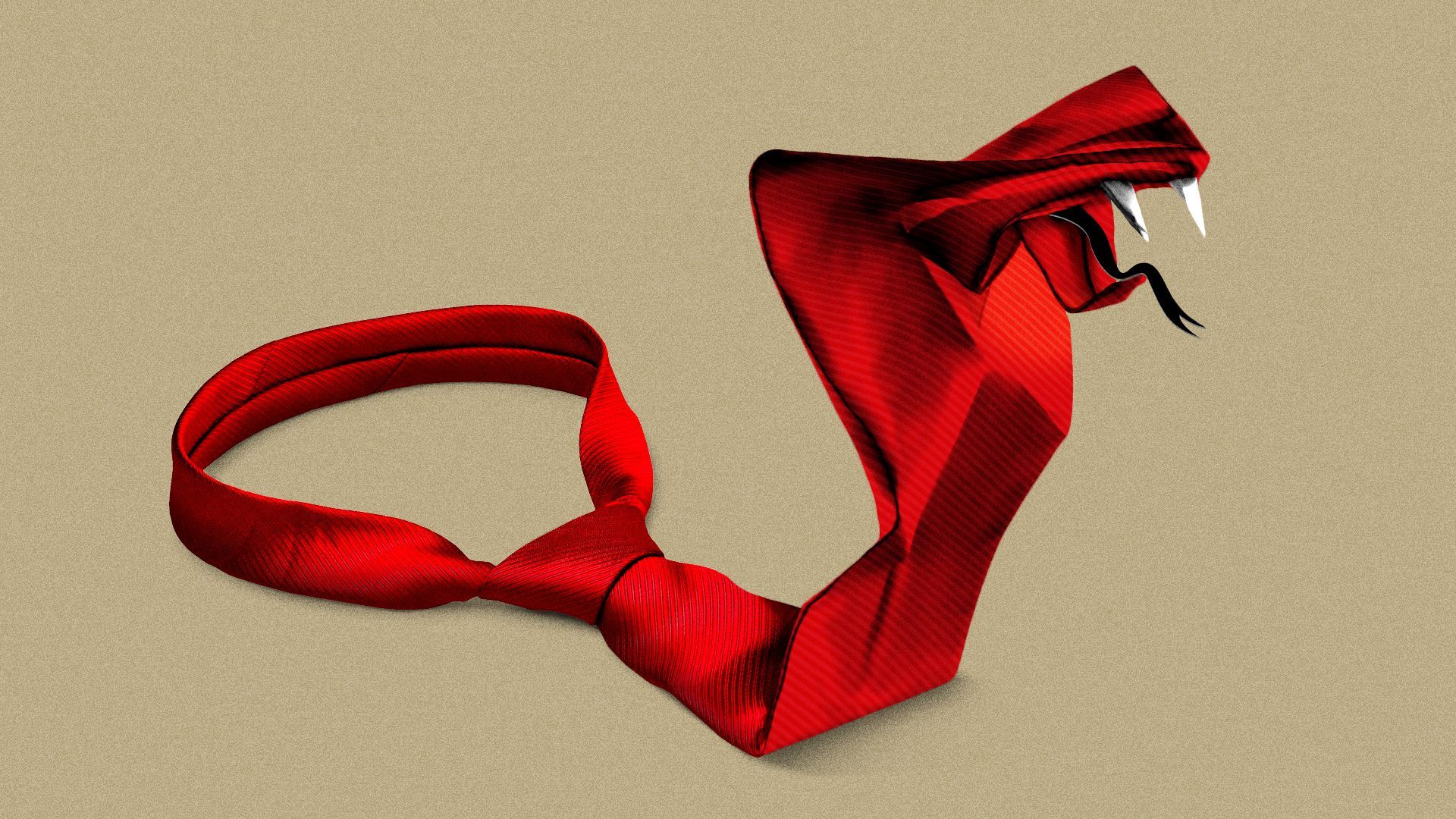
Illustration: Maura Losch/Axios
President-elect Trump will return to the Oval Office backed by a new team of senior officials and Cabinet members who are committed to exposing supposed conspiracies within the "deep state" they will now help run.
Why it matters: Trump bounded into politics with the racist "birther" conspiracy, crafted the '"Big Lie" to explain away his 2020 loss, and was swept back into office after falsely claiming Haitian immigrants were eating family pets in Ohio. Key players in his second administration share his conspiratorial worldview and are ready to act on it.
- Trump's new cadre includes world's richest man Elon Musk; Robert F. Kennedy Jr., the scion of Democrats' most storied political family; and QAnon-celebrated Kash Patel who all — no matter how wealthy or powerful — are motivated by the belief that they've been thwarted by a shadowy network of enemies and it's their duty to root them out on Trump's behalf.
- The anti-establishment will now grip the establishment's reins.
- Rather than typical GOP functionaries, Joseph Uscinski, a conspiracy theory researcher at the University of Miami, said Trump's criteria for top jobs appears to be "'Are they taken with conspiracy theories? Do they have antagonisms towards the political establishment?'"
State of play: A whole new media ecosystem has evolved to bolster Trump World's persecution complex from Trump's own platform, Truth Social, to Musk-era X, where MAGA influencers and their frequently false claims thrive.
- That's not to say conspiracy theories don't exist in traditional media or on the left: Trump's opponents are prone to their own misinformation.
- However, a government steeped in conspiracy theories can be "incredibly dangerous," Uscinski said.
- "When governments start engaging with conspiracy theories and start acting on them, they can do so ... with a monopoly on the use of authoritative force," he said.
The latest: RFK Jr., Trump's pick for secretary of Health and Human Services, is well-known for spreading vaccine conspiracy theories. But Axios learned he views his connection to Trump as a chance to validate his belief that the CIA had a role in his uncle's assassination.
- He pushed for his daughter-in-law, Amaryllis Fox Kennedy, to be named deputy CIA director in hopes she'd uncover a conspiracy to murder President John F. Kennedy.
Kash Patel, the president-elect's choice for FBI director, railed against the "deep state" on right-wing podcasts, with his "government gangsters" list and in his children's books.
- He's pushed the baseless theory that the Jan. 6, 2021, attack was instigated by the FBI and flirted with QAnon, signing some copies of his children's books with one of the movement's slogans, NPR reported.
Ex-Democrat Tulsi Gabbard, Trump's pick for director of national intelligence, echoed debunked claims about Ukraine and has been accused of parroting Russian propaganda.
- If confirmed, Gabbard would oversee 18 agencies, including the CIA and FBI.
Vivek Ramaswamy, who will lead the unofficial Department of Government Efficiency alongside Musk, raised eyebrows for floating 9/11 and Jan. 6 conspiracy theories.
- He's also said the "climate change agenda" is a "hoax."
Musk himself has been a megaphone for conspiracy theories to his millions of followers on X.
While the number of people espousing conspiracy theories has not necessarily increased over time, Uscinksi says, conspiracy theorists found a home within Trump's ideology and messaging.
- "The only conspiracies are coming from Democrats and their enablers in the media for engaging in the totally debunked Russia collusion hoax, impeachment scams, and the weaponization of the justice system through their failed witch hunts," Trump communications director Steven Cheung said in a statement to Axios.
The bottom line: While Trump isn't making more people believe conspiracy theories, Uscinksi said, Republicans today — in particular those who "really like Trump" — exhibit more signs of conspiracism than the GOP of the past.
- "The interesting thing now is, given what Trump has done to the Republican Party ... essentially turning it into a sort of populist, anti-establishment, conspiracist party ... is that they've pulled in a lot of people who believe a lot of conspiracy theories about a whole lot of things."
Go deeper: The GOP's big, mysterious enemy: "They"
