"President-elect immunity does not exist:" Prosecutors on Trump hush money case

Add Axios as your preferred source to
see more of our stories on Google.
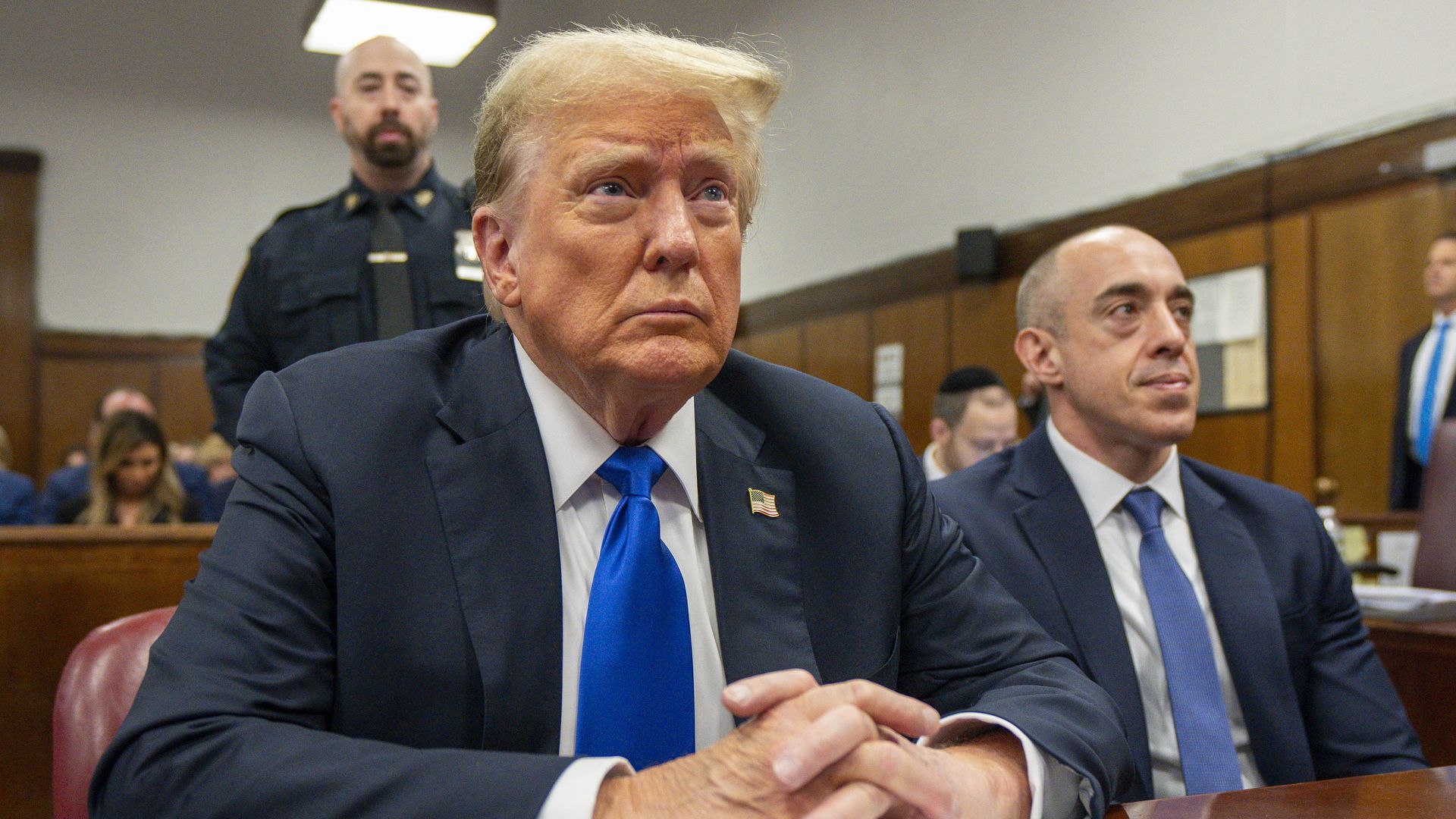
Trump appears in court for his hush money trial at Manhattan Criminal Court on May 30 in New York City. Photo: Steven Hirsch-Pool/Getty Images
Manhattan District Attorney Alvin Bragg argued in a court filing made public Tuesday that President-elect Trump's hush money conviction should not be tossed out because of his White House win.
Why it matters: As Trump's federal cases crumble as a result of his election victory, New York officials are standing by their historic prosecution.
- The New York attorney general's office also wrote in a letter dated Monday that there is "no merit" to the argument that Trump's appeal of his civil fraud judgment would impede his presidential duties.
- Judge Juan Merchan indefinitely postponed the president-elect's sentencing in his criminal hush money case last month, granting Trump a legal win.
- While special counsel Jack Smith has walked back his federal cases against Trump, the president-elect's New York conviction, which made him the first felon elected to the White House, hangs over his impending second term.
Driving the news: Bragg's office wrote in a filing that "President-elect immunity does not exist." Even after Trump is inaugurated, prosecutors added, that temporary immunity would still not justify "the extreme remedy of discarding the jury's unanimous guilty verdict."
- The district attorney's filing followed a push from Trump's team last week to dismiss the case on the merits that it would interfere with his presidency and transition. It also cited President Biden's pardon of his son, Hunter Biden, and criticized the Justice Department.
The bottom line: Bragg's office rebutted concern from Trump's team that the soon-to-be president could face potential jail time, noting the court is under no obligation to impose a sentence of incarceration and highlighting Trump's lack of prior criminal convictions.
- "The Court could therefore conclude that presidential immunity, while not requiring dismissal, nonetheless would require a non-incarceratory sentence in these circumstances," the filing read.
- The prosecution also noted in the filing that it would be "reasonable" for sentencing to be delayed until after Trump's upcoming term.
- Bragg's office offered another option, saying the court could follow the framework used when a defendant dies after they are found guilty. In those scenarios, the court could note in the record that the "conviction removed the presumption of innocence" but was not affirmed nor reversed.
Catch up quick: After Trump was found guilty on 34 counts of falsifying business records in May, Merchan set his sentencing for July.
- But the judgment in the case was consistently punted, chilled by the Supreme Court's landmark immunity ruling amid a presidential election year.
Zoom out: New York Attorney General Letitia James' office also pushed back on efforts from Trump's legal team to drop the civil case against Trump.
- "The ordinary burdens of civil litigation do not impede the President's official duties in a way that violates the U.S. Constitution," Deputy Solicitor General Judith Vale wrote in a message to Trump attorney John Sauer, whom the president-elect has tapped to serve as the next U.S. solicitor general.
Go deeper: Where Trump's cases stand as Inauguration Day nears
