Biden has some catching up to do on pardons


Add Axios as your preferred source to
see more of our stories on Google.
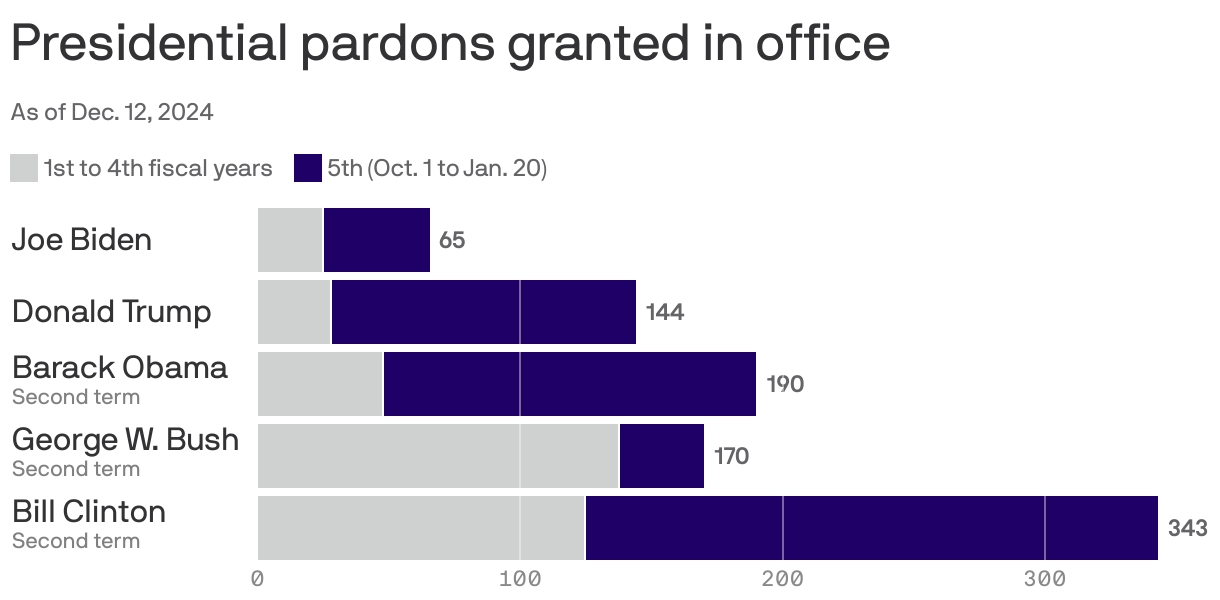
President Biden's pardon of his son Hunter ignited a debate over whether Biden was abusing his power for personal reasons, but he'll have to issue well over 100 more in his last few weeks in office to come close to his predecessors' totals.
Why it matters: The final days of a presidency are the season of pardons, as presidents seek to right what they see as judicial wrongs before they leave D.C. And after Biden's controversial pardon of his son, he's facing enormous pressure to flex his clemency muscle.
By the numbers: Biden actually has been reluctant to show mercy — handing out just 26 pardons and commuting 135 criminal sentences since he took office in January 2021. He's granted just 1.2% of the requests he's received, according to data from the Justice Department's Office of the Pardon Attorney.
- President-elect Trump — who had fewer acts of clemency than his recent predecessors during his first term — had granted 29 pardons at this point in 2020.
- But in the final weeks as the nation's 45th president, Trump nearly quintupled his number of pardons, ending with a total of 144.
What they're saying: White House Press Secretary Karine Jean-Pierre said this week that Biden — now being deluged with requests — is "thinking through that process [of end-of-year clemency announcements] very thoroughly."
- "I''m not going to get ahead of the president on this, but you could expect more ... pardons and clemency at the end of this term," she said.
Zoom in: Barack Obama, who had the most clemency grants of any president since Harry Truman, ended his two terms with 212 pardons and a whopping 1,715 commutations, far more than any recent president.
- The bulk of Obama's commutations cleared sentences for prisoners who had been convicted of drug charges.
Between the lines: Biden's decision to pardon his son drew outrage from Republicans and some Democrats who criticized the president for reneging on his promise not to pardon his son on gun and drug charges.
- But Biden is hardly the first president to grant a controversial, 11th-hour pardon family member or friend.
- On Bill Clinton's last day in office in 2001, he pardoned his half-brother, Roger Clinton Jr. — whose Secret Service code name was "Headache" — for his 1985 convictions on cocaine possession and drug trafficking. Roger Clinton was among 176 people pardoned that day.
- In 1974, Gerald Ford granted a "full, free and absolute pardon" to former President Nixon in an attempt to help the nation move on from the Watergate scandal that had led Nixon to resign.
- Ford paid a political price two years later when he lost the presidential election to Democrat Jimmy Carter, who campaigned on a promise to never lie to the American people.
Trump notoriously used his clemency power for people to whom he had personal or political ties. Weeks after he lost the 2020 presidential election, Trump pardoned Roger Stone, Paul Manafort and Charles Kushner, among others.
- Manafort was a former Trump campaign manager who'd been sentenced to seven years in prison for bank and tax fraud and other crimes. Stone, a GOP operative and Trump loyalist, had been convicted of lying to Congress in the federal probe into Russia's interference in the 2016 election.
- Kushner, Ivanka Trump's father-in-law, was pardoned after serving two years in prison for tax evasion and retaliating against a federal witness. Trump now has nominated Kushner, a fellow billionaire, to be the U.S. ambassador to France.
The intrigue: Biden's White House is considering giving preemptive pardons to officials who could be targets for prosecution by the incoming Trump administration, Politico's Jonathan Martin reported.
- Trump repeatedly has vowed to use the government to retaliate against his political enemies.
Go deeper: Congress hands Biden a huge Hunter-driven pardon wishlist
