2024's record-breaking, destructive Atlantic hurricane season ends

Add Axios as your preferred source to
see more of our stories on Google.
The active and destructive 2024 Atlantic hurricane season is nearing its official end on Saturday after a puzzling yet profoundly damaging run.
- The season featured an early flareup of activity — then a long, mysterious pause, followed by a backloaded blitz of storms that included two major hurricane U.S. landfalls.
Why it matters: Some of the season's storms bore the hallmarks of human-caused global warming, especially their rapid intensification and devastating amounts of rainfall.
Zoom in: Due to a combination of record hot ocean temperatures and predicted La Niña conditions in the tropical Pacific Ocean, forecasters universally projected an above-average to much-above-average season.
- In the end, the North Atlantic basin spun up 18 named storms, with maximum sustained winds of at least 39 mph. Eleven of these storms were hurricanes, along with five major hurricanes of Category 3 or greater, according to NOAA.
- Five hurricanes hit the mainland U.S., including two major hurricanes, Hurricanes Helene and Milton. Helene alone caused more than 200 fatalities.
- On July 1, the Atlantic saw its earliest Category 5 storm on record, with Hurricane Beryl.
A typical Atlantic hurricane season features 14 named storms, seven hurricanes and three major hurricanes.
Between the lines: The unusually hot sea surface temperatures that existed throughout the season across the Atlantic — from the Gulf of Mexico and Caribbean to the central and eastern Atlantic — set records and stemmed in part from human-caused global warming.
- When the atmosphere was cooperative, these hot ocean waters served as a key ingredient for extraordinarily rapid hurricane intensification rates throughout the season.
- Hurricane Milton's maximum sustained winds, for example, jumped by an astonishing 90 mph in a 24-hour period from Oct. 6 to Oct. 7, one of the most significant intensification rates on record.
- At least two studies found that climate change increased the maximum wind speeds in Hurricanes Helene and Milton. In fact, one of these studies found evidence that climate change boosted each 2024 Atlantic hurricane.
Researchers also found that climate change worsened the flood impacts of Helene by boosting its total rainfall by about 10%, and increasing the likelihood of such a severe event by up to 70%.
What they're saying: According to Steve Bowen, chief science officer at Gallagher Re, direct economic damage and losses from storms that hit the continental U.S. this year will likely exceed $100 billion, most of which will be from Helene and Milton.
- He said the recovery from Helene will be "prolonged and challenging for many" in part because of the sparse uptake of insurance policies under the National Flood Insurance Program in the hardest-hit portions of North Carolina and Tennessee.
- Viewed more broadly, he said, "more than 60% of U.S. tropical cyclone damage costs from this season will be uninsured — despite the fact that [the] insurance industry will have paid tens of billions in claims to help people get back on their feet."
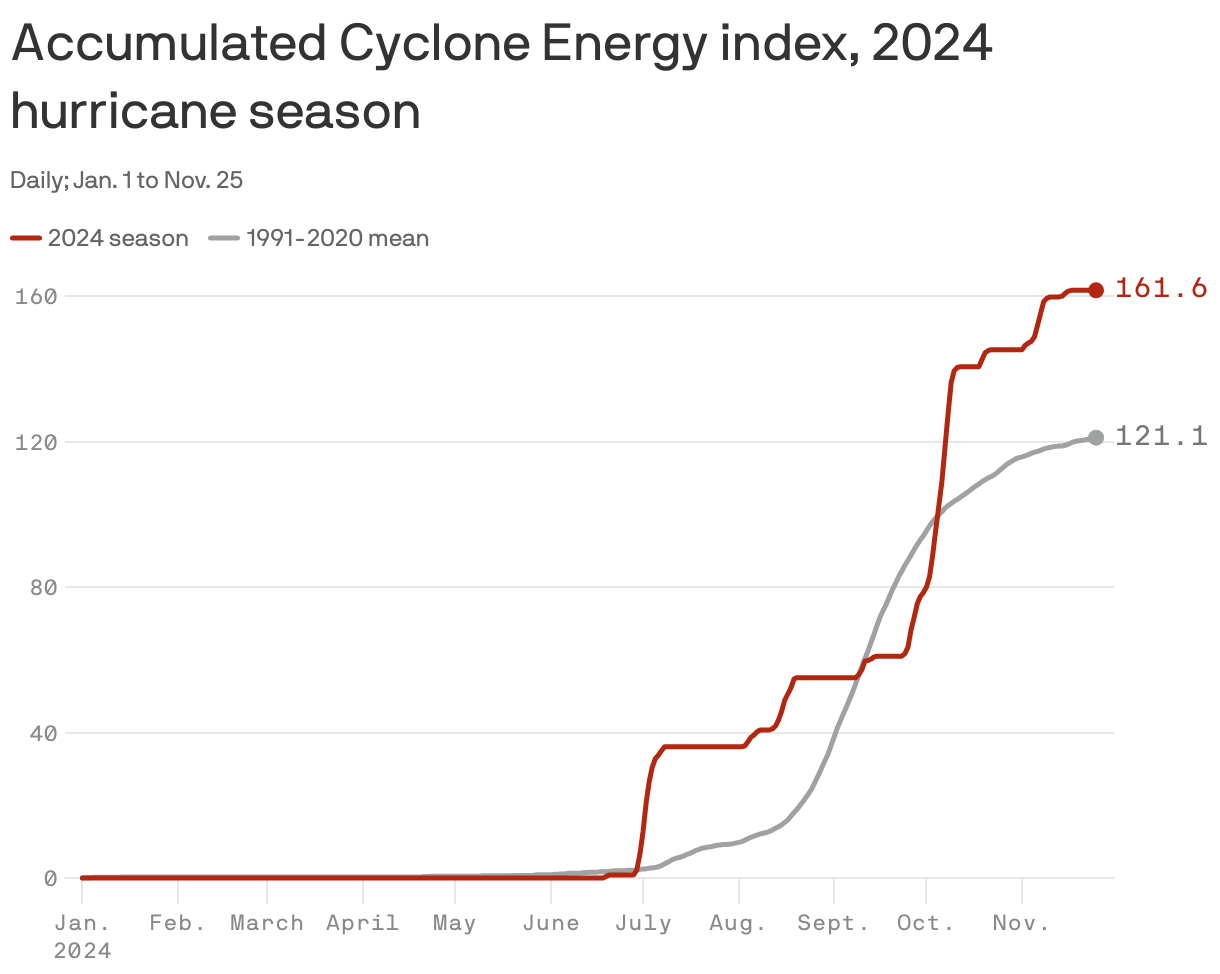
The intrigue: The Accumulated Cyclone Energy, or ACE Index, is a metric that incorporates the number of storms and their intensity and duration. It's considered to be a reliable indicator of a season's overall activity level.
- Going by this index, the 2024 Atlantic hurricane season was clearly exceptionally active though not record-setting, despite the favorable ocean conditions.
- There were, however, multiple instances in which storms rapidly intensified, consistent with trends tied to climate change and record warm waters.
The bottom line: While the season wasn't quite as extraordinarily active as some had predicted, it was above average in virtually all categories and wrought impacts that will be remembered for generations.
