Trump's messy coalition

Add Axios as your preferred source to
see more of our stories on Google.
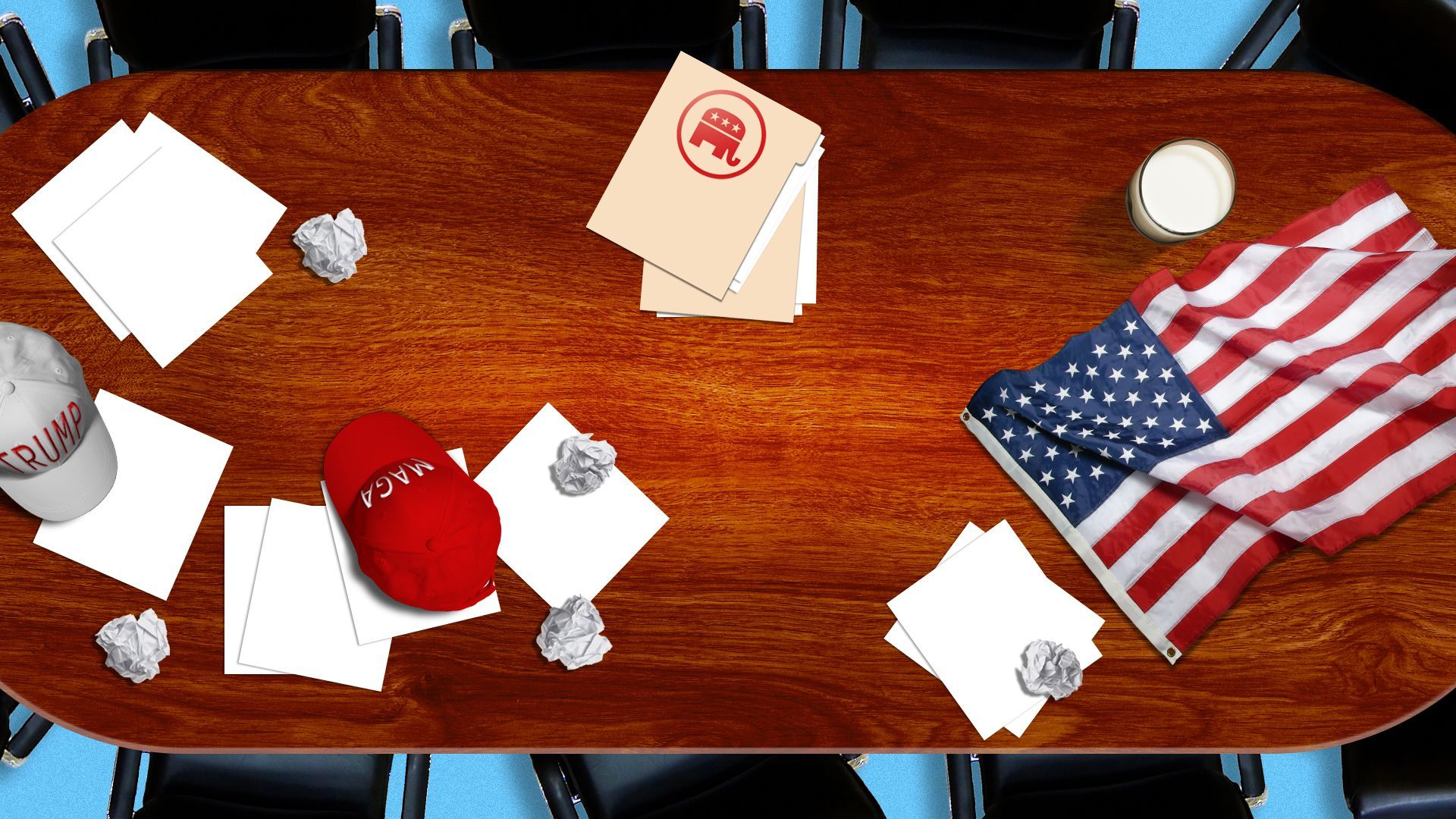
Illustration: Sarah Grillo/Axios
President-elect Trump's Cabinet increasingly resembles a European-style coalition government, staffed with a dizzying array of ideological rivals united — for now — by a grand MAGA vision.
Why it matters: The incoming administration has a little something for everyone: isolationists and hawks, populists and bankers — even a couple of lifelong Democrats who ran for president against Trump.
- Some supporters have praised Trump for the eclectic mix of nominees, saying it reflects the broad range of Americans who voted decisively for a new Washington.
- But if Trump's first term is any indication, his Cabinet of contradictions also could invite volatility and infighting that eventually spills into public view.
The big picture: Trump's picks suggest there are at least three factions in the new Republican coalition with enough support to warrant representation in his administration.
1. "America First" nationalists: These are the true believers tasked with Trump's highest-priority portfolios.
- Attorney General nominee Matt Gaetz would take a torch to the Justice Department, acting as the ultimate Trump loyalty cop in addition to being the nation's top law enforcement official.
- Defense secretary nominee Pete Hegseth is eyeing a cultural overhaul at the Pentagon, where he has vowed to eliminate diversity programs and fire generals he deems to be "woke."
- Border czar Tom Homan and immigration adviser Stephen Miller will be the zealous architects of what Trump says will be the largest mass deportation operation in U.S. history.
2. Establishment conservatives: The dominant forces in Trump's first Cabinet — think former Vice President Mike Pence, Treasury Secretary Steven Mnuchin and National Security Adviser John Bolton — have been weakened, but not fully exiled.
- A trio of early appointments helped settle stomachs in the national security establishment: Sen. Marco Rubio (R-Fla.) for secretary of State, Rep. Michael Waltz (R-Fla.) for national security adviser and Rep. Elise Stefanik (R-N.Y.) for UN ambassador.
- But it's these types of hawkish nominees that most risk upsetting Trump's base: MAGA influencers were infuriated by the Rubio pick, blasting him as a "neocon" who supports U.S. intervention abroad.
3. Dissident Democrats: The newest members of MAGA are among the most powerful, having endeared themselves to Trump's base as anti-establishment crusaders. They're also most likely to cause cracks in the coalition.
- Elon Musk, the billionaire charged with slashing the federal bureaucracy from outside government, has glued himself to Trump's side and clashed with at least one top adviser over Cabinet picks.
- Robert F. Kennedy Jr., the vaccine skeptic nominated to lead the nearly $2 trillion Department of Health and Human Services, has drawn opposition from some conservatives over his support for abortion rights. His vision for regulating the pharmaceutical industry also collides with the views of Vivek Ramaswamy, Musk's partner in shrinking government.
- Former Rep. Tulsi Gabbard, nominated to head the U.S. intelligence community, is a staunch anti-interventionist who has disparaged Republican hawks as "warmongers" — including Rubio, with whom she'll share a table at Cabinet meetings.
Zoom in: The ongoing fight over who will lead the Treasury Department is a microcosm of the competing economic ideologies in Trump's coalition.
- Trump is a dyed-in-the-wool protectionist who wants someone to faithfully execute his plans to impose sweeping tariffs, which could ignite a global trade war and supercharge inflation.
- But the president-elect is also fearful of rattling the stock market and wants a steady hand who can reassure Wall Street — a mission fundamentally at odds with his tariff agenda.
- Hedge fund manager Scott Bessent, Apollo CEO Marc Rowan and former Fed governor Kevin Warsh are believed to be the finalists, after Trump tapped pro-tariff billionaire Howard Lutnick to be Commerce secretary.
The bottom line: Unlike 2017, every one of Trump's nominees would enter government with eyes wide open about what the president values more than ideology or intellect: loyalty.
- That alone could ensure a far smoother first year.
