Letter: Israel vows not to forcibly displace Palestinians from northern Gaza

Add Axios as your preferred source to
see more of our stories on Google.
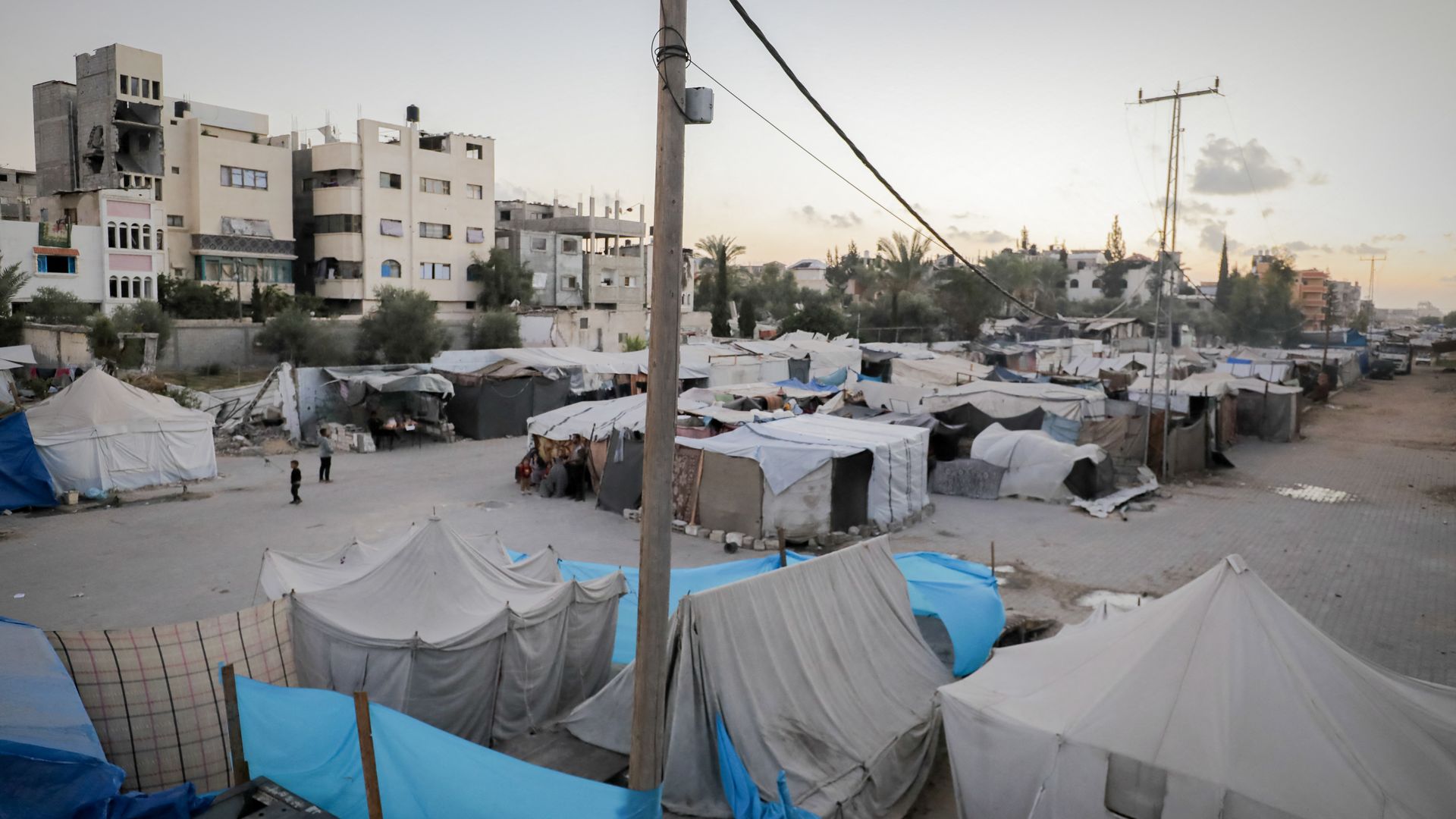
Tents fill a displacement camp in central Gaza. Photo: Moiz Salhi/Middle East Images/AFP via Getty Images
Israel formally promised the Biden administration last week that it has no intention of forcibly displacing Palestinians from northern Gaza or starving the civilian population there, according to a copy of the letter obtained by Axios.
Why it matters: Despite the assurances, Biden administration officials are deeply concerned that the Israel Defense Forces will not allow tens of thousands of Palestinian civilians that left northern Gaza — especially the town of Jabalia — to return.
- The officials also expressed concern that the Israeli commitments will not be relevant once the Trump administration assumes office, given the diminished threat of the U.S. suspending military assistance.
Between the lines: The Israeli letter was sent in response to an ultimatum laid out by Secretary of State Antony Blinken and Secretary of Defense Lloyd Austin on Oct. 13 regarding the humanitarian crisis in Gaza. The situation in northern Gaza was one of the key concerns raised by the Biden administration.
- The deadline for the ultimatum expired last Wednesday. If the Biden administration had determined Israel wasn't taking sufficient steps to increase aid to Gaza, the U.S. could have suspended arms supplies to Israel, in accordance with U.S. law.
- State Department deputy spokesman Vedant Patel said last week that the Biden administration hasn't made an assessment "at this time" that Israel is in violation of U.S. law, but stressed that this assessment is ongoing.
Driving the news: The letter, dated Nov. 13, was sent a day after Israeli minister for strategic affairs Ron Dermer visited Washington and briefed Blinken and national security adviser Jake Sullivan on measures to address U.S. concerns about Gaza.
- The 23-page letter, addressed to Blinken and Austin and signed by Dermer and Israel's minister of defense Israel Katz, includes a long list of steps the Israelis have taken over the last month — or plan to take in the coming weeks — to improve the humanitarian situation.
- Two Biden administration officials told Axios the Israelis would never have taken these steps without the U.S. ultimatum and the threat of suspension of military assistance.
What they're saying: "Israel affirms that it has no policy of forced evacuation of civilians from anywhere in the Gaza Strip, including northern Gaza," Katz and Dermer wrote in the letter.
- The Israeli ministers claimed the IDF has not issued "evacuation orders" to Palestinian civilians at any point in the war, but has instead warned civilians in certain areas in advance of military operations.
- They stressed no civilians has been "forced to leave," and that the population that chooses to remain is taken into consideration during operational planning, including the facilitation of humanitarian assistance.
Zoom out: In practice, the Israeli military operation in Jabalia pushed 55,000 Palestinians to leave. Hundreds of Palestinians, many of them women and children, were killed in the operation — including in airstrikes on residential buildings.
Zoom in: Katz and Dermer also pushed back on the claim that Israel is implementing a plan for the starvation of northern Gaza in order to force Hamas militants to surrender.
- "The claim that the so-called 'Generals Plan' was either approved by the political and military ranks or is being implemented by Israel is completely false," they wrote.
- Katz and Dermer said Israel doesn't limit the entry or the provision of humanitarian assistance anywhere in Gaza, and "certainly does not do so in an attempt to coerce the evacuation of civilians."
Yes, but: In practice, the access of aid trucks was limited during the operation in northern Gaza strip, and very little aid managed to reach Jabalia.
State of play: The number of aid trucks entering Gaza increased to 200 per day the first two weeks of November, according to the letter. The Israeli security cabinet has ordered the IDF to increase the daily figure to 250 trucks and verify that enough trucks enter northern Gaza.
- The U.S. has demanded Israel allow 350 trucks per day. Katz and Dermer claimed the UN's inability to send enough trucks to the crossings is to blame for the missed goal, but said Netanyahu has ordered the IDF to get to 350 trucks as soon as possible.
- The Israeli ministers noted that Israel stopped the delivery of aid through commercial channels because it benefited Hamas and strengthened its rule over Gaza.
- "[I]f the entry of humanitarian aid in non-commercial channels should prove insufficient, Israel will not object to the entry of humanitarian goods through commercial channels in the future," as long as Israel's interests are not harmed, the ministers wrote.
What to watch: The IDF is taking several steps to prevent the targeting of aid workers, including by installing 100 geo-location devices on UN vehicles to ease coordination with convoys.
Behind the scenes: One of the U.S. demands was for Israel to allow the International Committee of the Red Cross (ICRC) to visit prisons and detention centers in Israel in order to assess the treatment of detainees from Gaza.
- Dermer and Katz said Israel won't allow it, citing ICRC conduct "which was in violation of own principles of impartiality and confidentiality" and the group's handling of the issue of Israeli hostages in Gaza.
- At the same time, the ministers said the security cabinet approved the establishment of an independent team of former Israeli judges and two foreign observers that will visit detention facilities and prisons.
- "Israel is willing to immediately engage with the U.S. on the terms of reference and function of this independent team and discuss the prospect of direct U.S. involvement," they wrote.
The big picture: Another key U.S. concern was the new Israeli laws against the UN Relief and Works Agency (UNRWA) that will significantly limit its operations in the West Bank, East Jerusalem and Gaza.
- Dermer and Katz wrote that Israel wants to discuss with the U.S. "how best to smooth the transition to other agencies before the laws take effect" in less than three months.
- They revealed the security cabinet had instructed the Israeli foreign ministry to propose alternatives to UNRWA in Gaza and the West Bank.
- The Israeli ministers also wrote that the Jerusalem municipality is going to replace UNRWA in providing educations and social services to tens of thousands of Palestinians in East Jerusalem.
- They also proposed that the Palestinian Authority replace UNRWA in providing these services in the West Bank.
