Biden administration adds teeth to scrutiny of foreign deals

Add Axios as your preferred source to
see more of our stories on Google.
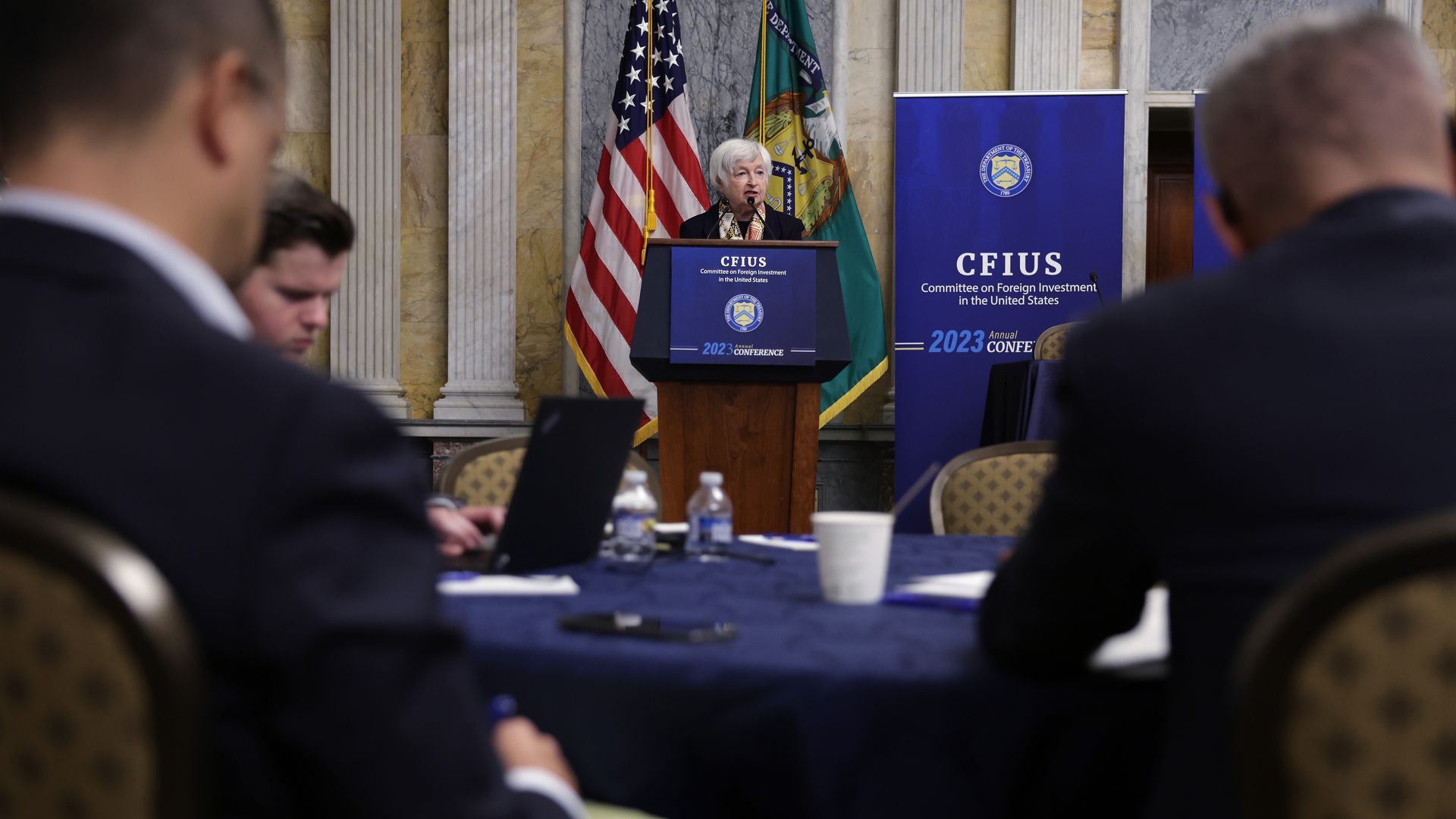
Treasury Secretary Janet Yellen speaks at a foreign investment conference last year. Photo: Alex Wong/Getty Images
The White House will beef up the powers of the secretive committee charged with reviewing cross-border deals, Axios has learned.
Why it matters: The panel will have more authority to decide the fate of foreign-linked mergers at a time when such combinations — including those involving China — are more politicized than ever.
- It is likely among the final major Biden-era rules impacting the business community - a parting shot that could be politically difficult to roll back.
Zoom in: The Committee on Foreign Investment in the U.S., better known as CFIUS, will get expanded subpoena power to assess national security risks — even before it officially reviews a transaction, according to a release seen by Axios.
- CFIUS will be able to impose higher fines for any misstatements or omissions — as much as $5 million per violation, up from the current threshold of $250,000. The rules also expand the circumstances under which the committee can levy these fines.
- CFIUS will also be authorized to set strict timelines for companies to respond to its proposals.
The big picture: The final rule set to be issued on Monday, which Axios first reported was under consideration, signals the intent for a more proactive — and potentially tougher — review panel.
- In the last 2 years, Treasury says CFIUS has issued three times more penalties than in its previous 50 years.
- Its new power could chill the deal surge some expect under the incoming Trump administration — or at least put transactions under a sharper microscope.
CFIUS got an overhaul during Trump's first term after heightened concerns about China's access to U.S. technological secrets.
- The rare overlap between administrations suggests a potentially higher bar for clearance of cross-border deals and investments.
Zoom out: Officials have already widened the scope of what counts as a national security concern — giving CFIUS more purview over deals.
- A Biden-era executive order required CFIUS to consider risks to the U.S. supply chain when reviewing deals. That is one of several reasons lawmakers say CFIUS should recommend blocking Nippon Steel's acquisition of U.S. Steel.
- Treasury earlier this month granted CFIUS the power to probe real estate purchases near certain U.S. military sites — a move aimed at safeguarding these sites from "foreign adversaries," like China.
- Among CFIUS' high-profile reviews: its recommendation that China-based ByteDance unwind the acquisition that created TikTok. (Congress ultimately passed a law demanding ByteDance divest or risk a ban.)
What they're saying: Paul Rosen, assistant Treasury secretary for investment security, tells Axios that CFIUS wants to incentivize more deals and investment by moving cases through its pipeline quickly — at least those it does not deem risky.
- "We see this as part of a broader evolution of CFIUS," Rosen said of the updated rules.
The bottom line: CFIUS is getting more power to OK or kill mergers, but don't expect politicians to wait for a committee ruling before trying to stomp controversial cross-border deals.
