Trump's decisive win scrambles global climate talks

Add Axios as your preferred source to
see more of our stories on Google.
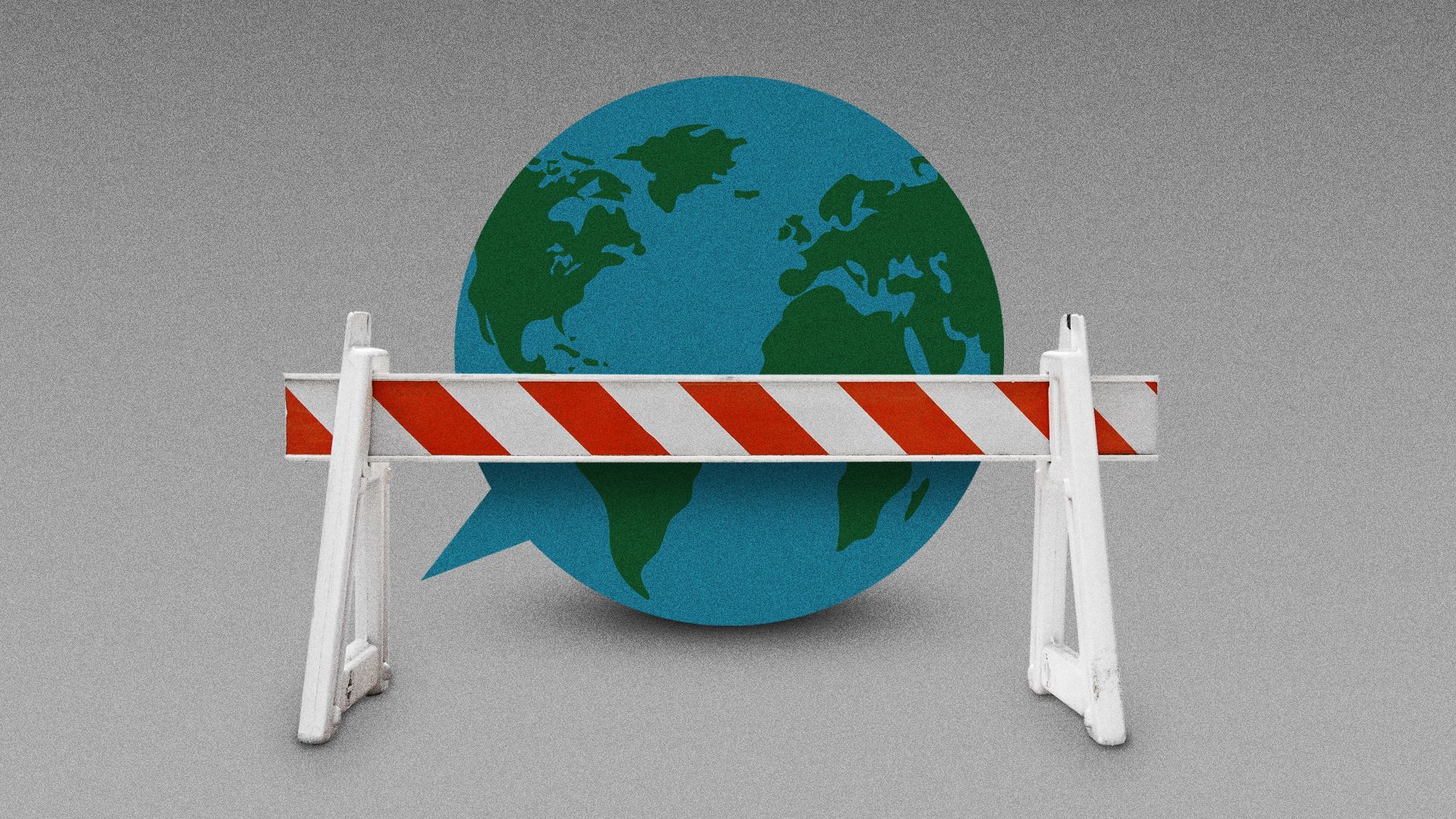
Illustration: Maura Losch/Axios
President-elect Trump's decisive reelection this week poses a major roadblock for countries seeking to address global climate change via the U.N. negotiations process.
Why it matters: With the world now on course to sail past the Paris temperature targets, countries can't wait until 2029 to curtail emissions and get money flowing to the most vulnerable nations.
- Major questions loom about which nations — if any — will fill the vacuum to be left by the U.S. when Trump, as promised (and as done during his first term), pulls the country out of the Paris Agreement.
- Such a move may come as early as day one of his next administration.
Zoom in: The first test of the election's ramifications for climate diplomacy will come before that, however. Starting Nov. 11, diplomats will meet in Baku, Azerbaijan, for the annual UN climate summit, known as COP29.
- The top goal of the talks is for countries to agree to a new annual funding commitment to help developing countries adapt to climate change impacts and curtail their emissions.
- At the summit, the U.S. delegation — led by top climate diplomat John Podesta — will now be lame ducks. New financial commitments will be viewed with skepticism, given likely opposition from the incoming Republican Congress.
- The two most likely parties to step up their roles are the European Union and China, the latter of which is the world's biggest emitter of planet-warming greenhouse gases from burning of fossil fuels such as coal, oil and natural gas.
Yes, but: China historically hasn't been a leader in the global climate talks, instead often acting with or via other nations with similar interests.
- Also, key European leaders plan to sit out the talks. They include German Chancellor Olaf Scholz, French President Emmanuel Macron and European Commission President Ursula von der Leyen, based on a list of speakers at the summit's heads of state portion.
Friction point: Tensions may flare if, as expected, industrialized nations push China to join the group of contributors of more climate finance, since the U.S. and EU are the biggest historical emitters of greenhouse gases.
- In addition, there's still lingering mistrust since the U.S., EU and other developed nations failed to meet their climate finance pledge of $100 billion per year until two years after the deadline.
- However, some say countries may send a signal that responds to Trump's rout, indicating they intend to move forward on funding and emissions cuts without Washington, according to Li Shuo, director of the China Climate Hub at the Asia Society Policy Institute.
What they're saying: "It's reasonable to expect an early and strong reaction from much of the rest of the world at the beginning of COP29 showing support to climate multilateralism and to reaffirm their previously made commitments," Shuo told reporters Wednesday.
- "The climate finance debate, which will be the essential topic in Baku, won't be easily delivered. It won't be delivered without a fight, but I'm confident that we will have a deal by the end of the COP."
- Shuo also called for an "urgent realignment" of global economic powers that brings the EU closer to China on climate cooperation.
Between the lines: The world has been here before, with the U.S. poised to withdraw from Paris. And then — as is likely now — the climate talks continued.
- But last time, there wasn't a war raging in Ukraine or conflict in the Middle East, which could hinder global cooperation.
- "The rest of the world now needs to come to grips with this and decide how it is going to respond," said Alden Meyer, a senior associate with the consulting firm E3G.
- "In 2017 when he withdrew from Paris, not a single country followed the U.S. out the door," Meyer said.
What we're watching: The severity of present-day climate impacts, such as through extreme weather events like the recent flooding in Spain, may help push countries to stay on course, or even speed up, efforts to reduce emissions and fund adaptation efforts, said Alex Scott of the Italian climate think tank ECCO.
- "We've had much worse climate impacts" now compared to during Trump's first term, Scott said.
- "They are killing people and destroying economies all over the world, and the leaders of other countries are feeling that, and are taking those issues to their bilateral relationships, to their multilateral relationships."
The bottom line: COP29 now has new importance as the first international forum for countries to signal how they'll respond to a second Trump administration.
