Trump won, but Elon Musk may be the bigger winner

Add Axios as your preferred source to
see more of our stories on Google.
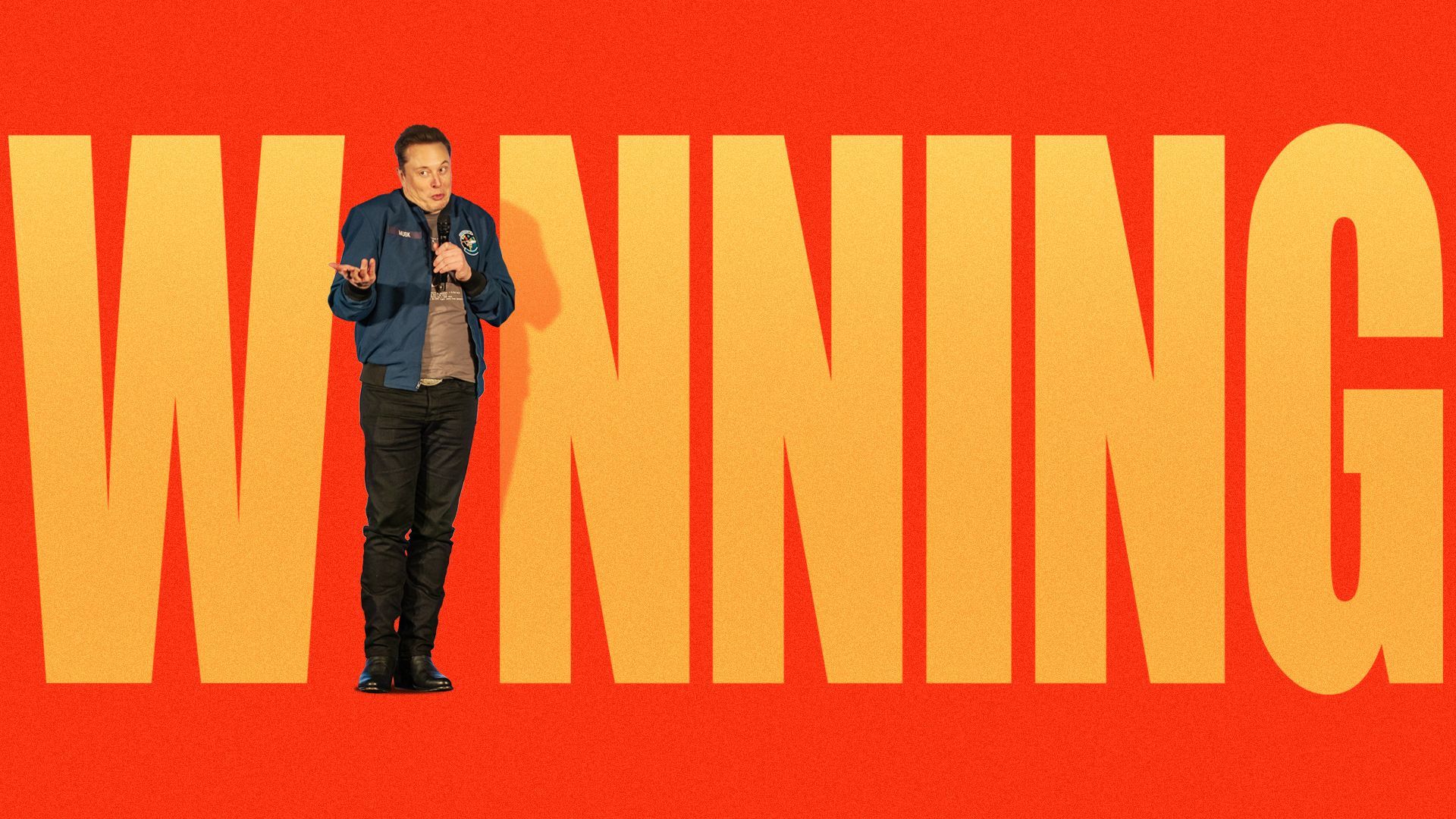
Photo illustration: Sarah Grillo/Axios. Photo: Samuel Corum/Getty Images
The world's richest person keeps getting what he wants, time and time again — and each win makes him bolder.
Why it matters: Elon Musk enthusiastically backed Donald Trump's effort to recapture the White House in a winning bet that'll give the Tesla, SpaceX and X boss more political influence than he's ever had.
The big picture: It's been a long time since Musk placed a losing bet.
- He wanted a Trump win — and got it, after spending more than $130 million on the race, according to CFRA Research.
- He wanted to buy Twitter — though he later regretted the price he agreed to pay — and he got it for $44 billion. (The subsequent headaches weren't so great either.)
- He wanted one of the most lucrative pay packages ever given to an executive — and he got it, albeit after a Delaware judge temporarily canceled the initial version.
- He wanted a steady flow of government contracts for SpaceX — and he keeps getting them. He wanted the right to keep Tesla's so-called Full Self-Driving (FSD) system on the road — even though it is not fully autonomous — and he's gotten that too despite regulatory scrutiny.
Let's be clear: Billionaires tend to get what they want — it's a natural outgrowth of their massive wealth.
- But Musk, as a risk taker, has gone further than most to use his wealth and public influence to achieve his business and political agenda, with a string of victories that only make him more brash.
The intrigue: On the surface, you'd think that a Trump administration could be bad news for Tesla, given that Trump may cancel EV incentives.
- But Tesla analysts say that could benefit Musk's company, because its competitors are more reliant on incentives. Tesla's stock was up 14% Wednesday afternoon.
- "For Tesla we see this as a huge positive. Tesla has the scale and scope that is unmatched in the EV industry and this dynamic could give Musk and Tesla a clear competitive advantage in a non-EV subsidy environment," Wedbush Securities analyst Dan Ives wrote in a research note today.
The big question: Will Musk be able to translate his Trump support into genuine policy influence?
- On China, can he — and will he even try to — convince Trump to not launch a trade war? Tesla relies heavily on China for sales and manufacturing and could lose a lot if China retaliates on Tesla.
- On autonomous vehicles, can Musk convince a Trump administration to green-light self-driving cars nationally? Musk has acknowledged that Tesla's future is heavily dependent on being able to commercialize the Cybercab, a robotaxi that will need the government's approval to hit the road.
- On government bureaucracy, Musk has offered to help slash jobs and departments. How will that role be shaped?
Reality check: Not everything goes Musk's way.
- Advertisers have fled X, leading its worth to plunge by 79% since he bought it two years ago, according to the latest valuation by Fidelity, which helped Musk buy the company when it was known as Twitter.
- But even then, Musk has accumulated substantial political and social influence via X and appears to care more about using the platform to communicate his personal views than as a money-making vehicle.
The bottom line: Elon Musk victory laps are the norm, and with the power of the government behind him may only get more audacious.
